
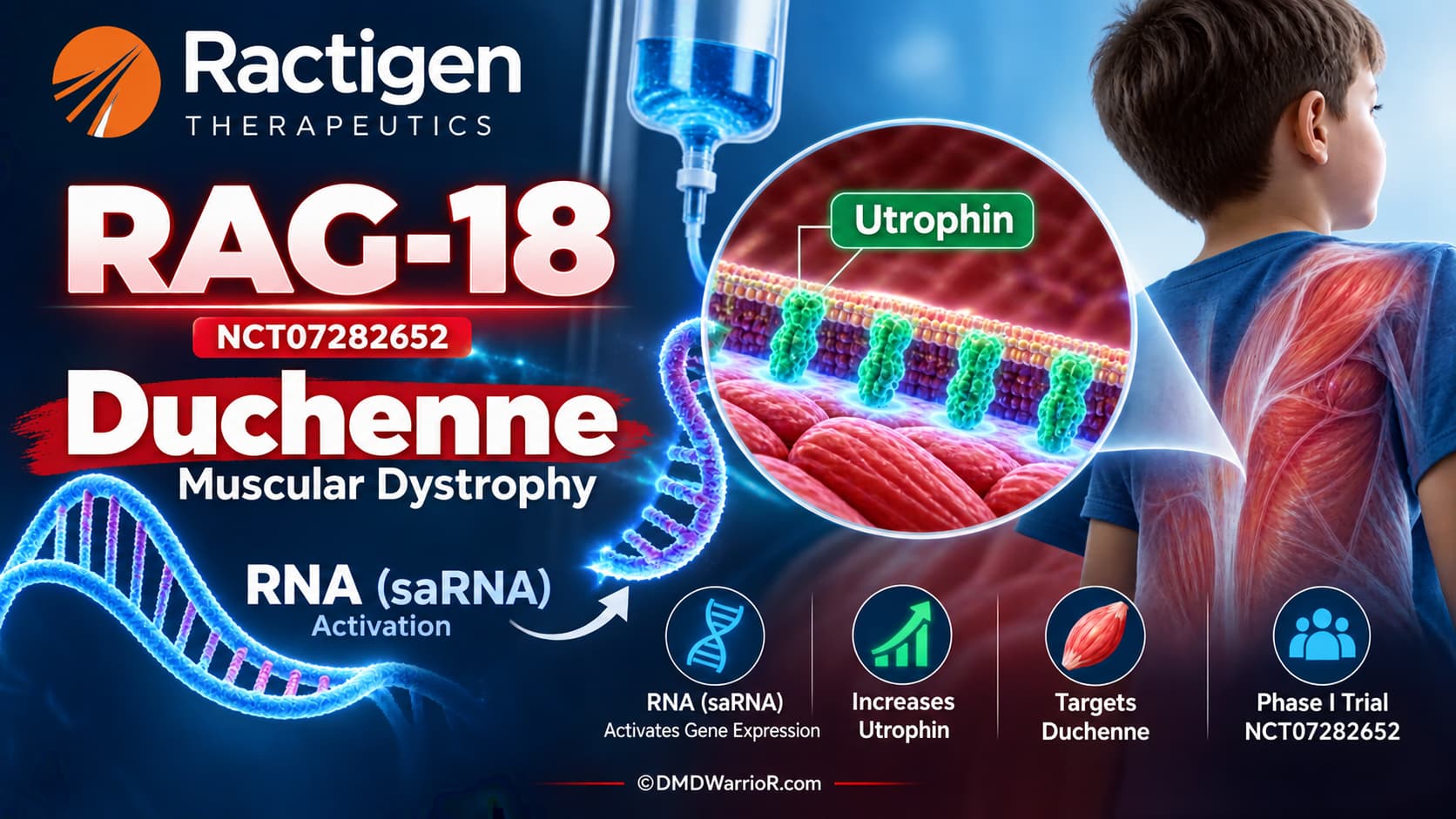
Ractigen Therapeutics has presented positive first-in-human data for RAG-18 (NCT07282652), an investigational treatment for Duchenne muscular dystrophy (Duchenne) that uses small activating RNA (saRNA) to increase the production of utrophin. The Phase I study data were presented at the 31st Annual Congress of the World Muscle Society (WMS 2026) in Hiroshima, Japan. The results provide early clinical evidence that saRNA can reach human skeletal muscle and activate a naturally occurring protein. Learn More: NCT07282652
What Is Utrophin and Why Is It Important?
Utrophin is a naturally occurring protein that is structurally related to dystrophin. In Duchenne, the lack of functional dystrophin damages muscle fibers. Utrophin can act as a substitute for dystrophin at the muscle membrane, regardless of the specific DMD mutation a person has.
For this reason, increasing utrophin could offer a treatment approach that is not dependent on a patient’s particular genetic mutation. RAG-18 is designed to increase the body’s own production of utrophin rather than introducing a replacement gene.
How Does RAG-18 Work?
RAG-18 uses Ractigen Therapeutics’ RNA activation technology and is delivered through the company’s Lipid-Conjugated Oligonucleotide (LiCO™) technology. It is given as a monthly intravenous infusion.
The treatment is designed to use the cell’s own transcription machinery to increase utrophin production. It does not use a viral vector or permanent DNA editing. RAG-18 has also received Orphan Drug Designation and Rare Pediatric Disease Designation from the U.S. FDA.
What Did the First Three Participants Show?
The reported data came from the first cohort of three ambulatory boys aged 4–15 with genetically confirmed Duchenne. They received 15 mg of RAG-18 monthly and were followed through Day 169.
Muscle biopsies showed a 3.5- to 5.3-fold increase in utrophin at the muscle membrane compared with baseline. The researchers also observed changes in muscle structure, including increased muscle fiber size and a reduction in muscle fat. Muscle MRI showed reductions in measures associated with active muscle edema and inflammation. Read More: The Safety and Tolerability of RAG-18
Functional results showed mixed but generally positive or stable signals. One participant improved his 6-minute walk distance by 36.5 meters, while another maintained his walking distance. A third participant experienced a 62.5-meter decline. Pulmonary measurements showed positive numerical trends in all three participants. Cardiac function remained within normal limits during the 24-week follow-up.
Safety and Next Steps
RAG-18 showed a favorable safety and tolerability profile in the first cohort. There were no dose-limiting toxicities, serious adverse events, or Grade 3 or higher treatment-emergent adverse events. Reported adverse events were mild and temporary.
The second cohort, using a 30 mg monthly dose, is fully enrolled, and safety follow-up is continuing.
These early findings provide clinical proof-of-mechanism for RNA activation in Duchenne, showing that RAG-18 can increase utrophin in human skeletal muscle. However, the functional results were mixed among the three participants, and the study is still in an early stage.
Discover More: Duchenne Clinical Trial Locations Map