
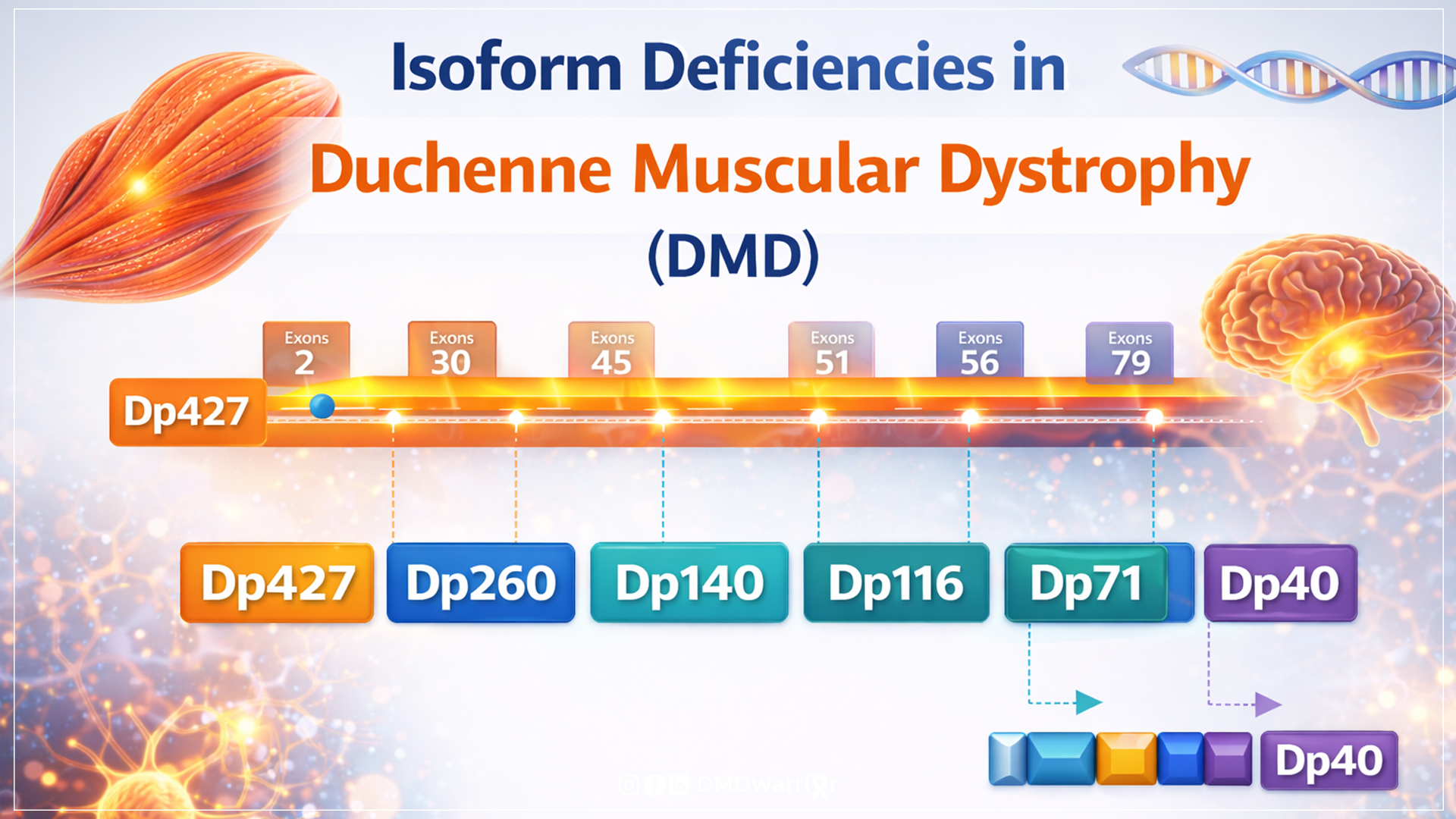
Duchenne muscular dystrophy (DMD) is a severe, progressive neuromuscular disorder caused by mutations in the dystrophin gene. Among these, the effects of exon deletions and isoform deficiencies in Duchenne muscular dystrophy play a central role in disease variability, severity, and multi-system involvement. These mutations disrupt not only full-length dystrophin but also shorter isoforms such as Dp427, Dp260, Dp140, Dp116, Dp71, and Dp40, leading to complex clinical outcomes that extend beyond muscle degeneration to cognitive, retinal, and peripheral nerve dysfunction. Understanding the impact of dystrophin exon deletions and isoform loss is essential for precision medicine, genotype-phenotype correlation, and the development of targeted therapies.
Table of Contents
Understanding Duchenne Muscular Dystrophy at the Molecular Level
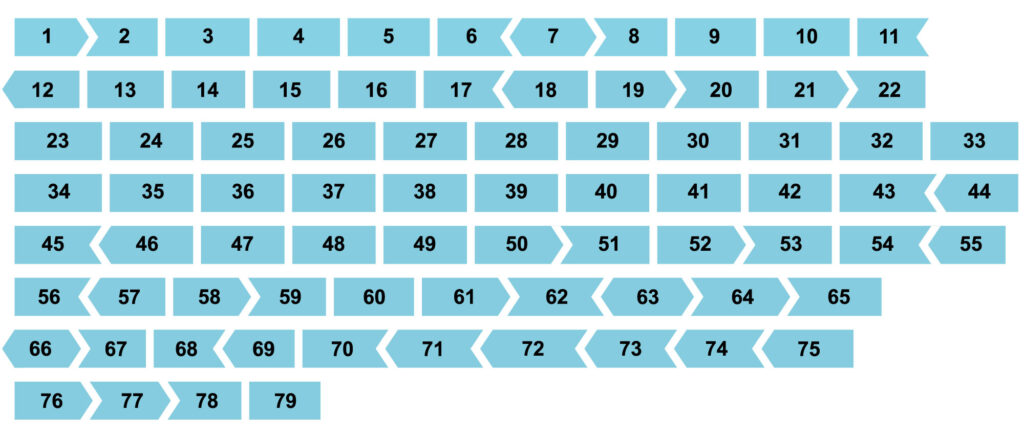
Duchenne muscular dystrophy is caused by mutations in the DMD gene, one of the largest genes in the human genome, spanning 79 exons. The majority of mutations are exon deletions, which disrupt the reading frame and prevent the production of functional dystrophin protein. Learn More: DMD Gene
Dystrophin acts as a structural anchor, linking the cytoskeleton of muscle cells to the extracellular matrix. Without it, muscle fibers become fragile, leading to progressive degeneration.
Why Exon Deletions Matter
Exon deletions are not uniform in their effects. The clinical severity depends on:
- Whether the deletion disrupts the reading frame (out-of-frame mutations)
- Which dystrophin isoforms are affected
- The location of the mutation within the gene
This is where the effects of exon deletions and isoform deficiencies in Duchenne muscular dystrophy become particularly significant. Learn More: What is Exon Deletion?
Dystrophin Isoforms: A Complex Expression System
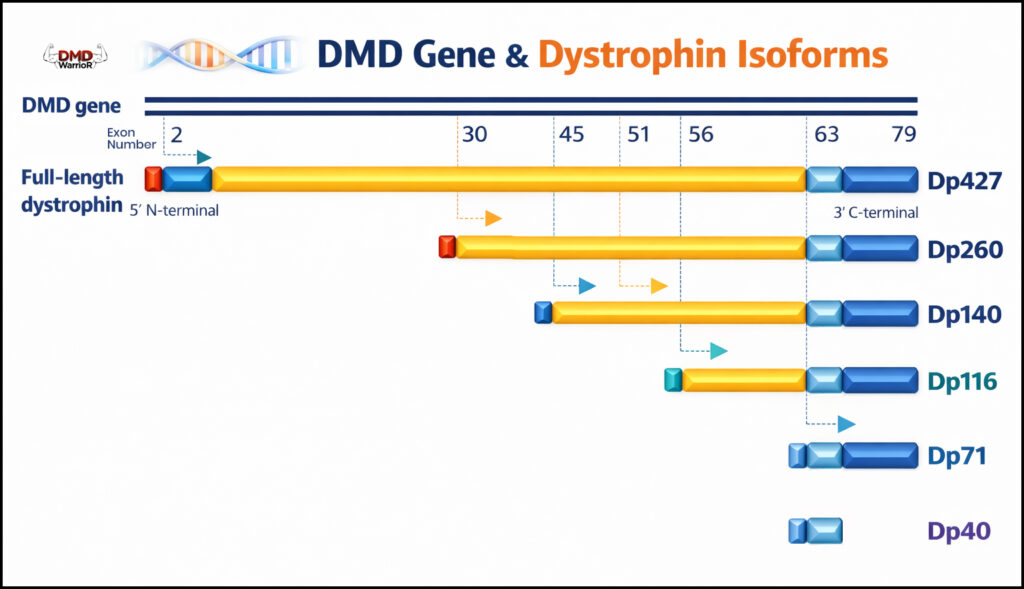
The dystrophin gene produces multiple isoforms through different promoters. Each isoform has tissue-specific expression and unique functions.
Major Dystrophin Isoforms
| Isoform | Approx. Size | Expression Sites |
|---|---|---|
| Dp427 (muscle, brain, Purkinje) | 427 kDa | Skeletal muscle, brain |
| Dp260 | 260 kDa | Retina |
| Dp140 | 140 kDa | Brain, kidney |
| Dp116 | 116 kDa | Peripheral nerves |
| Dp71 | 71 kDa | Brain, many tissues |
| Dp40 | 40 kDa | Brain (synaptic regions) |
Each isoform contributes to different physiological systems, which explains why DMD is not solely a muscle disease.
TRY NOW: DMD or BMD? Exon Check Tool
Dp427 Isoform: The Core Structural Protein
Function of Dp427
Dp427 is the full-length dystrophin protein and is essential for:
- Sarcolemma stability
- Protection against contraction-induced damage
- Signal transduction within muscle cells
Impact of Dp427 Deficiency
The absence of Dp427 leads to:
- Progressive muscle weakness
- Elevated creatine kinase levels
- Replacement of muscle tissue with fat and fibrosis
This is the primary driver of the classical DMD phenotype.
Clinical Relevance
All patients with Duchenne muscular dystrophy lack functional Dp427. However, additional isoform deficiencies modify disease severity.
Dp260 Isoform: Retinal Function and Visual Implications
Role of Dp260
Dp260 is primarily expressed in the retina, particularly in photoreceptor cells. It plays a role in:
- Synaptic transmission
- Visual signal processing
Effects of Dp260 Deficiency
Patients lacking Dp260 may experience:
- Abnormal electroretinograms (ERG)
- Subclinical visual dysfunction
Although vision is not typically impaired in daily life, measurable retinal abnormalities are common.
Dp140 Isoform: Cognitive and Neurodevelopmental Impact
Expression and Function
Dp140 is expressed in:
- Developing brain
- Kidney
It is critical for:
- Neurodevelopment
- Cognitive function
Consequences of Dp140 Deficiency
One of the most important aspects of the effects of exon deletions and isoform deficiencies in Duchenne muscular dystrophy is cognitive involvement.
Dp140 deficiency is strongly associated with:
- Intellectual disability
- Learning difficulties
- Autism spectrum traits
- ADHD-like symptoms
Genotype-Phenotype Correlation
Exon deletions affecting regions downstream of exon 44 often disrupt Dp140 expression. Studies show:
- Patients lacking Dp140 have significantly lower IQ scores
- Increased risk of neurobehavioral disorders
Dp116 Isoform: Peripheral Nervous System Involvement
Function of Dp116
Dp116 is expressed in Schwann cells of peripheral nerves and contributes to:
- Myelin stability
- Nerve conduction
Impact of Deficiency
Although less studied, Dp116 deficiency may lead to:
- Mild peripheral neuropathy
- Altered nerve conduction velocity
This aspect is often underdiagnosed but contributes to overall disease burden.
Dp71 Isoform: Ubiquitous and Critical
Role of Dp71
Dp71 is the most abundant dystrophin isoform and is expressed in:
- Brain
- Endothelial cells
- Epithelial tissues
It plays roles in:
- Cell signaling
- Blood-brain barrier integrity
- Synaptic organization
Effects of Dp71 Deficiency
Loss of Dp71 is associated with:
- Severe cognitive impairment
- Psychiatric symptoms
- Disrupted neuronal architecture
Patients lacking both Dp140 and Dp71 exhibit the most severe neurocognitive phenotypes.
Dp40 Isoform: Emerging Insights
What is Dp40?
Dp40 is a shorter isoform derived from Dp71, primarily found in:
- Synaptic regions of the brain
Potential Role
Though still under investigation, Dp40 may be involved in:
- Synaptic vesicle regulation
- Neurotransmitter release
Clinical Implications
Deficiency in Dp40 may exacerbate:
- Cognitive dysfunction
- Synaptic abnormalities
How Exon Deletions Affect Isoform Expression
The dystrophin gene contains multiple promoters located at different exons. Therefore, exon deletions can selectively disrupt specific isoforms.
Sample 1: Deletion of Exons 8 and 30
A large-scale deletion spanning from Exon 8 to Exon 30 is an “out-of-frame” mutation. Because it removes a massive portion of the dystrophin gene, it primarily affects the full-length protein (Dp427) and marks the very beginning of the retinal isoform (Dp260).
1. Affected vs. Preserved Isoforms
- Dp427 (Muscle/Brain): Absent. This is the full-length protein essential for muscle fibers. Its absence leads to the classic Duchenne (DMD) phenotype.
- Dp260 (Retina): Severely Affected/Absent. Since Dp260 normally starts at a promoter located near Exon 30, this deletion removes its starting point. Retinal signaling is typically disrupted.
- Dp140 (Brain/Kidney): Preserved. Dp140 starts much later, at Exon 44. Since the deletion (8-30) ends well before Exon 44, this critical brain protein is produced normally.
- Dp71 (General/Brain): Preserved. Dp71 starts at Exon 63 and remains completely unaffected.
2. Impact on the Child and IQ Levels
- Cognitive Profile: Mutations in the early part of the gene (Exons 1-30) are generally associated with better cognitive outcomes than mutations at the end of the gene. Since Dp140 and Dp71 (the most important brain isoforms) are both preserved, the biological foundation for brain development is mostly intact.
- Estimated IQ: Children with an Exon 8-30 deletion typically have an average IQ in the 85–90 range (Low-average to Normal). While some learning or behavioral challenges (like ADHD) can still occur, severe intellectual disability is rare in this specific mutation group.
- Physical Impact: Due to the massive size of the deletion (22 exons removed), the physical symptoms (muscle weakness) are usually classic Duchenne (DMD) and require early physical therapy and medical management.
For a child with an Exon 8-30 deletion, the primary clinical challenge is physical mobility. From a cognitive perspective, this child has a much higher potential for typical academic learning compared to children with distal mutations.
Sample 2: Deletion of Exons 42 and 43
A deletion of Exons 42 and 43 is an “out-of-frame” mutation that primarily leads to the absence of the full-length dystrophin protein (Dp427), causing the classic Duchenne Muscular Dystrophy (DMD) phenotype. However, because this mutation occurs in the middle of the gene, some critical brain-related isoforms are preserved.
1. Affected vs. Preserved Isoforms
- Dp427 (Muscle/Brain): Absent. This is the full-length protein required for muscle stability (Exons 1-79).
- Dp260 (Retina): Disrupted/Affected. Since Dp260 starts at Exon 30, a deletion at 42-43 occurs within its sequence, potentially affecting retinal signaling (measurable via ERG). Learn More: DMD Exon 42-43 Deletion
- Dp140 (Brain/Kidney): Preserved. Dp140 starts at Exon 44. Since the deletion (42-43) ends before Exon 44, this brain-essential protein is usually produced normally.
- Dp71 (General/Brain): Preserved. Dp71 starts much later, at Exon 63. It remains unaffected by a 42-43 deletion.
2. Impact on the Child and IQ Levels
- Cognitive Profile: Because the most critical brain isoforms (Dp140 and Dp71) are preserved, children with an Exon 42-43 deletion generally have a lower risk of severe intellectual disability compared to those with later mutations (like Exon 64-65).
- Estimated IQ: The average IQ for this group typically falls in the 80–85 range (low-average to borderline). While this is slightly lower than the general population average (100), it is significantly higher than the Dp71-deficient group.
- Specific Challenges: Even with a near-normal IQ, these children may still experience “DMD-related learning profiles,” such as difficulties with short-term memory, phonological processing (reading), or ADHD symptoms.
For a child with an Exon 42-43 deletion, the clinical focus is primarily on physical/motor management, as the biological foundation for cognitive development is largely intact compared to distal mutations.
Sample 3: Deletion of Exons 45 and 54
A deletion spanning from Exon 45 to Exon 54 is a common mutation in DMD. This specific range is highly significant because it completely removes the starting point and a major portion of the brain-related isoform Dp140.
1. Affected vs. Preserved Isoforms
- Dp427 (Muscle/Brain): Absent. The full-length protein is not produced, leading to the Duchenne (DMD) phenotype.
- Dp260 (Retina): Absent/Disrupted. Since Dp260 starts at Exon 30 and continues to Exon 79, this deletion (45-54) occurs right in the middle of its sequence.
- Dp140 (Brain/Kidney): Absent. This is the primary concern. Dp140 starts at Exon 44. A deletion of 45-54 completely disrupts this protein, which is vital for fetal brain development.
- Dp71 (General/Brain): Preserved. Dp71 starts at Exon 63 and remains unaffected.
2. Impact on the Child and IQ Levels
- Cognitive Profile: The loss of Dp140 is strongly linked to a higher prevalence of learning and behavioral challenges. Children in this group often face more cognitive hurdles than those with early-exon mutations (like 8-30).
- Estimated IQ: Research shows that children lacking Dp140 (mutations between Exons 44-62) typically have an average IQ in the 70–75 range (Borderline intellectual functioning).
- Neurodevelopmental Risks: There is a significantly higher risk for:
- ADHD (Attention Deficit Hyperactivity Disorder)
- Autism Spectrum Disorder (ASD)
- Difficulties with working memory and complex verbal tasks.
For a child with an Exon 45-54 deletion, clinical management should include early neuropsychological evaluation. While the most critical brain protein (Dp71) is present, the loss of Dp140 often necessitates additional educational support and speech therapy.
Sample 4: Deletion of Exons 64 and 65
A deletion of Exons 64 and 65 affects almost all major isoforms of the dystrophin gene, including the most critical one for brain function, Dp71.
1. Affected Isoforms
Since these exons are located near the end of the gene (distal region), they disrupt the following isoforms:
- Dp427 (Muscle/Brain): The full-length protein (Exons 1-79).
- Dp260 (Retina): The ocular isoform (Exons 30-79).
- Dp140 (Brain/Kidney): The brain development isoform (Exons 44-79).
- Dp116 (Nervous System): The Schwann cell isoform (Exons 56-79).
- Dp71 (General/Brain): The most critical loss. Since Dp71 starts at Exon 63, a deletion at 64-65 directly disrupts it.
2. Impact on the Child and IQ Levels
- Cognitive Impact: Dp71 is the most abundant dystrophin isoform in the brain. Its absence represents the highest risk group for intellectual disability among all DMD mutations.
- Estimated IQ: Research indicates that children with Dp71 deficiency (mutations after Exon 63) often have an average IQ in the 50–60 range (moderate learning disability).
- Neuropsychiatric Findings: This group has a significantly higher prevalence of Autism Spectrum Disorder (ASD), severe speech/language delays, and ADHD compared to those with earlier mutations (like Exon 42-43).
While an Exon 42-43 deletion primarily affects the muscles with mild cognitive impact, an Exon 64-65 deletion significantly affects both the muscles and the brain’s fundamental processing capacity.
Genotype-Phenotype Correlation in DMD
Numerous studies confirm that the effects of exon deletions and isoform deficiencies in Duchenne muscular dystrophy are predictive of disease progression.
Key Findings
- Dp140 deficiency correlates with lower IQ (Taylor et al., 2010)
- Combined Dp140/Dp71 loss leads to severe cognitive deficits (Muntoni et al., 2003)
- Distal mutations are associated with worse neurodevelopmental outcomes
Implications for Diagnosis and Genetic Counseling
Understanding isoform involvement allows clinicians to:
- Predict cognitive outcomes
- Provide personalized counseling
- Tailor educational interventions
Genetic testing should include:
- Precise exon mapping
- Isoform impact analysis
Cognitive and Behavioral Management in DMD
Given the role of isoform deficiencies:
- Early neuropsychological assessment is critical
- Educational support should be individualized
- Behavioral therapy may be necessary
Research Gaps and Future Perspectives
Despite advances, gaps remain:
- Limited understanding of Dp40
- Lack of therapies targeting brain isoforms
- Need for longitudinal cognitive studies
Frequently Asked Questions (FAQ)
How do exon deletions affect dystrophin isoforms?
Exon deletions can disrupt different promoters within the DMD gene, affecting specific dystrophin isoforms such as Dp427, Dp140, or Dp71. The exact impact depends on the location of the deletion. For example, deletions around exon 45–54 often impair Dp140, which is linked to cognitive function, while all Duchenne patients lack Dp427.
Which dystrophin isoform is most important in DMD?
Dp427 is the most critical isoform because it maintains muscle fiber stability. Its absence causes the primary symptoms of Duchenne muscular dystrophy, including progressive muscle weakness. However, other isoforms like Dp140 and Dp71 are important for brain function and influence cognitive outcomes.
Why do some children with DMD have learning difficulties?
Learning difficulties in DMD are often linked to deficiencies in brain-expressed isoforms such as Dp140 and Dp71. When these isoforms are affected by exon deletions, children may experience cognitive delays, attention deficits, or behavioral challenges, independent of muscle severity.
What happens in exon 45–54 deletion in DMD?
Deletion of exons 45–54 typically disrupts the main dystrophin protein (Dp427) and often affects Dp140, leading to both muscle weakness and an increased risk of cognitive issues. Other isoforms like Dp71 are usually preserved, so severe intellectual disability is less common compared to more distal deletions.
Can exon deletions be treated or corrected?
While exon deletions cannot currently be permanently “fixed,” treatments like exon skipping therapy aim to restore the reading frame and produce a shorter but functional dystrophin protein. Gene therapies are also being developed to deliver micro-dystrophin, improving muscle function.
Does every exon deletion cause the same severity in DMD?
No, the severity varies depending on whether the deletion disrupts the reading frame and which isoforms are affected. Deletions impacting only Dp427 mainly cause muscle symptoms, while those also affecting Dp140 or Dp71 increase the likelihood of cognitive and behavioral complications.
What is the role of Dp140 in Duchenne muscular dystrophy?
Dp140 plays a key role in brain development and cognitive function. Its deficiency is strongly associated with learning disabilities, lower IQ scores, and neurobehavioral conditions such as ADHD or autism spectrum traits in individuals with DMD.
Are vision problems common in DMD?
Vision problems are usually mild or subclinical in DMD. Some patients may have retinal abnormalities due to Dp260 deficiency, but these rarely affect everyday vision. Most visual changes are only detectable through specialized tests like electroretinography.
Why is genetic testing important in DMD?
Genetic testing identifies the exact exon deletion and helps predict which dystrophin isoforms are affected. This information is crucial for prognosis, cognitive assessment, eligibility for specific therapies (like exon skipping), and personalized disease management.
Read More: How Does Duchenne Muscular Dystrophy Affect the Brain?
Conclusion
The effects of exon deletions and isoform deficiencies in Duchenne muscular dystrophy extend far beyond muscle degeneration. Each dystrophin isoform—Dp427, Dp260, Dp140, Dp116, Dp71, and Dp40—plays a unique role in different tissues, and their combined loss shapes the full clinical spectrum of DMD. A deeper understanding of these mechanisms is essential for improving diagnosis, prognosis, and therapeutic strategies.
Academic Sources and References
- Szwec, S., Durska, A., Kościelniak-Wawro, P. et al. Dystrophins DP71 and DP427 determine cell viability during proliferation and myofibre differentiation. Cell Death Dis (2026).
- Kate Maresh et al. Startle responses in Duchenne muscular dystrophy: a novel biomarker of brain dystrophin deficiency. 2023.
- Muntoni F, Torelli S, Ferlini A. Dystrophin and mutations: one gene, several proteins, multiple phenotypes. Lancet Neurology, 2003.
- Taylor PJ et al. Dystrophin gene mutation location and cognitive impairment in DMD. Neurology, 2010.
- Doorenweerd N et al. Brain involvement in Duchenne muscular dystrophy. Brain, 2017.
- Blake DJ et al. Function and genetics of dystrophin. Physiological Reviews, 2002.
- Hoffman EP et al. Dystrophin: the protein product of the Duchenne gene. Cell, 1987.