
Duchenne muscular dystrophy (DMD) is a rare, progressive genetic disorder that causes muscle weakness due to the absence of dystrophin — a protein that protects muscle cells from damage. It primarily affects boys and typically begins in early childhood.
- Affects approximately 1 in 3,500–5,000 live male births worldwide
- Caused by mutations in the DMD gene on the X chromosome
- Leads to progressive muscle degeneration
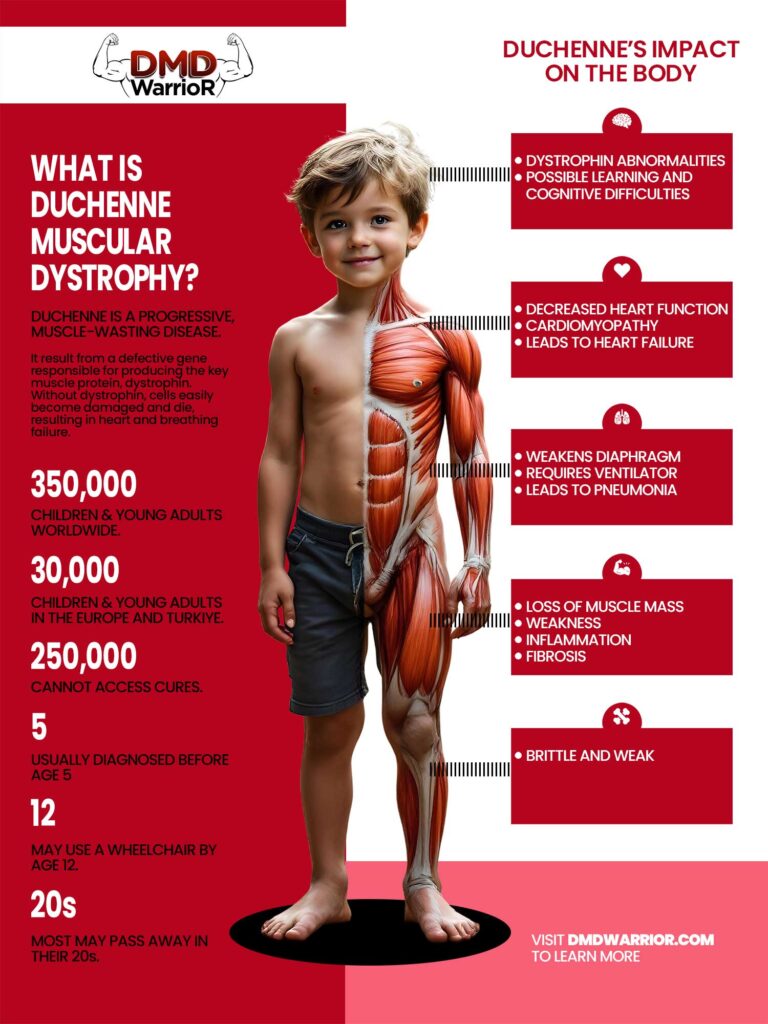
Table of Contents
FAQs About Symptoms
What are the first signs of Duchenne muscular dystrophy?
• Clumsiness.
• Problems climbing stairs.
• Trouble jumping or hopping.
• Frequent tripping or falling.
• Walking on their toes.
• Leg pain.
• Weakness in the face, shoulder, and arms.
• Inability to open or close the eyes.
At what age do symptoms appear?
Usually between ages 2–5.
Why do calves swell in child with DMD?
Muscle tissue is replaced by fat and connective tissue (pseudohypertrophy).
Does DMD affect the heart?
Yes. Cardiomyopathy is common and requires monitoring.
Does DMD affect breathing?
Yes. Respiratory muscles weaken over time.
When do most boys stop walking?
Typically between ages 8–14.
Does DMD affect intelligence?
Some individuals experience learning disabilities or attention difficulties.
Does muscle pain occur?
Cramping and fatigue are common.
Are speech delays possible?
Yes, especially in early childhood.
Does DMD worsen over time?
Yes, it is progressive.
Which muscles are affected first?
Hip, pelvic, and thigh muscles.
Does DMD affect arm strength?
Yes, especially later in progression.
Can scoliosis develop?
Yes, especially after loss of ambulation.
Does DMD cause joint stiffness?
Yes, contractures may develop.
Are symptoms the same for everyone?
No. Severity varies.
Why do kids with DMD walk on their toes?
Toe-walking is thought to help maintain balance for children with DMD, who have muscle weakness in their legs. Core muscle weakness can also cause children with DMD to walk with an uneven step pattern, where one side of their body moves differently from the other.
Does DMD affect swallowing strength?
FAQs About Causes & Genetics
What causes DMD?
Mutations in the dystrophin gene. » Genetic Causes of DMD
What is dystrophin?
A protein that stabilizes muscle cell membranes.
Is DMD inherited?
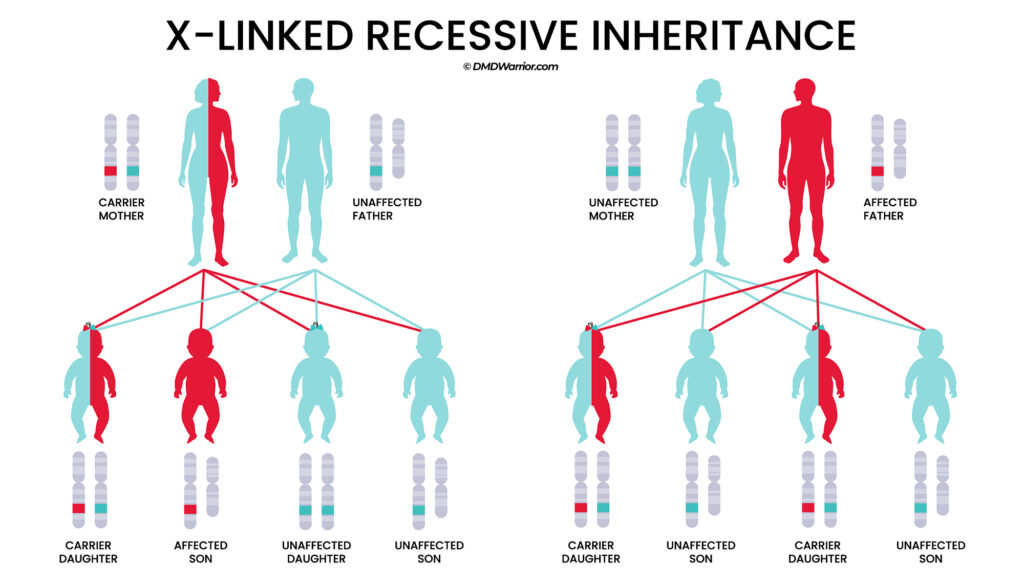
Yes — X-linked recessive inheritance.
Can DMD occur without family history?
Yes. About one-third are new mutations.
What is a carrier mother?
A woman with one mutated DMD gene copy. » How DMD Affects Girls and Women
What is the inheritance risk?
Carrier mothers have a 50% chance of passing it to sons.
Can girls have DMD?
Rarely, but possible.
What is Becker muscular dystrophy?
A milder form related to DMD. » Becker MD
How is Becker different?
Some dystrophin is produced. » BMD vs DMD
What are exon deletions?
Missing segments of the gene. » Exon Deletion
What are duplications?
Extra gene segments. » Types of DMD Genetic Variants
What is a nonsense mutation?
A mutation causing premature stop signals.
What is germline mosaicism?
Mutation present in some parental cells.
Can genetic counseling help?
Yes, especially for family planning.
Can embryos be screened?
Yes, through IVF with preimplantation testing.
FAQs About Diagnosis & Testing
How is DMD diagnosed?
Blood tests (high CK), genetic testing, sometimes biopsy. » Genetic Testing
What is creatine kinase (CK)?
An enzyme elevated when muscles break down. » Creatine Kinase
Is genetic testing accurate?
Yes, highly accurate.
Can DMD be diagnosed before symptoms?
Yes, via genetic testing.
Is newborn screening available?
In some countries and regions.
Should siblings be tested?
Yes, especially brothers.
What is a muscle biopsy?
Removal of tissue for analysis.
Can MRI help?
Yes, to assess muscle damage.
What specialists diagnose DMD?
Neurologists and geneticists.
How early should testing occur?
As soon as symptoms are noticed.
What confirms DMD vs Becker?
Type of gene mutation and dystrophin levels.
Is prenatal testing possible?
Is carrier testing recommended?
Yes for female relatives.
How long does diagnosis take?
Varies, but early referral speeds confirmation.
Why is early diagnosis important?
Earlier treatment improves outcomes.
FAQs About Treatments & Therapies
Is there a cure?
No cure yet.
What medications are used?
Corticosteroids like prednisone and deflazacort. » Pros and Cons of Steroids (Cortisone) for Duchenne
How do steroids help?
Slow muscle degeneration.
What are steroid side effects?
Weight gain, bone thinning, mood changes.
What is exon-skipping therapy?
A treatment that skips faulty gene sections. » Exon-Skipping
What is gene therapy?
Delivery of micro-dystrophin using viral vectors.
Are gene therapies approved?
Some are conditionally approved in certain countries.
What is cardiomyopathy treatment?
ACE inhibitors and beta blockers.
How is breathing supported?
Non-invasive ventilation like BiPAP. » Better Night’s Sleep with BiPAP Machine
Is physical therapy important?
Yes — critical for mobility.
Can exercise help?
Low-impact exercise is beneficial.
What exercises should be avoided?
High-resistance training.
Are braces helpful?
Yes, to prevent contractures.
When is scoliosis surgery needed?
After loss of ambulation if curvature progresses.
Is nutrition important?
Yes, especially weight management.
Are supplements recommended?
Vitamin D and calcium often are.
Are vaccines important?
Yes — including flu and pneumonia vaccines.
Are feeding tubes ever required?
Sometimes in advanced stages.
What is a multidisciplinary clinic?
A coordinated specialist team.
How often is cardiac screening done?
Typically annually.
How often are lung tests done?
Regular pulmonary function testing is recommended.
What mobility aids are used?
Manual and power wheelchairs. » Best Time for a Power Wheelchair in DMD
What is palliative care?
Support for comfort and quality of life.
Can clinical trials provide access to therapy?
Sometimes, depending on eligibility.
How has treatment improved survival?
Better cardiac and respiratory management.
FAQs About Daily Life & Caregiving
How can parents support emotional health?
Encourage independence and inclusion.
Are school accommodations needed?
Often yes (IEPs, accessibility).
Is mental health support helpful?
Very important.
Can individuals with DMD attend college?
Yes, with support.
Can adults with DMD work?
Many do with accommodations.
What home modifications help?
Ramps, accessible bathrooms.
Are support groups available?
Yes, including Parent Project Muscular Dystrophy and Muscular Dystrophy Association.
Is travel possible?
Yes, with planning.
How do families manage stress?
Counseling and community support.
Is financial assistance available?
Disability benefits and nonprofit grants.
What is transition care?
Moving from pediatric to adult care.
How are siblings supported?
Open communication.
Can adaptive technology help?
Yes — voice controls and assistive devices.
Is social inclusion important?
Extremely.
How can caregivers prevent burnout?
Respite care and shared responsibility.
Are online communities helpful?
Many families find them supportive.
What legal planning is recommended?
Guardianship and disability planning.
How should long-term care be planned?
With healthcare and financial advisors.
Can individuals live independently?
With adequate support systems.
How do families prepare for progression?
Proactive care planning.
FAQs About Research & Future Outlook
What research is ongoing?
Gene therapy, CRISPR, exon-skipping. » Clinical Trials for Duchenne (List of All Researches)
What is CRISPR?
A gene-editing technology under investigation.
Are stem cells being studied?
Yes.
What are antisense oligonucleotides?
Synthetic molecules used in exon skipping.
How can families join trials?
Through neuromuscular clinics and registries.
Has survival improved?
Yes — many now live into their 30s–40s. Median life expectancy was 22.0 years (95% confidence interval). Analyses stratified by 3 time periods in which patients were born showed markedly increased life expectancy in more recent patient populations; patients born after 1990 have a median life expectancy of 28.1 years.
What gives hope?
Advances in genetic medicine.
Are global registries important?
Yes for research and access to trials. » How to Participate in Clinical Trials for Duchenne (DMD)?
How quickly is research progressing?
Rapidly compared to past decades.
Will there be a cure?
Research aims toward disease-modifying or curative therapies.
Where can reliable information be found?
From neuromuscular specialists and trusted advocacy groups.
Most Common FAQs
What are the final stages of Duchenne muscular dystrophy?
During the final late non-ambulatory stage, people affected are having trouble using their hands and maintaining good posture. In all phases learning and behavioural problems may play a role as well.
Does DMD affect IQ?
Duchenne muscular dystrophy (DMD) is a progressive pediatric disorder that affects both muscle and brain. Children with DMD have mean IQ scores that are about one standard deviation lower than population means, with lower Verbal IQ than Performance IQ scores.
Why do mostly boys get DMD?
Duchenne muscular dystrophy is often only associated with people assigned male at birth, as it is caused by a mutation on a gene located on X chromosomes and so in people with XY chromosomes there is no other functioning gene to compensate.
Can DMD patients marry?
Because of improved guidelines recommending comprehensive multidisciplinary care, standardization of corticosteroid treatments, disease-modifying treatments, and advances in cardiac and respiratory support, life expectancy is increasing and many young adults with DMD attend college, have careers, get married.
Can boys with DMD be circumcised?
Many boys with DMD can be circumcised under local anesthesia.
Can DMD cause autism?
Patients with Duchenne muscular dystrophy have a higher incidence of neurodevelopmental disorders, particularly autism spectrum and attention-deficit/hyperactivity disorders, than the general population.