
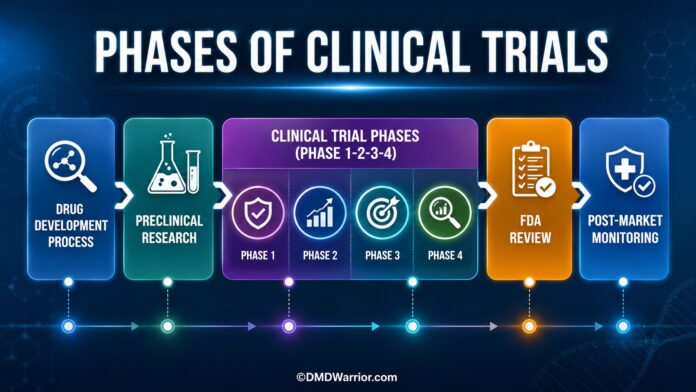
Understanding the phases of clinical trials can help families make sense of how a potential medicine moves from laboratory research toward possible approval and wider patient access. When families hear that a treatment is in Phase 1, Phase 2, or Phase 3, the terminology can be confusing. Each stage has a different scientific purpose, and reaching a later stage does not automatically mean that a treatment will be approved or become available. The phases of clinical trials are therefore best understood as a progressive system for evaluating safety, effectiveness, risks, and benefits.
Table of Contents
Drug Development Process
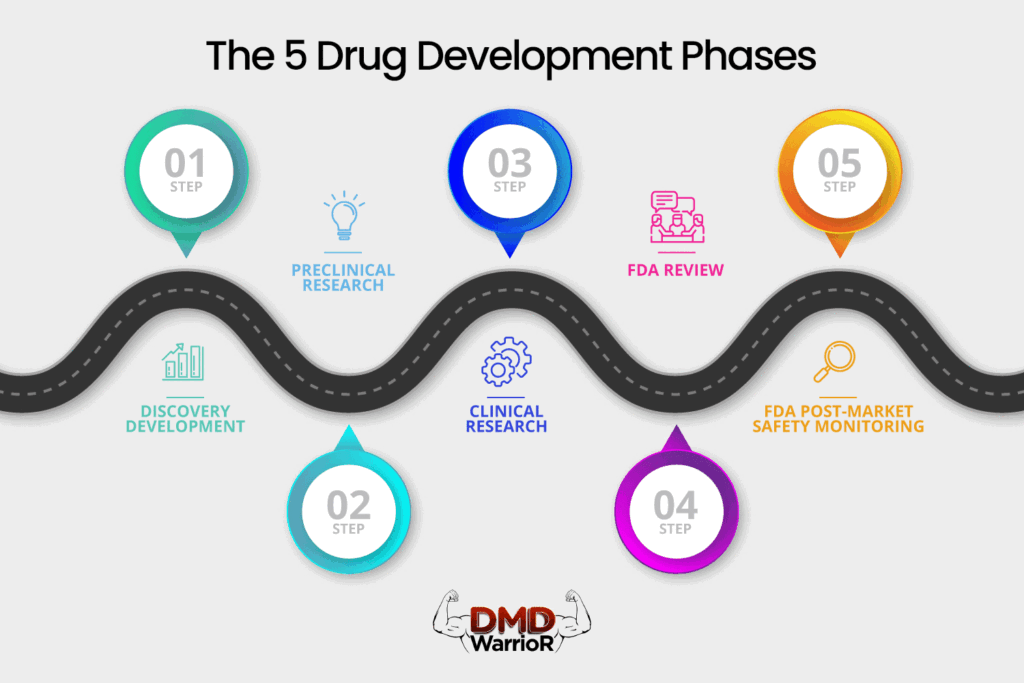
The drug development process begins long before the first patient receives an experimental treatment. According to the U.S. Food and Drug Administration (FDA), drug development can broadly be viewed as discovery and development, preclinical research, clinical research, FDA review, and post-market safety monitoring.
During discovery, researchers investigate disease mechanisms and potential therapeutic targets. Thousands of compounds or biological approaches may initially be considered, but only a small proportion progress far enough to undergo extensive development. Researchers investigate how a candidate works, how it is absorbed and distributed, appropriate dosing, potential toxicity, and interactions with other treatments.
The phases in drug development should therefore not be confused with clinical trial phases alone. Drug development includes laboratory research and regulatory activities before and after human trials. The phases of clinical trials represent the human research portion of this much larger pathway.
For families following a promising therapy, this distinction is important. A company announcing that a therapy has entered clinical development means that human testing has begun; it does not mean that the treatment has already demonstrated meaningful clinical benefit.
Preclinical Research
Before most experimental medicines enter human testing, researchers conduct preclinical studies. These studies may involve laboratory experiments and animal testing designed to answer fundamental questions about biological activity, toxicity, pharmacology, and potential safety. Learn More: MDX Mice in Research of DMD
Preclinical research is an important part of the drug development process because researchers need sufficient evidence before exposing people to an experimental intervention. The FDA explains that sponsors submit preclinical information as part of an Investigational New Drug (IND) application describing the proposed human research.
For families, one of the most important points is that successful preclinical research does not establish that a treatment will work in humans. Laboratory models can provide valuable evidence about mechanisms and potential effects, but human biology is considerably more complex.
This is particularly relevant for rare diseases. Research in rare disorders can be difficult because patient populations are small, natural-history information may be limited, and researchers must determine whether a measured change represents a clinically meaningful improvement. Academic literature has identified these issues as major challenges in rare-disease clinical research. Learn More: EMA
Clinical Trial Phases: Phase 1, Phase 2, Phase 3 and Phase 4
The clinical trial phases are designed to answer increasingly sophisticated questions. The phases of clinical trials generally progress from initial safety and dosing questions toward effectiveness, larger-scale safety evaluation, regulatory review, and post-approval monitoring.
Phase 1 Clinical Trial: Is the Treatment Safe?
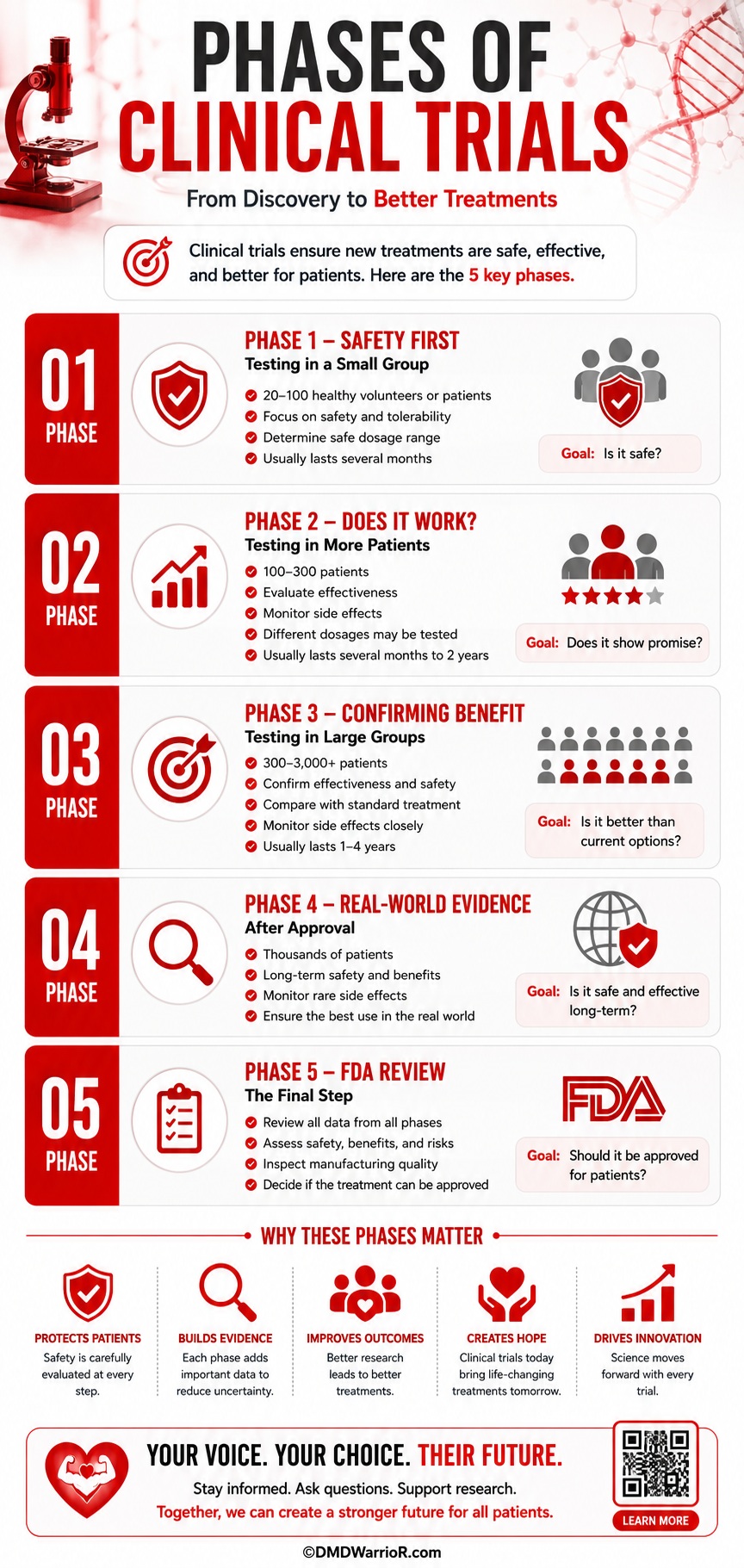
Phase 1 is generally the first time an investigational drug is administered to humans. These studies typically involve a relatively small number of participants and focus heavily on safety, tolerability, pharmacokinetics, pharmacodynamics, and appropriate dosing. FDA materials describe typical Phase 1 studies as involving approximately 20–80 participants, although the number varies according to the intervention.
The primary purpose of the first of the phases of clinical trials is not to prove that a treatment works. Researchers are primarily asking: What happens when people receive the treatment? What dose can be administered safely? What adverse effects occur? How does the body process the intervention?
For families, entering Phase 1 is therefore an important scientific milestone, but it should not be interpreted as evidence that effectiveness has been established.
Phase 2 Clinical Trial: Does It Appear to Work?
Phase 2 moves the investigation further. Participants generally have the disease or condition being studied, and researchers evaluate preliminary effectiveness while continuing to monitor safety.
The FDA describes Phase 2 studies as controlled clinical studies intended to obtain preliminary evidence of effectiveness and identify common short-term adverse effects and risks. These studies often involve several hundred participants, although the exact size varies considerably.
The second of the phases of clinical trials is particularly important because researchers begin to examine whether biological or laboratory findings translate into meaningful effects in patients. Study design may include different doses, control groups, placebo comparisons, biomarkers, functional measures, or other clinical endpoints.
However, a positive Phase 2 result does not guarantee success in Phase 3. A treatment may appear promising in a relatively small study but fail when tested in a larger and more diverse population.
Phase 3 Clinical Trial: Does the Evidence Hold Up?
Phase 3 is generally the largest and most rigorous pre-approval stage of the phases of clinical trials. These studies are designed to gather additional evidence about effectiveness and safety and to establish the overall benefit-risk profile of the treatment.
FDA guidance describes Phase 3 studies as typically involving several hundred to several thousand participants. They may evaluate broader populations, different doses, longer treatment periods, comparisons with standard treatments or placebo, and additional safety outcomes.
The third of the phases of clinical trials is particularly important because results can influence whether regulators consider the evidence sufficient for marketing authorization. A successful Phase 3 study, however, does not mean that every patient will respond or that every possible risk is already known.
Families should therefore ask not only whether a trial was “successful,” but also what endpoint was measured, how large the treatment effect was, how durable it was, what adverse events occurred, and whether the results were statistically and clinically meaningful.
Phase 4 Clinical Trial: What Happens After Approval?
Phase 4 occurs after a medicine has received regulatory approval and is being used in the wider population. Among the phases of clinical trials, this stage is unique because researchers can observe the treatment under real-world conditions and in much larger populations.
NIH explains that Phase 4 research continues to evaluate safety and can provide additional information about risks, benefits, and optimal use after approval.
This means that approval is not necessarily the end of scientific evaluation. Some uncommon or long-term adverse effects may only become apparent after a treatment has been used by many more people.
FDA Review
After sufficient clinical and preclinical evidence has been collected, a sponsor can submit an application seeking marketing approval. In the United States, a New Drug Application (NDA) contains extensive information, including preclinical data, clinical-trial results, analyses, proposed labeling, and safety information.
The FDA evaluates the submitted evidence and determines whether the available data support approval for the proposed use. The phases of clinical trials therefore form an important part of the regulatory evidence package, but FDA review considers the totality of evidence rather than simply whether a drug reached a particular phase.
For families, this distinction matters because “Phase 3 completed” and “FDA approved” are not synonymous. A company can complete a Phase 3 study without obtaining approval if the evidence does not adequately demonstrate that the benefits outweigh the risks for the proposed indication.
Post-Market Monitoring
Even after approval, monitoring continues. FDA’s drug-development framework includes post-market safety monitoring because the safety profile of a medicine can evolve as exposure increases across a much larger population.
Understanding the phases of clinical trials therefore helps families interpret pharmaceutical announcements more accurately. Phase 1 primarily addresses initial human safety and dosing; Phase 2 provides preliminary evidence of effectiveness while continuing safety evaluation; Phase 3 provides larger-scale evidence needed to assess the benefit-risk relationship; and Phase 4 generates additional evidence after approval.
What Families Should Ask About a Clinical Trial
When evaluating an experimental treatment, families should look beyond the phase number. Important questions include: What is the primary endpoint? What evidence of effectiveness has been reported? How many participants were enrolled? Was there a control group? What adverse events occurred? How long were participants followed? Were results statistically significant and clinically meaningful? Are biomarker results consistent with functional outcomes?
For rare diseases, these questions are particularly important because small populations can make trial design and interpretation more challenging.
The phases of clinical trials provide a framework for understanding where a treatment stands, but they do not provide the complete answer about whether that treatment is effective, safe, durable, affordable, or appropriate for an individual patient.
Ultimately, understanding the phases of clinical trials gives families a clearer way to interpret research news, clinical-trial announcements, and regulatory decisions. The drug development process is deliberately progressive: evidence is accumulated step by step, uncertainties are reduced, and regulators assess whether the available evidence supports wider use. Knowing what each stage is designed to demonstrate can help families distinguish between an interesting scientific development, promising early evidence, a meaningful clinical result, and an approved treatment. Discover Now: Explore Duchenne Clinical Trials
Final Thoughts
Understanding the phases of clinical trials helps families interpret treatment research with greater confidence. Each phase answers different questions about safety, effectiveness, and risk. Reaching a later phase does not guarantee approval or success. Families should always examine the evidence behind each clinical trial.