
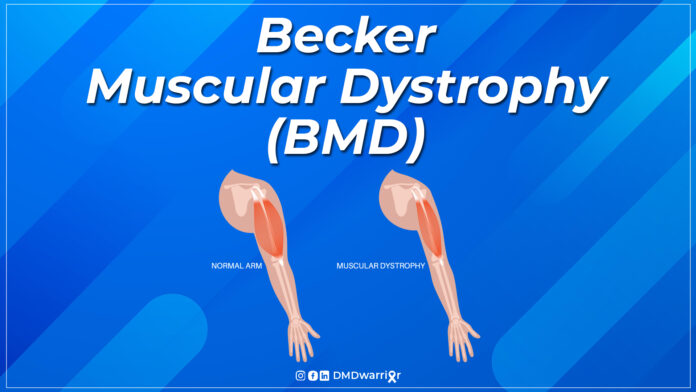
Becker muscular dystrophy (BMD) is a genetic neuromuscular disorder characterized by progressive muscle weakness caused by mutations in the dystrophin gene. Often discussed alongside dystrophin deficiency, X-linked recessive disorders, and progressive muscle degeneration diseases, Becker muscular dystrophy (BMD) represents a milder but still serious form of dystrophinopathy compared to Duchenne muscular dystrophy. Understanding Becker muscular dystrophy (BMD) is critical for early diagnosis, optimized treatment, and improved long-term outcomes for patients and families navigating this condition.
Table of Contents
What is Becker Muscular Dystrophy?
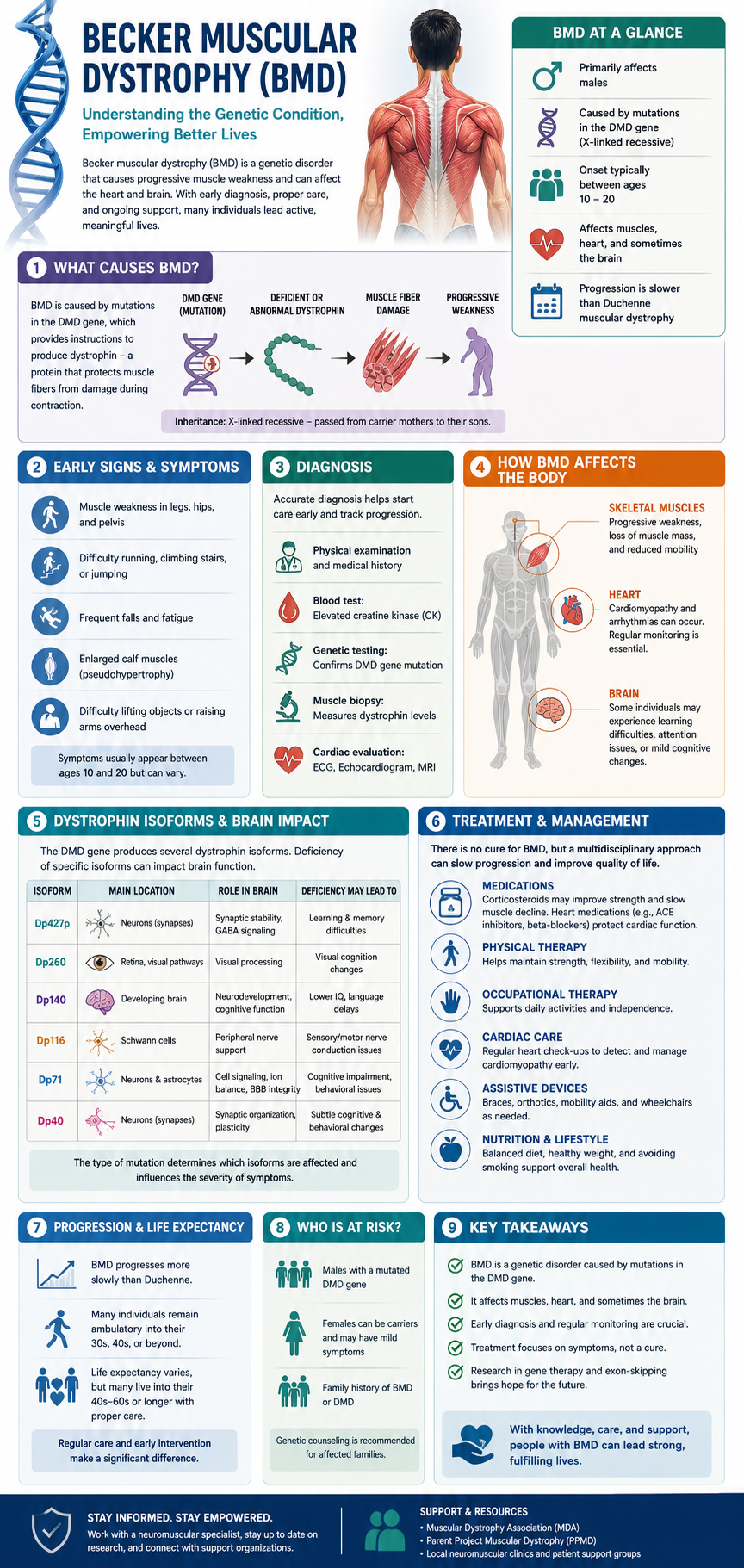
Becker muscular dystrophy is a hereditary condition that primarily affects skeletal and cardiac muscles. It is caused by mutations in the gene responsible for producing Dystrophin, a protein essential for maintaining muscle fiber integrity.
Unlike Duchenne muscular dystrophy, where dystrophin is nearly absent, Becker muscular dystrophy (BMD) involves partially functional dystrophin. This difference explains why symptoms are typically milder and appear later in life, often during adolescence or early adulthood.
Patients with Becker muscular dystrophy (BMD) may initially experience difficulty running, climbing stairs, or lifting objects. Over time, muscle weakness progresses, particularly in the hips, thighs, and shoulders.
What Causes Becker Muscular Dystrophy?
Becker muscular dystrophy (BMD) is caused by mutations in the DMD gene, located on the X chromosome. This gene encodes dystrophin, which stabilizes muscle cell membranes during contraction.
Key Mechanisms:
- Gene mutation → abnormal dystrophin
- Muscle fiber damage → degeneration
- Progressive weakness → functional decline
Because Becker muscular dystrophy (BMD) follows an X-linked recessive inheritance pattern, it primarily affects males, while females are typically carriers.
Learn More: Dystrophin Gene
Is Becker Muscular Dystrophy Genetic?
Yes—Becker muscular dystrophy (BMD) is an inherited condition. The mutation is passed from carrier mothers to their children.
Inheritance Pattern:
- Males (XY): affected if they inherit the mutated gene
- Females (XX): usually carriers, sometimes mild symptoms
Genetic counseling is strongly recommended for families with a history of Becker muscular dystrophy (BMD). Learn More: Genetic Counseling in Duchenne
What Are the First Symptoms of Becker Muscular Dystrophy?
Early signs of Becker muscular dystrophy (BMD) can be subtle and often go unnoticed.
Common Early Symptoms:
- Muscle weakness in legs and pelvis
- Frequent falls
- Difficulty running or climbing stairs
- Enlarged calf muscles (pseudohypertrophy)
As Becker muscular dystrophy (BMD) progresses, symptoms become more pronounced and may include fatigue and reduced endurance.
How Does Becker Muscular Dystrophy Affect the Brain?
Although Becker muscular dystrophy is classically defined by its effects on skeletal and cardiac muscle, the dystrophin protein is also expressed in the central nervous system. This means Becker muscular dystrophy (BMD) can have neurological and cognitive implications, though typically milder and more variable than in Duchenne muscular dystrophy.
Brain Involvement in Becker Muscular Dystrophy
Dystrophin plays a role in stabilizing neuronal membranes and supporting synaptic function, particularly in regions such as the hippocampus and cerebral cortex. When dystrophin isoforms are deficient or altered due to mutations in the DMD gene, subtle neurodevelopmental and cognitive differences may emerge.
Reported neurological features in Becker muscular dystrophy (BMD) include:
- Mild cognitive impairment
- Learning difficulties (especially verbal and executive function)
- Attention deficits
- Increased risk of neurobehavioral conditions (e.g., ADHD, anxiety)
However, it is important to emphasize that many individuals with Becker muscular dystrophy (BMD) have normal intelligence, and brain involvement is highly dependent on the specific mutation and affected isoforms. Read More: Psychological Support in DMD
Role of Dystrophin Isoforms in the Brain
The DMD gene produces multiple dystrophin isoforms through alternative promoters. Each isoform has a distinct expression pattern in the brain and contributes differently to neuronal function.
1. Dp427p (Full-Length Dystrophin)
- Predominantly expressed in neurons
- Localized at synapses
- Critical for GABAergic signaling and synaptic stability
Deficiency of Dp427p may lead to:
- Impaired inhibitory neurotransmission
- Learning and memory difficulties
2. Dp260
- Primarily expressed in the retina but also relevant to visual processing pathways
- Limited direct brain involvement, but may influence visual cognition
3. Dp140
- Highly expressed during brain development
- Associated with cognitive function
Deficiency of Dp140 is strongly linked to:
- Lower IQ scores
- Language delays
- Increased risk of neurodevelopmental disorders
4. Dp116
- Expressed mainly in Schwann cells (peripheral nervous system)
- Minimal direct role in central brain function
- May indirectly affect nerve conduction and sensory processing
5. Dp71
- The most abundant dystrophin isoform in the brain
- Found in astrocytes and neurons
- Essential for cell signaling, ion homeostasis, and blood-brain barrier integrity
Dp71 deficiency is associated with:
- Cognitive impairment
- Altered brain architecture
- Neurodevelopmental issues
6. Dp40
- A shorter isoform derived from Dp71
- Involved in synaptic organization and neuronal plasticity
Its deficiency may contribute to:
- Subtle cognitive and behavioral changes
Clinical Implications
The neurological impact of Becker muscular dystrophy (BMD) depends on which dystrophin isoforms are affected by the mutation. For example:
- Mutations affecting Dp140 and Dp71 are more likely to result in cognitive involvement
- Mutations limited to muscle-specific isoforms may spare brain function
This genotype–phenotype correlation is critical in predicting outcomes and guiding clinical management.
Key Takeaway
Becker muscular dystrophy (BMD) is not solely a muscle disease—it can also influence brain function through isoform-specific dystrophin deficiencies. While most individuals experience mild or no cognitive impairment, understanding the role of Dp427p, Dp260, Dp140, Dp116, Dp71, and Dp40 provides valuable insight into the broader systemic nature of the disorder.
Learn More: Isoform Deficiencies in Duchenne
FAQs: Becker Muscular Dystrophy
At What Age Does Becker Muscular Dystrophy Start?
Symptoms of Becker muscular dystrophy (BMD) typically appear between ages 10 and 20, although onset can vary widely. Some individuals may not be diagnosed until adulthood.
The slower progression of Becker muscular dystrophy (BMD) compared to Duchenne allows many patients to maintain mobility longer.
How Fast Does Becker Muscular Dystrophy Progress?
The progression of Becker muscular dystrophy (BMD) is variable. Some individuals remain ambulatory into their 40s or beyond, while others may require mobility aids earlier.
Factors influencing progression include:
• Specific genetic mutation
• Level of dystrophin production
• Access to early treatment and care
How is Becker Muscular Dystrophy Diagnosed?
Diagnosis of Becker muscular dystrophy (BMD) involves a combination of clinical evaluation and laboratory testing.
Diagnostic Tools:
Creatine kinase (CK) blood test (elevated levels)
Genetic testing (confirms DMD gene mutation)
Muscle biopsy (analyzes dystrophin levels)
Cardiac assessments (detect cardiomyopathy)
Early diagnosis of Becker muscular dystrophy (BMD) is essential for timely intervention.
What Tests Confirm Becker Muscular Dystrophy?
Confirmatory testing focuses on identifying dystrophin abnormalities.
Key Tests:
• DNA sequencing of the DMD gene
• Western blot analysis for dystrophin
• MRI for muscle degeneration patterns
These tests provide definitive evidence of Becker muscular dystrophy (BMD).
Can genetic testing diagnose Becker muscular dystrophy (BMD)?
Yes, genetic testing is the gold standard for diagnosing Becker muscular dystrophy (BMD). It identifies deletions, duplications, or point mutations in the DMD gene.
Carrier testing is also available for female relatives.
Read More: How DMD Affects Girls and Women
Is There a Cure for Becker Muscular Dystrophy?
Currently, there is no cure for Becker muscular dystrophy (BMD). However, ongoing research in gene therapy and exon-skipping technologies shows promise.
How is Becker Muscular Dystrophy Treated?
Treatment for Becker muscular dystrophy (BMD) focuses on managing symptoms and slowing disease progression.
Treatment Approaches:
Corticosteroids to improve muscle strength
Physical therapy to maintain mobility
Cardiac medications for heart complications
Assistive devices (braces, wheelchairs)
Multidisciplinary care significantly improves quality of life.
What drugs are used to treat Becker muscular dystrophy (BMD)?
Common medications include:
• ACE inhibitors for cardiomyopathy
• Beta-blockers for heart function
• Corticosteroids for muscle preservation
Does Becker Muscular Dystrophy Affect the Heart?
Yes, cardiomyopathy is a major complication of Becker muscular dystrophy (BMD). Regular cardiac monitoring is essential. Read More: Heart Health in Duchenne
What is Cardiomyopathy in BMD?
Cardiomyopathy refers to weakening of the heart muscle, which can lead to heart failure if untreated.
What is the Life Expectancy of Someone with BMD?
Life expectancy for Becker muscular dystrophy (BMD) varies widely. Many individuals live into their 40s–60s or longer with proper care.
Can People with Becker Muscular Dystrophy Live a Normal Life?
While Becker muscular dystrophy (BMD) presents challenges, many individuals lead productive lives with appropriate treatment and support.
Who is at Risk for Becker Muscular Dystrophy?
Risk factors include:
• Family history
• Carrier mother
• Genetic mutation in DMD gene
Can Females Have Becker Muscular Dystrophy?
Yes, female carriers can exhibit mild symptoms such as muscle weakness or cardiac issues.
What is the Difference Between Duchenne and Becker Muscular Dystrophy?

The key difference lies in dystrophin production:
• Duchenne: little or no dystrophin
• Becker: partially functional dystrophin
This results in milder symptoms and slower progression in Becker muscular dystrophy (BMD).
Is Becker Muscular Dystrophy Less Severe Than Duchenne?
Yes, Becker muscular dystrophy (BMD) is generally less severe, with later onset and longer life expectancy.
Final Thoughts
Becker muscular dystrophy (BMD) is a progressive yet manageable genetic condition affecting muscle strength and heart health. Early diagnosis and multidisciplinary care improve outcomes and quality of life. Advances in genetic research continue to offer hope for targeted therapies. Understanding symptoms, risks, and treatment options empowers patients and families. Regular cardiac monitoring remains essential for long-term health. Personalized care plans help slow disease progression. Awareness and education are key to timely intervention. Support networks play a vital role in daily life. Ongoing studies bring new possibilities. With proper care, many individuals lead active, meaningful lives.
Academic Sources and References
- Hoffman EP, Brown RH Jr, Kunkel LM. Dystrophin: The protein product of the Duchenne muscular dystrophy locus. Cell. 1987;51(6):919–928.
- Bushby K, Finkel R, Birnkrant DJ, et al. Diagnosis and management of Duchenne muscular dystrophy, part 1: diagnosis, and pharmacological and psychosocial management. The Lancet Neurology. 2010;9(1):77–93.
- Bushby K, Finkel R, Birnkrant DJ, et al. Diagnosis and management of Duchenne muscular dystrophy, part 2: implementation of multidisciplinary care. The Lancet Neurology. 2010;9(2):177–189.
- Emery AEH. The muscular dystrophies. The Lancet. 2002;359(9307):687–695.
- Nigro G, Comi LI, Politano L, Bain RJ. The incidence and evolution of cardiomyopathy in Duchenne muscular dystrophy. International Journal of Cardiology. 1990;26(3):271–277.
- Chamova T, Guergueltcheva V, Raycheva M, et al. Association of Dp140 absence with cognitive impairment in dystrophinopathies. Neurology. 2013;80(17):1596–1602.
- Bardoni A, Felisari G, Sironi M, et al. Loss of Dp140 regulatory sequences is associated with cognitive impairment in dystrophinopathies. The Lancet. 1999;353(9152):897–902.
- Pezzoni L, et al. Cognitive and neuropsychological profile in Becker muscular dystrophy. Neuromuscular Disorders. 2023.
- Blake DJ, Weir A, Newey SE, Davies KE. Function and genetics of dystrophin and dystrophin-related proteins in muscle. Physiological Reviews. 2002;82(2):291–329.
- Ervasti JM, Campbell KP. A role for the dystrophin-glycoprotein complex as a transmembrane linker between laminin and actin. The Journal of Cell Biology. 1993;122(4):809–823.
- Muntoni F, Torelli S, Ferlini A. Dystrophin and mutations: one gene, several proteins, multiple phenotypes. The Lancet Neurology. 2003;2(12):731–740.
- Taylor PJ, Betts GA, Maroulis S, et al. Dystrophin gene mutation location and the risk of cognitive impairment. Neurology. 2010;74(13):1044–1050.
- Daoud F, Angeard N, Demerre B, et al. Cognitive and behavioral disturbances in Becker muscular dystrophy. Neuromuscular Disorders. 2009;19(6):383–388.
- Le Rumeur E. Dystrophin and the two related genetic diseases, Duchenne and Becker muscular dystrophies. Bosnian Journal of Basic Medical Sciences. 2015;15(3):14–20.
- Koenig M, Beggs AH, Moyer M, et al. The molecular basis for Duchenne versus Becker muscular dystrophy. The American Journal of Human Genetics. 1989;45(4):498–506.