

What is exon deletion, and why does it matter in Duchenne muscular dystrophy? An exon deletion occurs when one or more sections of a gene are missing, potentially affecting how the body produces an essential protein. In DMD, these deletions occur in the DMD gene, which contains the instructions for producing dystrophin. Understanding the exact exon deletion can help families better understand genetic test results, potential treatment approaches, and what the mutation may mean.
An exon deletion is a genetic change in which one or more exons—the sections of a gene that contribute to the instructions for making a protein—are missing from DNA. In Duchenne muscular dystrophy, exon deletions commonly affect the DMD gene, which provides instructions for producing dystrophin, an essential protein for healthy muscle function. Read More: DMD Gene
Understanding the specific exons that are deleted can be extremely important because the location and size of a deletion can affect how the genetic instructions are read and, in some cases, whether an individual may be eligible for a mutation-specific treatment approach. Read More: What is Duchenne?
Table of Contents
What Is an Exon?
An exon is a segment of a gene that remains in the mature messenger RNA (mRNA) after RNA processing and contributes to the instructions used to produce a protein.
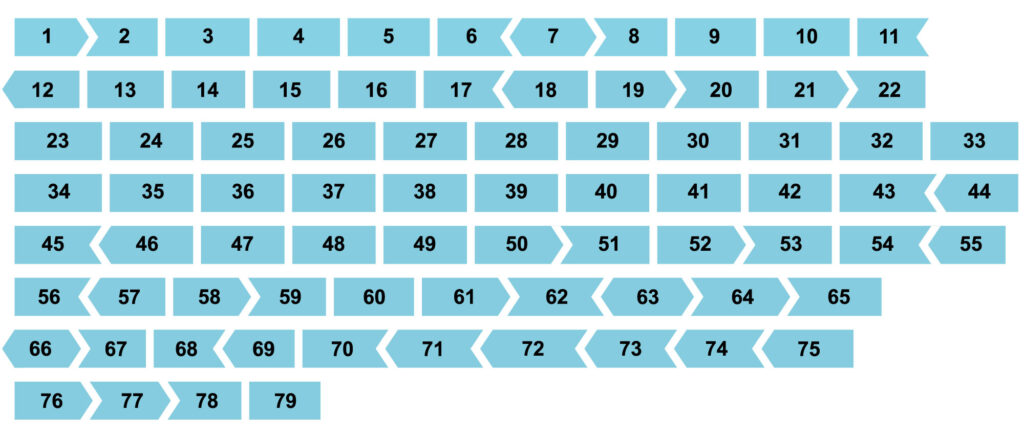
You can think of a gene as a long instruction manual divided into numbered sections. The DMD gene contains 79 exons, which work together to provide the instructions for producing dystrophin.
Dystrophin helps stabilize muscle fibers during contraction. When mutations in the DMD gene prevent the body from producing sufficient functional dystrophin, muscle cells become progressively vulnerable to damage.
What Happens When an Exon Is Missing?
An exon can be completely or partially deleted because of a genetic mutation. When one or more exons are missing from the DMD gene, the remaining genetic sequence may no longer be read correctly.
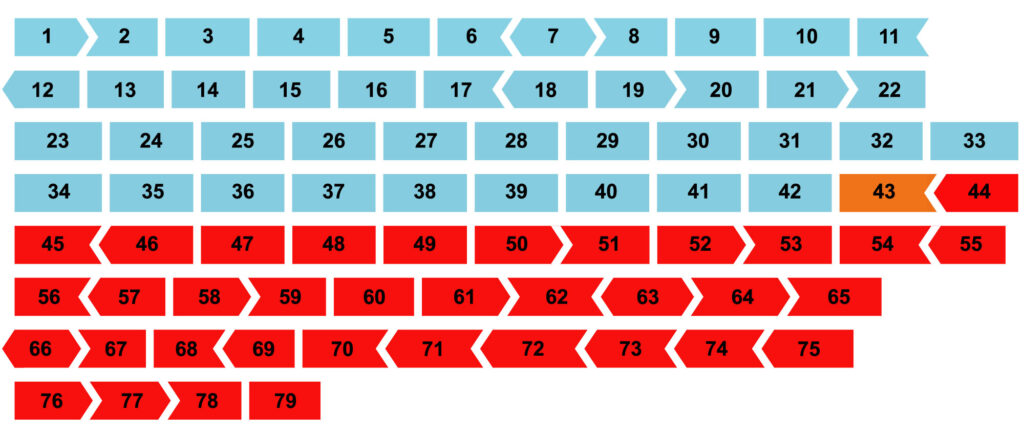
The critical question is whether the deletion disrupts the reading frame.
This is why simply knowing that an exon is deleted is not always enough to understand its clinical significance. The exact deletion—such as exon 45 deletion or exons 46–50 deletion—needs to be considered. Learn More: DMD Exon 46-50 Deletion
What Is an Exon Deletion in Duchenne Muscular Dystrophy?
An exon deletion in Duchenne muscular dystrophy is a mutation in the DMD gene in which one or more exons are absent.
DMD is caused by pathogenic variants in the DMD gene on the X chromosome. Deletions of one or more exons are among the most common types of DMD mutations.

For example, a genetic test may report:
- Deletion of exon 45
- Deletion of exons 45–47
- Deletion of exons 45–50
- Deletion of exons 51–52
These results describe which portions of the DMD gene are missing.
Exon deletion refers to the process by which one or more of the exons in the dystrophin gene are lost, leading to a shorter or incomplete version of the dystrophin protein. There are several ways this can happen, including large deletions where entire sections of the gene are lost or smaller deletions where only a single exon or a few exons are removed.

When exons are deleted in the dystrophin gene, the mRNA produced by the gene will be abnormal. This abnormal mRNA will lead to a truncated dystrophin protein or a complete absence of dystrophin altogether. Since dystrophin is essential for proper muscle function, its absence results in progressive muscle weakness and degeneration seen in DMD patients.
Why Does the Location of the Deletion Matter?
The location of an exon deletion can affect how the remaining exons connect and whether the genetic reading frame is maintained.
This distinction is commonly described as:
In-frame deletion: The reading frame remains intact.
Out-of-frame deletion: The reading frame is disrupted.
Established genetic testing guidelines recognize the importance of the reading frame when interpreting DMD and Becker muscular dystrophy (BMD) variants. In general, out-of-frame deletions are more strongly associated with the DMD phenotype, while in-frame deletions are more often associated with the milder BMD phenotype. However, this is a general rule rather than an absolute prediction for every individual. Read More: Duchenne vs. Becker
What Is the DMD Gene and Why Is It Important?
The DMD gene contains the genetic instructions for dystrophin.
Dystrophin is a structural protein that helps protect muscle fibers from damage caused by repeated contraction. When dystrophin is absent or significantly reduced, muscle fibers become progressively damaged.
The DMD gene is exceptionally large and contains 79 exons. Its size contributes to the relatively high frequency and diversity of mutations observed in DMD. Deletion mutations are particularly common, with deletion hotspots reported in regions including exons 2–20 and 45–55.
How Does an Exon Deletion Affect Dystrophin?
When a deletion disrupts the reading frame, the cellular machinery may not be able to correctly interpret the remaining genetic instructions.
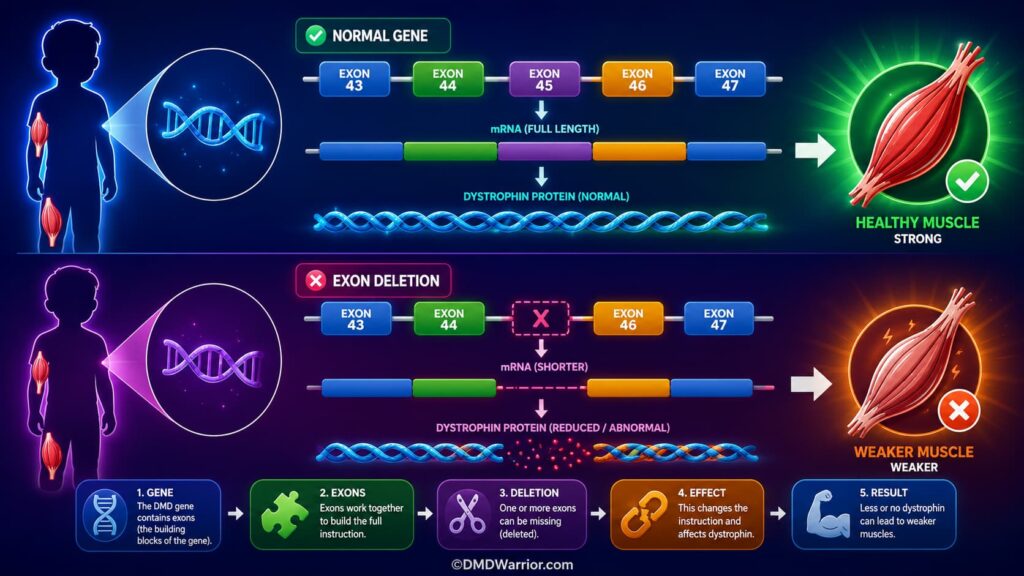
This can result in little or no functional dystrophin being produced.
By contrast, some deletions preserve the reading frame and may allow production of a shorter dystrophin protein that retains some function. This difference is one reason why two people with different DMD deletions can have different clinical presentations.
How Are Exon Deletions Detected?
An exon deletion is identified through genetic testing.
For someone suspected of having DMD or BMD, molecular genetic testing can determine whether the DMD gene contains deletions, duplications, or smaller sequence variants.
Deletion and duplication analysis is particularly important because these larger genetic changes account for a substantial proportion of DMD mutations.
What Does a Genetic Test Result Look Like?
A report may state something similar to:
DMD gene: deletion of exons 45–50
This does not mean that the person has “lost six genes.” It means that six numbered exon regions within the same DMD gene are missing.
The exact result should be interpreted by a qualified geneticist, neurologist, genetic counselor, or other appropriate healthcare professional. Read More: DMD Genetic Testing
Exon Deletion vs. Exon Duplication
An exon deletion means one or more exon regions are missing.
An exon duplication means one or more exon regions are present in an additional copy.
Both can affect the reading frame of the DMD gene.
For example, if a deletion or duplication changes the number of DNA bases in a way that disrupts the three-base reading pattern used during protein production, the resulting dystrophin instructions may become abnormal.
This is why genetic reports should not be interpreted simply by looking at the number of exons involved. The precise mutation and its effect on the reading frame are important.
What Is the Connection Between Exon Deletion and Exon Skipping?
One of the most important reasons families may hear about exon deletions is their connection with exon-skipping therapies.
Exon skipping is a mutation-specific strategy designed to help restore the reading frame of the DMD messenger RNA.
Imagine the DMD gene as a train made up of connected carriages. If several carriages are missing, the remaining connections may no longer line up correctly. An exon-skipping approach attempts to remove an additional exon so that the remaining sequence can once again be read in the correct frame. Read More: What is Exon Skipping
Can Exon Skipping Correct Every Exon Deletion?
No.
Exon skipping is mutation-specific. Whether a particular deletion can potentially be addressed depends on the exact exons that are missing and whether skipping another exon can restore the reading frame.
For example, research has demonstrated that different deletion patterns may be amenable to skipping the same exon, while other deletions may not be correctable through that approach.
Therefore, families should not assume that an exon deletion automatically means that a particular exon-skipping treatment is appropriate. Read More: Next Generation Exon Skipping Therapies
Does an Exon Deletion Mean a Child Has Duchenne?
Not necessarily.
An exon deletion in the DMD gene can be associated with Duchenne muscular dystrophy or Becker muscular dystrophy, among other possible interpretations depending on the specific variant and clinical context.
The reading-frame rule is useful, but it is not perfect. Some in-frame deletions have been identified in individuals with DMD, and some particular deletions can be associated with different clinical phenotypes.
For this reason, genetic results should always be considered alongside the person’s clinical findings, family history, and other relevant testing.
Why Knowing the Exact Exon Deletion Matters
For a family affected by DMD, knowing the precise genetic mutation can provide important information.
It can help healthcare professionals:
- Confirm the molecular diagnosis
- Understand the type of DMD mutation
- Determine whether the deletion is in-frame or out-of-frame
- Assess potential genotype-phenotype relationships
- Evaluate eligibility for certain mutation-specific therapies
- Identify relatives who may benefit from genetic counseling and testing
- Support appropriate family planning discussions
Most importantly, “DMD exon deletion” is not a complete genetic description by itself.
The exact exon or exon range matters.
A deletion of exon 45 is different from a deletion of exons 45–50. Their potential effects on the reading frame and treatment options may differ.
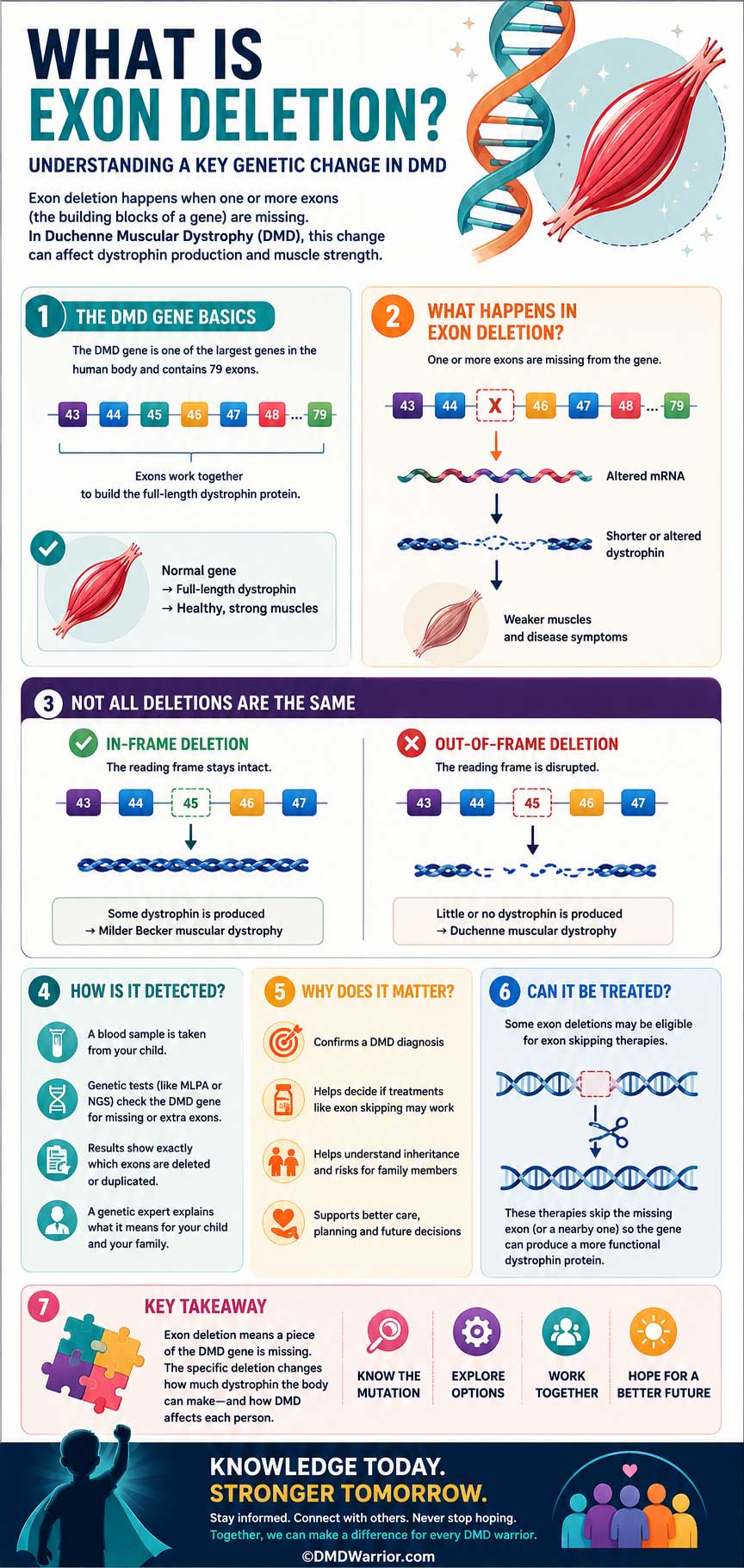
Frequently Asked Questions About Exon Deletion
Is exon deletion the same as a gene deletion?
No. An exon deletion generally refers to the loss of one or more specific sections within a gene. The entire gene does not necessarily disappear.
Is an exon deletion inherited?
It can be inherited, but it can also arise as a new, or de novo, mutation. Genetic counseling can help determine the inheritance pattern in a particular family.
Can an exon deletion cause DMD?
Yes. Pathogenic exon deletions in the DMD gene are a major cause of Duchenne muscular dystrophy. However, the precise effect depends on the deletion and its consequences for dystrophin production.
Can an exon deletion be treated?
Some specific DMD exon deletions may be amenable to mutation-specific approaches such as exon skipping. However, eligibility depends on the exact genetic mutation and the treatment being considered.
Where can I find my child’s exon deletion?
The exact deletion should normally be listed on the molecular genetic testing report. If the report says something such as “deletion of exons 45–50,” that range identifies the missing exon regions.
Conclusion
Understanding exon deletion is essential for families affected by DMD. Each deletion has a specific genetic meaning. The exact exons involved matter. The reading frame can affect dystrophin production. Genetic testing reveals the mutation. Exon skipping may help some mutations. Not every deletion is treatable. Results require expert interpretation. Accurate genetic information supports better decisions. Knowledge can help families navigate DMD care.
Academic Sources & References
- Abbs, S., et al. (2020). EMQN best practice guidelines for genetic testing in dystrophinopathies. European Journal of Human Genetics, 28, 1147–1162.
- Darras, B. T., Urion, D. K., & Ghosh, P. S. Dystrophinopathies. GeneReviews®, NCBI Bookshelf.
- Aartsma-Rus, A., & den Dunnen, J. T. (2019). Phenotype predictions for exon deletions/duplications: A user guide for professionals and clinicians using Becker and Duchenne muscular dystrophy as examples. Human Mutation, 40(9), 1381–1391.