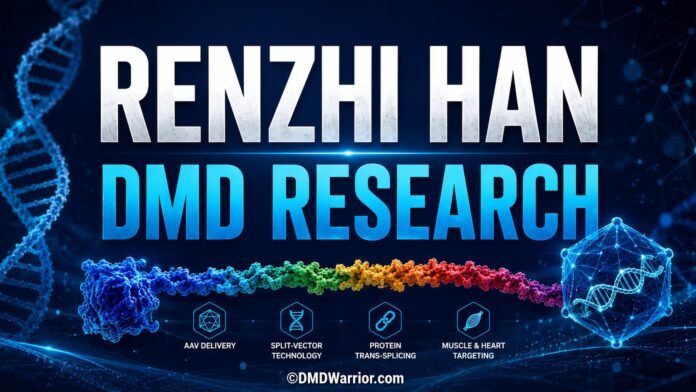
Renzhi Han, PhD, at Indiana University is advancing a new direction in gene therapy research: finding a way to deliver full-length dystrophin safely and effectively to muscle and heart cells. With a new four-year, 2.6 million dollars from the National Institutes of Health (NIH), Han and his team are now exploring whether this approach can overcome some of the limitations of current micro-dystrophin therapies.
Table of Contents
The Problem With Micro-Dystrophin
One of the biggest challenges in dystrophin gene therapy is the size of the dystrophin gene.
Adeno-associated viruses (AAVs) are commonly used as delivery vehicles, but their microscopic size prevents them from carrying the full-length dystrophin gene. This is why researchers developed micro-dystrophin, a shortened version that can fit inside an AAV. Learn More: Project Details
Micro-dystrophin was an important first step in bringing gene therapy to DMD patients. However, it lacks many of the important functional segments found in full-length dystrophin.
According to Han, this means that micro-dystrophin may provide only partial protection. His research is therefore focused on a much more ambitious question: Can we deliver the complete, fully functional dystrophin protein instead of a shortened version? Read More: Who is Renzhi Han, PhD?
A New Way to Deliver Complete Dystrophin
The answer may come from combining several advances in delivery technology.
Han’s team is investigating protein trans-splicing technology together with myotropic AAV capsid engineering. These technologies could make it possible to deliver complete dystrophin proteins into the body despite the size limitations of conventional AAV delivery.
The concept is remarkably straightforward: instead of trying to fit the entire full-length dystrophin into one microscopic delivery vehicle, the protein can be divided into three separate pieces.
These pieces can then be delivered using more efficient vehicles and reassembled inside muscle and heart cells into a complete, fully functional protein. Han describes this as a new kind of “delivery truck” system designed to overcome the physical limitations of conventional AAV delivery.
Why Lower Viral Doses Matter
Delivery is only part of the challenge.
Current AAV-based approaches can require high viral doses, which may trigger dangerous immune responses and potentially cause organ toxicity. Han’s research therefore also aims to develop more efficient delivery vehicles that could reach target tissues using safer, lower viral doses.
With next-generation capsid engineering and split-vector technology, the goal is to deliver full-length dystrophin directly to skeletal muscles, the diaphragm and the heart while reducing the amount of viral material required.
From Partial Protection to Complete Restoration
Han’s research is still at the experimental stage. The new NIH funding will allow his laboratory to investigate the feasibility of full-length dystrophin delivery in animal models of DMD and to work toward making the approach safer and more effective for potential future clinical trials.
But the direction of the research is significant.
Rather than accepting the limitations of a truncated protein, Han is pursuing the possibility of restoring the complete dystrophin protein.
As he puts it, the field may be moving beyond a choice between “a truncated protein or no treatment at all.” The ultimate goal is a shift from partial protection toward complete biological restoration.
For DMD research, that is a compelling question for the future:
What if the next breakthrough in gene therapy is not a better micro-dystrophin, but a way to deliver full-length dystrophin?
Discover More: Duchenne Clinical Trial Locations Map