
Duchenne Muscular Dystrophy (DMD) is a severe genetic disorder characterized by progressive muscle weakness and degeneration. Affecting approximately 1 in 3,500 to 5,000 boys worldwide, DMD is primarily caused by mutations in the DMD gene, which encodes a critical protein called dystrophin. Understanding the genetic causes of Duchenne Muscular Dystrophy, the role of dystrophin, inheritance patterns, and the origins of DMD gene variants is essential for families, caregivers, and healthcare providers. This article provides an in-depth exploration of these topics while offering guidance for affected families.
Table of Contents
Genetic Causes of Duchenne Muscular Dystrophy
Duchenne Muscular Dystrophy is caused by mutations in the DMD gene, located on the X chromosome. These mutations can include:
- Deletions – The most common type, accounting for approximately 60–70% of cases, where one or more exons of the DMD gene are missing. » Exon Deletion
- Duplications – Extra copies of certain exons, leading to abnormal dystrophin production.
- Point Mutations – Small changes in the DNA sequence, including nonsense and frameshift mutations.
- Splice Site Mutations – Alterations that affect how RNA is processed, leading to defective dystrophin protein.
These genetic mutations disrupt the production of dystrophin, a vital protein for muscle cell integrity, resulting in progressive muscle weakness and eventual loss of mobility. Learn More: Types of DMD Genetic Variants
What is the Role of Dystrophin?
Dystrophin is a large structural protein located in the cytoskeleton of skeletal and cardiac muscle cells. Its main functions include:
- Maintaining Muscle Integrity: Dystrophin connects the internal cytoskeleton to the extracellular matrix, protecting muscle fibers from damage during contraction.
- Preventing Muscle Degeneration: Absence or deficiency of dystrophin leads to repeated injury, inflammation, and eventual replacement of muscle tissue with fat and fibrotic tissue.
- Supporting Cardiac Function: Dystrophin also stabilizes heart muscle, explaining why many individuals with DMD develop cardiomyopathy.
In Duchenne Muscular Dystrophy, dystrophin is almost entirely absent, whereas in Becker Muscular Dystrophy, dystrophin is partially functional. This difference explains the more severe and earlier onset of Duchenne compared to Becker. Read More: The Dystrophin Gene
How Are Duchenne and Becker Muscular Dystrophies Inherited?
Both Duchenne and Becker Muscular Dystrophies are X-linked recessive disorders, meaning the defective gene is located on the X chromosome.
Key Points:
- Boys are predominantly affected: Males inherit one X chromosome from their mother and one Y chromosome from their father. A single defective DMD gene on the X chromosome causes the disease.
- Females are usually carriers: Females have two X chromosomes, so if one X carries the mutation, the other usually compensates. Some carriers may show mild symptoms, including muscle weakness or heart issues.
- Inheritance Patterns:
- If a mother is a carrier, each son has a 50% chance of having DMD, and each daughter has a 50% chance of being a carrier.
- Fathers cannot pass X-linked DMD to their sons but will pass the gene to all daughters, who become carriers.
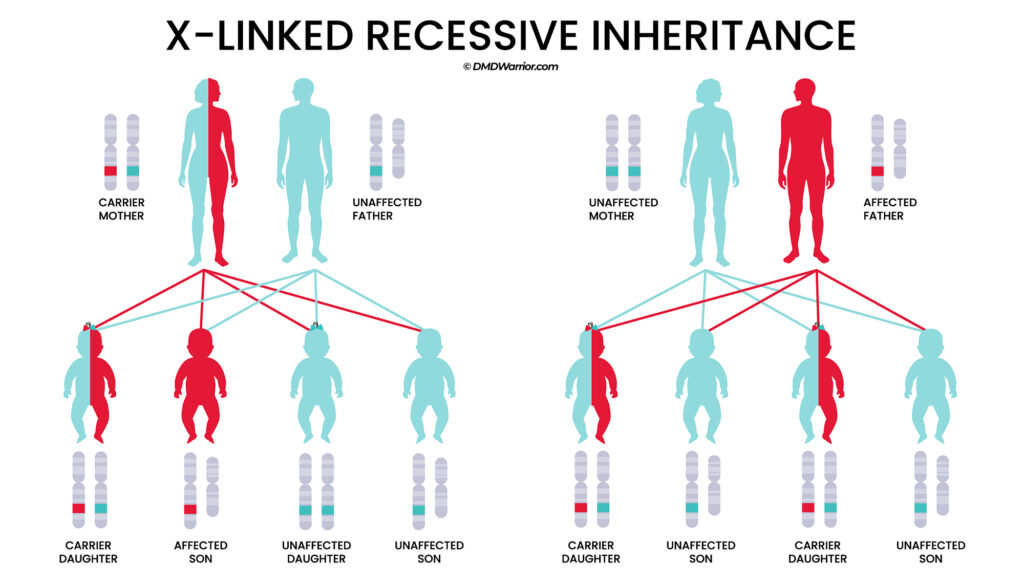
Understanding these inheritance patterns is critical for family planning and genetic counseling.
Where Do DMD Gene Variants Come From?
DMD gene variants arise from three main sources:
- Inherited Mutations: Passed down from a carrier mother, accounting for roughly two-thirds of cases.
- De Novo Mutations: Spontaneous mutations that occur in the egg, sperm, or early embryonic development. Around one-third of DMD cases arise this way.
- Germline Mosaicism: Sometimes a mother may have some egg cells with the mutation but no symptoms herself. This can unexpectedly lead to multiple affected children.
Recent advances in genetic testing and sequencing technologies allow families to identify carriers and better understand the origins of these mutations. Learn More: Genetic Testing
Clinical Implications
Understanding the genetic causes of DMD helps in:
- Early Diagnosis: Genetic testing can confirm DMD in young children with delayed milestones or muscle weakness.
- Therapeutic Planning: Treatments such as exon-skipping therapy target specific gene mutations.
- Family Counseling: Identifying carriers allows families to make informed reproductive decisions.
- Monitoring Cardiac Health: Knowing the genetic basis helps predict cardiac complications and guide surveillance.
Frequently Asked Questions (FAQs)
What is the difference between Duchenne and Becker Muscular Dystrophy?
Duchenne is more severe due to almost complete lack of dystrophin, whereas Becker produces partially functional dystrophin, leading to later onset and slower progression. > BMD vs DMD.
Can girls have Duchenne Muscular Dystrophy?
It is extremely rare but possible, usually due to X-chromosome abnormalities or skewed X-inactivation. Most females are carriers with mild or no symptoms. Learn More: Duchenne Carriers
How is DMD diagnosed genetically?
Through DNA testing, including deletion/duplication analysis and sequencing of the DMD gene. Prenatal and carrier testing are also available.
Are DMD mutations inherited from parents?
About two-thirds are inherited from carrier mothers, while one-third arise as spontaneous (de novo) mutations.
Can a father pass DMD to his son?
No, fathers pass the Y chromosome to sons, so X-linked DMD cannot be transmitted from father to son.
Are there treatments targeting the DMD gene?
Yes, therapies like exon-skipping drugs and gene therapy are designed to address specific genetic mutations.
What support exists for families?
Genetic counseling, patient advocacy groups, clinical trials, and multidisciplinary care centers help families manage DMD effectively.
Final Thoughts
Understanding the genetic causes of Duchenne Muscular Dystrophy is crucial for early diagnosis and effective care. The role of dystrophin explains the progressive muscle weakness seen in DMD. Knowing how Duchenne and Becker are inherited helps families assess risk. Awareness of DMD gene variants informs genetic counseling and family planning. Advances in gene therapy and exon-skipping treatments offer hope. Carrier testing supports preventive strategies. Multidisciplinary care improves quality of life. Cardiac monitoring is essential. Research continues to uncover new therapies. Early intervention can make a lasting difference.