
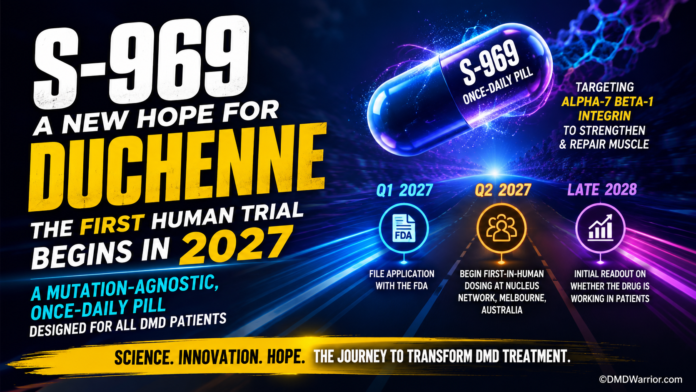
For families affected by Duchenne muscular dystrophy (DMD), every new clinical development offers hope. While many promising therapies begin in the laboratory, the true test comes when they are evaluated in people. Sarcomatrix Therapeutics is now preparing to take that important step with its experimental drug S-969, announcing an ambitious roadmap that could lead to the first human trial in 2027.
According to the company’s development timeline, Sarcomatrix plans to submit an Investigational New Drug (IND) application to the U.S. Food and Drug Administration (FDA) during the first quarter of 2027. If regulators authorize the study, the company expects to begin first-in-human dosing in the second quarter of 2027 at Nucleus Network in Melbourne, Australia. Initial data showing whether the therapy demonstrates biological activity and early signs of effectiveness are expected by late 2028.
Although this timeline represents an important milestone, it is equally important to understand that these are development goals rather than guarantees. Drug development is a lengthy process, and many investigational therapies experience delays or fail to demonstrate sufficient safety or effectiveness during clinical testing.
Table of Contents
Why Is S-969 Different?
Most therapies currently being developed for Duchenne muscular dystrophy focus on correcting specific genetic mutations. Because DMD is caused by thousands of different mutations in the dystrophin gene, many of these treatments only benefit relatively small groups of patients.
Sarcomatrix is pursuing a different strategy.
Instead of repairing the defective dystrophin gene, S-969 targets a naturally occurring protein called alpha-7 beta-1 integrin, which helps stabilize muscle fibers and supports the muscle’s own repair mechanisms. By strengthening muscle tissue regardless of the patient’s specific genetic mutation, the therapy is designed to be mutation-agnostic, meaning it may have the potential to benefit a much broader Duchenne population.
Another notable feature is its method of administration. Unlike gene therapies that require intravenous infusion, S-969 is being developed as a once-daily oral pill, potentially making treatment more convenient if it eventually proves safe and effective.
From Laboratory Research to Human Studies
Sarcomatrix remains a preclinical-stage biotechnology company. This means that S-969 has not yet been tested in human volunteers. Before a new medicine reaches patients, researchers must first complete extensive laboratory studies and animal testing to demonstrate an acceptable safety profile.
Once sufficient preclinical evidence has been collected, companies submit an IND application to the FDA requesting permission to begin clinical trials. If approved, Phase 1 studies primarily evaluate safety, tolerability, dosing, and how the drug behaves inside the human body.
The planned study at Nucleus Network in Melbourne represents this critical transition from laboratory science to clinical medicine. Success at this stage would allow researchers to collect the first real-world evidence of how S-969 performs in people living with Duchenne muscular dystrophy.
What Will Families Learn by Late 2028?
Many families may wonder what the expected late-2028 readout actually means.
An initial readout does not mean the therapy has been proven effective or is ready for approval. Instead, early clinical data generally help answer several important questions:
- Is the drug safe for patients?
- Are there any serious side effects?
- Does the medicine reach its intended biological target?
- Are there early signs that muscle function or muscle biology may improve?
If these early results are encouraging, larger studies would still be required before regulators could consider approving the treatment.
A Growing Pipeline Beyond Gene Therapy
Gene therapy has transformed Duchenne research during recent years, but scientists increasingly recognize that no single approach is likely to solve every challenge associated with the disease.
Mutation-independent therapies such as S-969 could eventually complement existing treatments by improving muscle stability regardless of the underlying genetic mutation. Because S-969 does not attempt to replace the dystrophin gene, it may also have potential applications beyond Duchenne, including Becker muscular dystrophy and certain forms of limb-girdle muscular dystrophy.
Whether these possibilities become reality will depend entirely on future clinical trial results.
Financial and Scientific Foundation
Sarcomatrix has already secured approximately 8.9 million USD in funding from investors and research grants, including support from the U.S. National Institutes of Health (NIH). The company also originated from research conducted at the University of Nevada, Reno, where much of the underlying science was developed. More than 75 patents have reportedly been filed, and an Orphan Drug Designation application for S-969 is currently in progress.
While these achievements strengthen the company’s scientific foundation, they do not guarantee regulatory approval.
Looking Ahead
For the Duchenne community, the next two years will be closely watched. If Sarcomatrix successfully submits its FDA application in early 2027 and begins dosing patients later that year, families may receive the first meaningful clinical insights by the end of 2028.
That timeline still represents only the beginning of clinical development. Nevertheless, moving from laboratory research into human studies is one of the most significant milestones any investigational therapy can achieve. Whether S-969 ultimately becomes a future treatment remains unknown, but its progress highlights the continued expansion of innovative, mutation-independent approaches aimed at improving outcomes for individuals living with Duchenne muscular dystrophy.
Explore Now: DMDWarrioR Clinical Trials Hub