
The duchenne muscular dystrophy treatment cost has become one of the most controversial and morally troubling issues in modern medicine. From duchenne therapy cost to gene therapy pricing for Duchenne muscular dystrophy, families are facing financial demands that are not just high—they are often catastrophic. What should be a life-saving medical necessity has instead become a global case study in pricing excess, systemic failure, and institutional neglect.
Across continents, parents are forced to navigate an unbearable reality: treatments exist, but access is dictated by wealth, geography, and bureaucratic gatekeeping. The cost of Duchenne muscular dystrophy treatment is no longer just a healthcare issue—it is an ethical crisis exposing the priorities of pharmaceutical companies, governments, and even advocacy organizations and associations.
Table of Contents
The Unforgivable Reality Behind Duchenne Muscular Dystrophy Treatment Cost
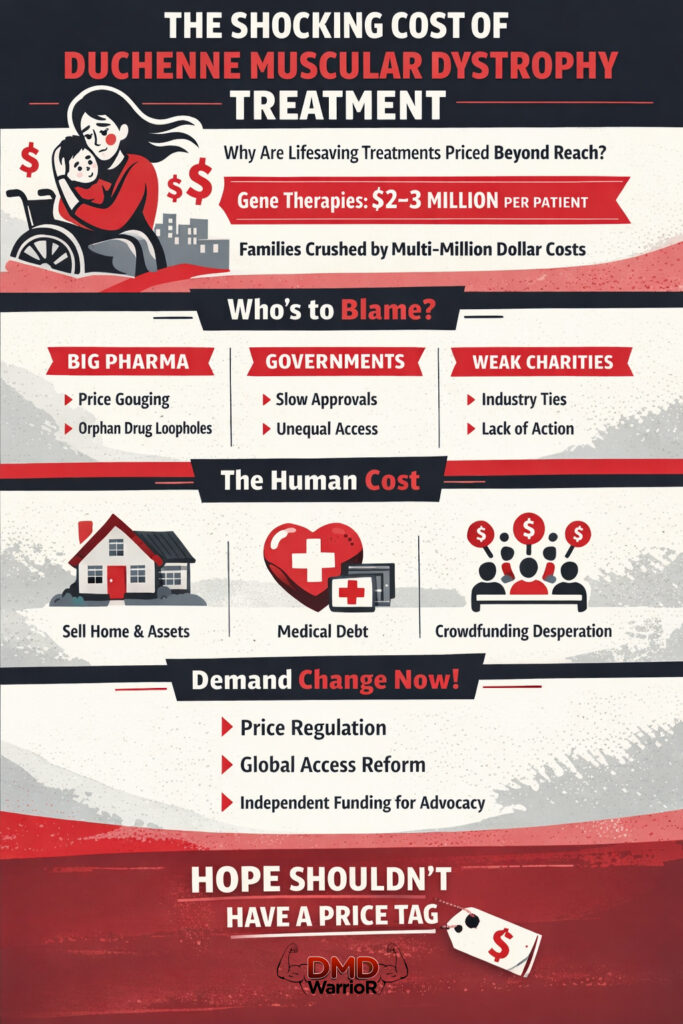
The numbers alone are staggering. Some therapies for Duchenne muscular dystrophy particularly gene therapies can exceed 2–3 million USD per patient. Exon-skipping drugs, corticosteroids, cardiac medications, respiratory support, and long-term multidisciplinary care collectively push lifetime costs into the millions of dollars per patient.
This raises an unavoidable question:
How did treating a rare pediatric disease become one of the most expensive endeavors in modern healthcare?
Gene Therapy Pricing – Innovation or Exploitation?
Gene therapies are often presented as revolutionary breakthroughs. And scientifically, they are. But economically, they have become symbols of extreme pricing behavior.
- One-time gene therapies priced at over 2,9 million USD
- Limited long-term efficacy data
- Restricted access due to reimbursement barriers
Pharmaceutical companies justify these costs by citing:
- Research and development expenses
- Small patient populations (orphan drug model)
- Long-term healthcare savings
However, multiple analyses challenge these claims.
Evidence:
- ICER (Institute for Clinical and Economic Review) reports have repeatedly flagged rare disease therapies as exceeding cost-effectiveness thresholds.
- A study in Health Affairs (2020) found that orphan drug pricing often reflects market tolerance, not actual R&D recovery costs.
The result?
Families are being charged what the market can bear—not what is fair.
Exon Skipping Therapies – High Cost, Modest Benefit
Exon skipping drugs such as eteplirsen and golodirsen cost hundreds of thousands of dollars annually, yet their clinical benefit remains debated.
Key concerns:
- Limited improvement in functional outcomes
- Accelerated approvals based on surrogate endpoints
- Continued high pricing despite uncertain efficacy
Study reference:
- Mendell et al., Annals of Neurology (2013)
- FDA advisory committee discussions (2016) highlighted insufficient evidence for robust clinical benefit
Despite this, pricing remains aggressively high.
Pharmaceutical Companies – Profit Over Patients?
Let’s be direct:
The current pricing structure for Duchenne muscular dystrophy treatment cost reflects a system designed for profit maximization—not patient access.
The Orphan Drug Loophole
The Orphan Drug Act (1983) was intended to incentivize rare disease research. Instead, it has been widely criticized for enabling:
- Extended market exclusivity
- Minimal competition
- Inflated pricing strategies
A study in JAMA (2017) found that orphan drugs are often more profitable than non-orphan drugs, contradicting the narrative of financial necessity.
Pricing Without Accountability
Unlike many industries, pharmaceutical pricing operates with limited transparency:
- No standardized global pricing framework
- Confidential rebate agreements
- Lack of cost breakdown disclosure
Patients and governments are expected to accept pricing without justification.
Strategic Scarcity and Market Control
Some companies restrict supply, delay global distribution, or prioritize high-income markets. This creates:
- Artificial scarcity
- Geographic inequality
- Delayed treatment access
For a progressive disease like Duchenne, delay equals irreversible damage.
Governments and Health Ministries – Passive Enablers
If pharmaceutical companies set the price, governments often fail to challenge it.
Reimbursement Delays That Cost Lives
In many countries:
- Approval processes take years
- Negotiations stall over pricing
- Patients age out of eligibility
This bureaucratic inertia effectively denies treatment.
Inequality Across Borders
Access to Duchenne muscular dystrophy treatment cost varies drastically:
| Region | Access Level |
|---|---|
| USA | High cost, insurance-dependent |
| Europe | Limited but subsidized |
| Developing countries | Nearly nonexistent |
This creates a disturbing reality:
A child’s chance of survival depends on their passport.
Budget Excuses vs Policy Failures
Governments often cite budget constraints. However:
- Healthcare budgets frequently allocate billions to less critical areas
- Rare disease funding remains disproportionately low
- Negotiation leverage is underutilized
The issue is not just affordability—it is prioritization.
DMD Associations – Mission Drift and Silence
Perhaps the most uncomfortable truth:
Some organizations established to protect patients have failed to challenge the system effectively.
Dependence on Industry Funding
Many advocacy groups receive funding from pharmaceutical companies. This creates:
- Conflicts of interest
- Softened criticism
- Reduced pressure for price reform
Awareness Without Action
Raising awareness is important—but insufficient.
- Campaigns highlight the disease
- Emotional storytelling drives donations
- Structural problems remain untouched
Families do not need awareness alone—they need access and affordability.
The Human Cost Behind Duchenne Muscular Dystrophy Treatment Cost
Behind every statistic is a family navigating impossible decisions:
- Sell assets or forgo treatment
- Relocate to access healthcare
- Crowdfund for survival
This is not a functioning healthcare system—it is a survival lottery.
Psychological and Financial Collapse
Research shows:
- Increased caregiver burnout (Pediatrics, 2018)
- Severe financial toxicity in rare diseases (Orphanet Journal of Rare Diseases, 2021)
Families are not just fighting the disease—they are fighting the system.
A Broken Economic Model
The Duchenne muscular dystrophy treatment cost crisis exposes fundamental flaws:
Value-Based Pricing Failure
Current pricing models claim to reflect value. In reality:
- Value is inflated
- Evidence is limited
- Prices are disconnected from outcomes
Lack of Global Coordination
No unified strategy exists to:
- Negotiate prices collectively
- Share data transparently
- Ensure equitable access
What Needs to Change – Urgent Reforms
This situation is not inevitable. It is the result of policy choices—and it can be changed.
Enforce Pricing Transparency
- Mandatory disclosure of R&D costs
- Public access to pricing frameworks
Global Price Negotiation Alliances
Countries should collaborate to:
- Increase bargaining power
- Prevent price exploitation
Reform the Orphan Drug System
- Limit excessive exclusivity
- Tie incentives to affordability
Independent Funding for Advocacy Groups
To eliminate conflicts of interest:
- Reduce reliance on pharma funding
- Increase public and independent grants
FAQ: Duchenne Muscular Dystrophy Treatment Costs Are
How much does Duchenne muscular dystrophy treatment cost?
The duchenne muscular dystrophy treatment cost can range from hundreds of thousands to several million dollars per patient. Gene therapies alone may exceed 2–3 million USD for a single treatment, while exon-skipping drugs can cost over $300,000 annually. When combined with ongoing care—such as physical therapy, cardiac support, respiratory care, and assistive devices—the lifetime cost often reaches multiple millions. These figures vary by country, insurance coverage, and access to treatment programs.
Why is Duchenne muscular dystrophy treatment so expensive?
The high duchenne muscular dystrophy treatment cost is largely driven by factors such as limited patient populations (rare disease status), expensive research and development processes, and market exclusivity under orphan drug regulations. However, critics argue that prices often exceed what is necessary to recover costs, reflecting profit-driven pricing strategies rather than true value or affordability.
Are Duchenne treatments covered by insurance or government healthcare?
Coverage for duchenne muscular dystrophy treatment cost varies widely. In some countries, national healthcare systems or insurance providers may cover part or all of the treatment, but approval processes can be slow and restrictive. In other regions, families may face partial coverage, high out-of-pocket costs, or complete lack of access. Even when coverage exists, eligibility criteria and reimbursement delays can significantly limit timely treatment.
Can families get financial assistance for Duchenne treatment?
Yes, some families can access financial support to manage duchenne muscular dystrophy treatment cost through patient assistance programs, nonprofit organizations, and crowdfunding platforms. Pharmaceutical companies may also offer limited access programs. However, these options are often inconsistent, highly competitive, and insufficient to fully offset the total cost, leaving many families still facing significant financial burden.
Is there any way to reduce the cost of Duchenne muscular dystrophy treatment?
Reducing duchenne muscular dystrophy treatment cost on an individual level is challenging, but families can explore multiple strategies. These include seeking treatment in countries with subsidized healthcare, applying for clinical trials, negotiating with insurance providers, and accessing nonprofit support programs. On a broader level, systemic changes—such as pricing regulation, global negotiation efforts, and policy reforms—are essential to make treatments more affordable and accessible.
Final Thoughts – A System That Demands Accountability
The duchenne muscular dystrophy treatment cost crisis is not just about money—it is about ethics, priorities, and responsibility. Pharmaceutical companies continue to defend pricing strategies that exclude patients. Governments hesitate to challenge them. Advocacy groups often remain constrained by funding dependencies.
Meanwhile, children with Duchenne muscular dystrophy lose time—time they cannot afford to lose.
- This is not innovation.
- This is not progress.
- This is a systemic failure demanding urgent accountability.