

Gowers signs in Duchenne muscular dystrophy and the Gowers maneuver are among the earliest and most clinically significant indicators of proximal muscle weakness in affected children. Often observed in toddlers and young boys, this characteristic movement pattern reflects progressive muscle degeneration and compensatory biomechanics. Understanding the Gowers sign is critical not only for early diagnosis of Duchenne muscular dystrophy (DMD), but also for tracking disease progression, guiding interventions, and improving long-term outcomes.
Table of Contents
What Is Gowers Sign?
Definition and Clinical Meaning
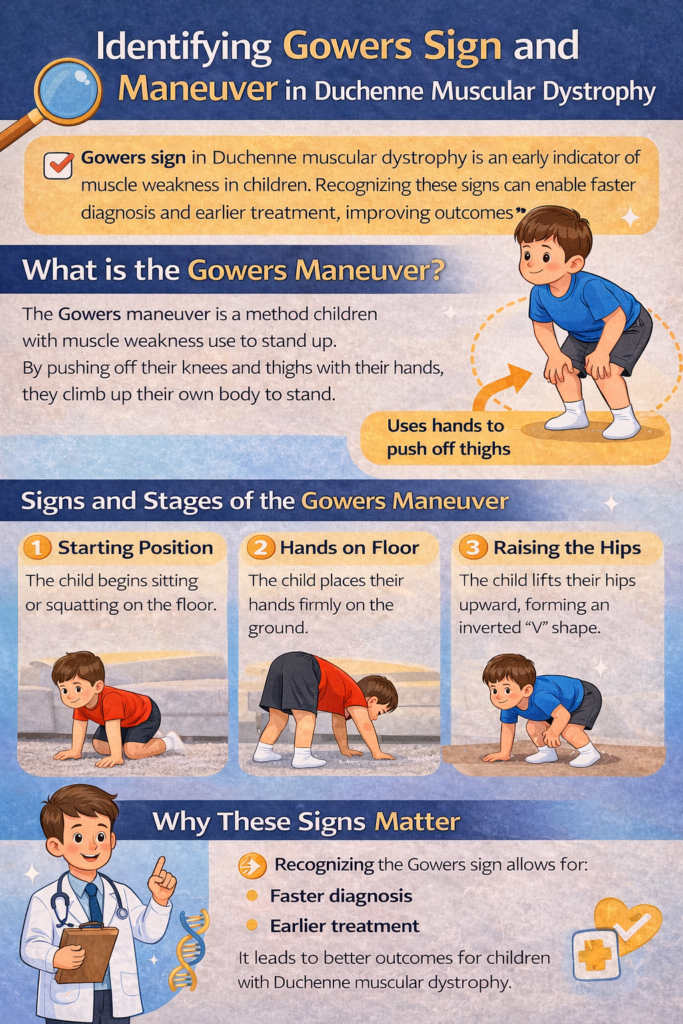
The Gowers sign refers to a specific movement pattern in which a child uses their hands and arms to “climb up” their own body from a squatting or sitting position to stand upright. This compensatory strategy occurs due to weakness in the proximal muscles, particularly those of the hips and thighs. Learn More: Early Signs of Duchenne Muscular Dystrophy
Historical Background
The sign is named after Sir William Richard Gowers, a 19th-century neurologist who first described this phenomenon in children with muscular dystrophies.
Why It Happens
In DMD, mutations in the dystrophin gene lead to:
- Progressive muscle fiber degeneration
- Replacement of muscle tissue with fat and fibrotic tissue
- Weakness beginning in proximal muscle groups
As a result, children cannot generate enough power (force) in their quadriceps and hip extensors to stand normally.
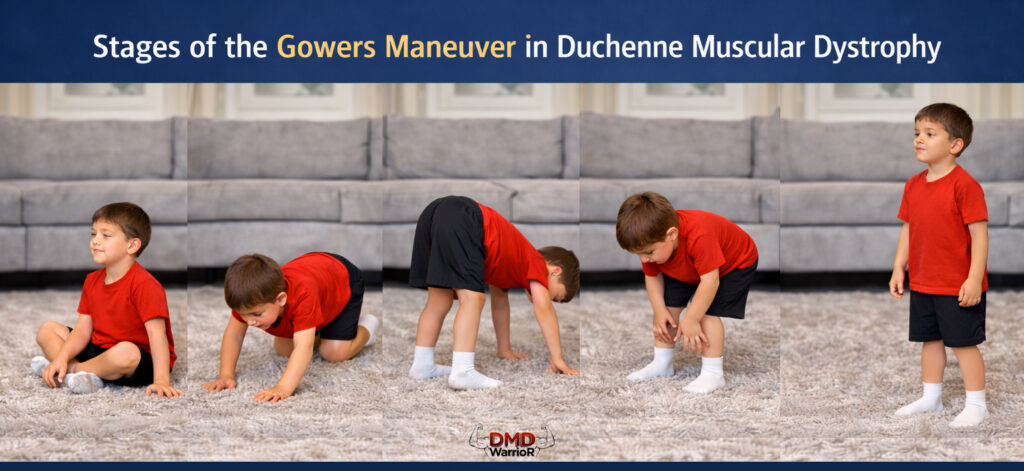
What Is the Gowers Maneuver in Duchenne Muscular Dystrophy?
Step-by-Step Breakdown of the Gowers Maneuver
The Gowers maneuver in Duchenne muscular dystrophy is a sequential movement pattern:
Stage 1: Sitting or Squatting Position
The child starts on the floor, often in a seated or squatting posture.
Stage 2: Hands on Floor
They place their hands on the ground to stabilize their body.
Stage 3: Raising the Hips
The child lifts their hips upward, forming an inverted “V” shape.
Stage 4: Hands to Knees
Hands move from the floor to the knees.
Stage 5: Climbing the Thighs
The child “walks” their hands up their thighs.
Stage 6: Standing Upright
Eventually, they achieve a standing position using upper body assistance.
Clinical Importance of Gowers Sign in Duchenne Muscular Dystrophy
Early Diagnostic Marker
The Gowers sign is often one of the first observable clinical signs of DMD, typically appearing between ages 2–5.
Why Early Detection Matters
- Enables early genetic testing
- Allows timely initiation of corticosteroid therapy
- Improves long-term prognosis
- Facilitates early physiotherapy and supportive care
Indicator of Disease Progression
The severity and frequency of the Gowers maneuver correlate with disease progression:
- Mild: Occasional use of hands
- Moderate: Consistent use with noticeable delay
- Severe: Inability to stand without assistance
Pathophysiology Behind Gowers Sign
Role of Dystrophin Deficiency
Dystrophin is essential for maintaining muscle cell integrity. Its absence leads to:
- Membrane instability
- Muscle fiber damage
- Chronic inflammation
- Progressive muscle weakness
Affected Muscle Groups
The Gowers maneuver primarily reflects weakness in:
- Gluteus maximus
- Quadriceps femoris
- Hip flexors and extensors
Biomechanical Compensation
Children compensate by:
- Shifting weight to upper limbs
- Using arms as leverage
- Reducing reliance on weakened lower extremities
Differential Diagnosis: Conditions with Positive Gowers Sign
Although strongly associated with DMD, the Gowers sign may also appear in other neuromuscular conditions:
1. Becker Muscular Dystrophy
- Milder, later onset
- Slower progression
2. Limb-Girdle Muscular Dystrophy
- Affects shoulder and pelvic muscles
3. Spinal Muscular Atrophy (SMA)
- Motor neuron disorder
4. Congenital Myopathies
- Structural muscle abnormalities
How Is Gowers Sign Assessed Clinically?
Physical Examination
Clinicians observe:
- Ability to rise from floor
- Time taken to stand
- Use of hands for support
Functional Tests
Timed Gowers Test
Measures how long it takes a child to stand from the floor.
North Star Ambulatory Assessment (NSAA)
A standardized scale for motor function in DMD. Read More: NSAA
Gowers Sign vs Normal Development
Normal Toddler Behavior
Young children may briefly use hands when learning to stand, but:
- This disappears quickly with development
- Movements become smoother and independent
Red Flags for DMD
- Persistent use beyond age 3
- Frequent falls
- Delayed walking
- Toe walking
Associated Symptoms in Duchenne Muscular Dystrophy
Motor Symptoms
- Difficulty running and jumping
- Frequent falls
- Waddling gait
Musculoskeletal Changes
- Calf pseudohypertrophy
- Contractures
- Scoliosis
Systemic Involvement
Diagnostic Workup After Observing Gowers Sign
1. Creatine Kinase (CK) Levels
Markedly elevated in DMD patients.
2. Genetic Testing
Confirms mutations in the dystrophin gene.
3. Muscle Biopsy
Shows absence of dystrophin protein.
4. Imaging and Functional Tests
- MRI for muscle degeneration
- Pulmonary function tests
Management Strategies Following Diagnosis
Pharmacological Treatments
- Corticosteroids (e.g., prednisone, deflazacort)
- Exon-skipping therapies
- Gene therapies (emerging)
Rehabilitation
- Physiotherapy
- Occupational therapy
- Assistive devices
Multidisciplinary Care
- Cardiology
- Pulmonology
- Orthopedics
Learn More: Multidisciplinary Team in DMD
Prognostic Value of Gowers Maneuver
Tracking Functional Decline
Increased reliance on the maneuver often indicates:
- Loss of muscle strength
- Transition toward loss of ambulation
Predicting Disease Milestones
- Loss of independent walking (typically by early teens)
- Need for wheelchair support
Parent and Caregiver Guidance
When to Seek Medical Advice
Parents should consult a specialist if:
- Child frequently uses hands to stand
- Motor milestones are delayed
- There is a family history of muscular dystrophy
Home Observations
Encourage parents to monitor:
- Changes in mobility
- Fatigue levels
- Ability to climb stairs
Research and Advances in Understanding Gowers Sign
Digital Biomarkers
Wearable technology and AI-based gait analysis are being explored to quantify:
- Movement patterns
- Disease progression
Clinical Trials
Ongoing trials aim to:
- Improve muscle strength
- Slow disease progression
- Restore dystrophin expression
FAQ: Gowers Sign in Duchenne Muscular Dystrophy
What is Gowers sign in simple terms?
Gowers sign is when a child uses their hands to push on their legs to stand up from the floor. This happens because the muscles in the hips and thighs are weak. It is one of the earliest and most recognizable signs of Duchenne muscular dystrophy and often appears before a formal diagnosis is made.
What causes Gowers sign?
Gowers sign is caused by weakness in the proximal muscles, especially the hip extensors and thigh muscles. In Duchenne muscular dystrophy, this weakness occurs due to the absence of dystrophin, a protein that protects muscle fibers. Without dystrophin, muscles gradually weaken and cannot support normal movements like standing up.
What is the Gowers maneuver step by step?
The Gowers maneuver follows a predictable sequence:
• The child sits or lies on the floor
• Places hands on the ground
• Lifts the hips upward
• Moves hands onto the knees
• “Climbs” up the thighs with the hands
• Reaches a standing position
This sequence reflects a compensatory strategy to overcome muscle weakness.
At what age should Gowers sign be a concern?
Gowers sign becomes concerning if it persists after age 3. While younger toddlers may briefly use their hands when learning to stand, continued use beyond this age suggests abnormal muscle weakness and should prompt medical evaluation.
Is Gowers sign painful for children?
Gowers sign itself is not painful. However, it reflects underlying muscle damage and weakness, which may lead to fatigue, discomfort, or cramps over time. The main issue is not pain but the progressive loss of muscle strength and function.
Can Gowers sign be the first symptom of DMD?
Yes, Gowers sign is often one of the earliest noticeable symptoms of Duchenne muscular dystrophy. Parents may observe it before other signs such as frequent falls or difficulty climbing stairs. Early recognition plays a key role in achieving a timely diagnosis.
How is Gowers sign different from normal development?
In normal development, toddlers may briefly use their hands to stand, but this behavior disappears quickly as strength improves. In contrast, Gowers sign is persistent, more pronounced, and often accompanied by other symptoms like a waddling gait and delayed motor milestones.
What should parents do if they notice Gowers sign?
Parents should consult a pediatrician or pediatric neurologist as soon as possible. The doctor may recommend blood tests (such as creatine kinase), genetic testing, and further evaluations. Early action allows for earlier treatment and better management of the condition.
Can therapy reduce the severity of Gowers maneuver?
Yes, physical therapy, corticosteroid treatment, and supportive care can help maintain muscle strength and slow disease progression. While the maneuver may not completely disappear, early and consistent treatment can make it less pronounced and delay functional decline.
Does Gowers sign mean the child will lose the ability to walk soon?
Not immediately. Gowers sign indicates early muscle weakness, but progression varies among individuals. With modern treatments and proper care, many children maintain walking ability longer than in the past. Regular monitoring helps predict and manage disease progression effectively.
Learn More: Pathomechanics of Gowers’ Sign
Final Thoughts
The Gowers signs and the Gowers maneuver in Duchenne muscular dystrophy remain foundational clinical indicators for early detection and disease monitoring. Their presence reflects deeper pathophysiological processes involving dystrophin deficiency and progressive muscle degeneration. Recognizing these signs early enables timely intervention, improved care coordination, and better long-term outcomes for patients. For clinicians, caregivers, and researchers alike, understanding and monitoring the Gowers maneuver is essential in the broader management strategy of Duchenne muscular dystrophy.
Academic Sources and References
- Bushby K, et al. Diagnosis and management of Duchenne muscular dystrophy. Lancet Neurology, 2010.
- Birnkrant DJ, et al. DMD Care Considerations. Lancet Neurology, 2018.
- Mercuri E, Muntoni F. Muscular dystrophies. Lancet, 2013.
- Hoffman EP, et al. Dystrophin: the protein product of the Duchenne gene. Cell, 1987.
- McDonald CM, et al. Clinical outcome measures in DMD. Muscle & Nerve, 2013.