

Signs of Duchenne muscular dystrophy (DMD) are often subtle in early childhood but progressively become more apparent as muscle weakness worsens. Recognizing the early symptoms of Duchenne muscular dystrophy is critical for timely diagnosis, intervention, and access to emerging therapies.
This article provides a comprehensive, evidence-based overview of DMD signs, progression patterns, and clinical red flags that families and clinicians should not overlook.
Table of Contents
What Is Duchenne Muscular Dystrophy?
Duchenne muscular dystrophy (DMD) is a genetic X-linked recessive neuromuscular disorder caused by mutations in the DMD gene, which encodes dystrophin—a protein essential for muscle fiber stability. The absence of dystrophin leads to progressive muscle degeneration and weakness. Read More: What is Duchenne?
- Primarily affects boys (≈1 in 3,500–5,000 male births)
- Symptoms typically appear between ages 2–5
- Progressive and ultimately life-limiting without intervention
Early Signs of Duchenne Muscular Dystrophy (Ages 0–5)
Developmental Delays
One of the earliest signs of Duchenne muscular dystrophy is delayed developmental milestones.
Key Indicators:
- Late walking (after 18 months)
- Delayed speech development
- Difficulty running or climbing stairs
Studies suggest that language delay may precede motor symptoms, indicating central nervous system involvement. (Pane et al., 2013)
Muscle Weakness in the Lower Limbs
DMD typically begins with proximal muscle weakness, especially in the hips and thighs.
Clinical Signs:
- Frequent falls
- Waddling gait
- Difficulty standing from sitting
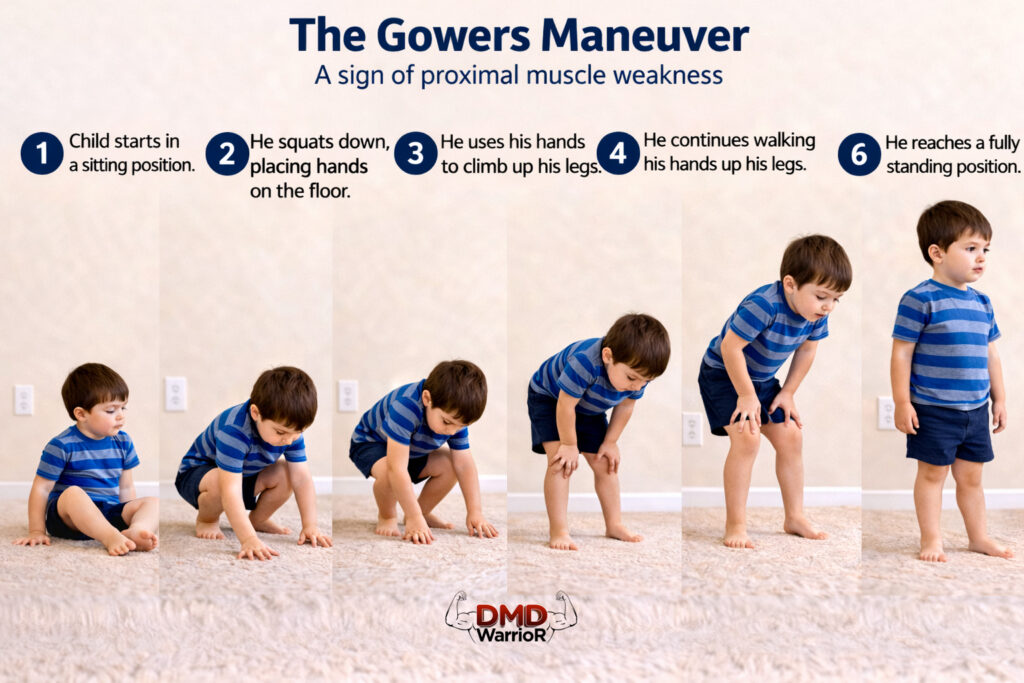
Gowers Manoeuvre
A hallmark early clinical sign.
Description:
Children use their hands to “climb up” their thighs to stand due to weak hip and thigh muscles.
This is considered a highly specific early diagnostic indicator.
Enlarged Calf Muscles (Pseudohypertrophy)
Despite muscle weakness, calves may appear enlarged due to fat and connective tissue replacement.
Progressive Signs (Ages 5–12)
As DMD progresses, muscle degeneration accelerates.
Loss of Ambulation
- Most children lose the ability to walk by age 10–12 without treatment
- Increased reliance on wheelchairs
Contractures and Joint Stiffness
Muscle shortening leads to:
- Tight Achilles tendons
- Reduced range of motion
- Postural abnormalities
Scoliosis
Spinal curvature develops as trunk muscles weaken.
Fatigue and Exercise Intolerance
Children tire quickly even with mild physical activity.
Advanced Signs (Adolescence and Beyond)
Respiratory Muscle Weakness
- Reduced lung capacity
- Sleep-disordered breathing
- Risk of respiratory infections
Learn More: Maintaining for Lung Muscles in Duchenne
Cardiomyopathy
Dystrophin deficiency also affects cardiac muscle.
Symptoms:
- Irregular heartbeat
- Heart failure in later stages
According to McNally & Mestroni (2017), cardiac complications are a leading cause of mortality in DMD.1
Read More: Heart Health in Duchenne Muscular Dystrophy
Upper Limb Weakness
- Difficulty lifting arms
- Loss of independence in daily tasks
Cognitive and Behavioral Signs of Duchenne Muscular Dystrophy
DMD is not solely a muscle disorder.
Learning Disabilities
- Dyslexia
- Dyscalculia
- Attention deficits
Learn More: Learning Disabilities in Duchenne
Neurobehavioral Issues
Research shows dystrophin isoforms are expressed in the brain, explaining these features (Ricotti et al., 2016).2
Red Flags That Should Prompt Immediate Testing
Parents and clinicians should seek evaluation if the following are observed:
- Persistent toe walking
- Frequent falls and clumsiness
- Delayed motor milestones
- Elevated creatine kinase (CK) levels
- Family history of muscular dystrophy
Diagnostic Pathway
Step 1: Blood Test (Creatine Kinase)
CK levels are often 10–100 times higher than normal.
Discover More: What is Creatine Kinase (CK)?
Step 2: Genetic Testing
Confirms mutations in the DMD gene.
Discover More: Genetic Testing in DMD
Step 3: Muscle Biopsy (if needed)
Used when genetic testing is inconclusive.
Differential Diagnosis
Conditions that may mimic early DMD signs:
- Becker muscular dystrophy
- Limb-girdle muscular dystrophy
- Cerebral palsy
- Spinal muscular atrophy
Why Early Recognition of Signs Matters
Early identification allows:
- Timely corticosteroid therapy
- Access to gene therapies and clinical trials
- Multidisciplinary care (cardiac, respiratory, physiotherapy)
- Improved quality of life and survival
Evidence-Based Clinical Insights
Study 1: Early Diagnosis Impact
Bushby et al. (2010) emphasize that early intervention improves functional outcomes and delays disease progression.3
Study 2: Cognitive Profile
Pane et al. (2012) found up to 30% of boys with DMD have cognitive impairment.4
Study 3: Cardiac Involvement
Nigro et al. (1990) demonstrated early onset of cardiomyopathy even before symptoms appear.5
Long-Term Disease Progression Timeline
| Age Range | Typical Signs |
|---|---|
| 0–3 | Delayed milestones |
| 3–6 | Gowers manoeuvre, frequent falls |
| 6–10 | Loss of running ability |
| 10–12 | Loss of ambulation |
| 13+ | Cardiac and respiratory decline |
Frequently Overlooked Early Signs
- Speech delay mistaken for autism only
- Mild clumsiness attributed to normal variation
- Behavioral issues misdiagnosed as ADHD without neurological evaluation
Clinical Monitoring Recommendations
Patients diagnosed with DMD should undergo:
- Cardiac evaluation every 6–12 months
- Pulmonary function tests annually
- Orthopedic assessments
- Neuropsychological evaluation
Emerging Biomarkers and Early Detection Research
Recent advances include:
- Newborn screening programs using CK levels
- MRI-based muscle imaging
- Genetic carrier screening
According to recent publications, earlier detection may soon be possible at birth, transforming disease outcomes.
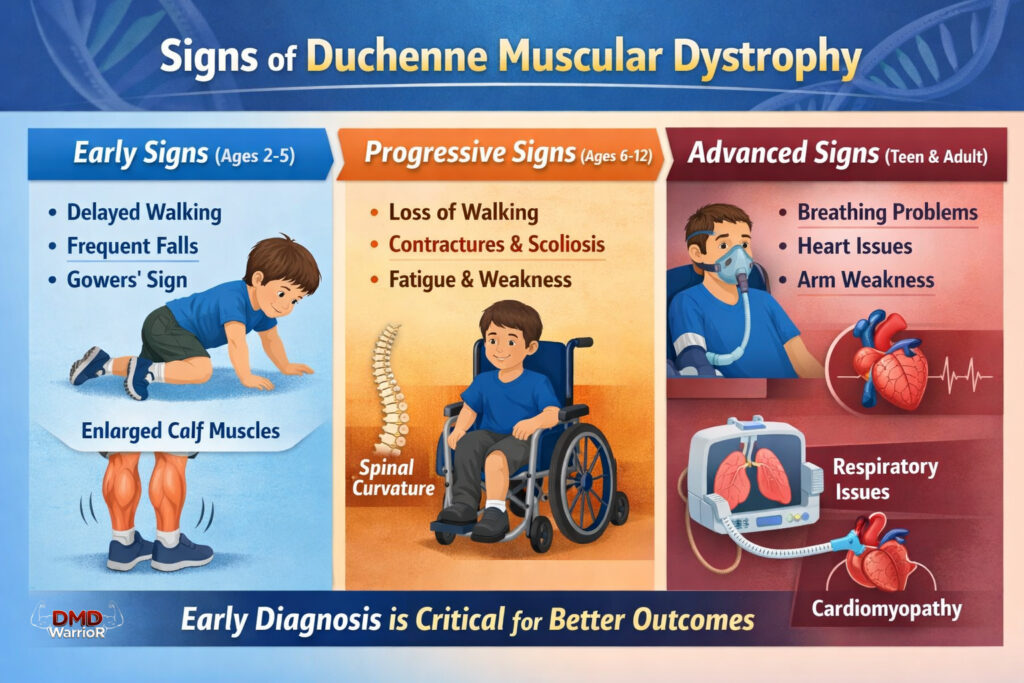
FAQ: Signs of Duchenne Muscular Dystrophy
What are the first signs of Duchenne muscular dystrophy?
The first signs of Duchenne muscular dystrophy (DMD) typically appear between ages 2 and 5 and often involve delayed motor development. Common early symptoms include late walking, difficulty running, frequent falls, and trouble climbing stairs. A key early indicator is Gowers’ sign, where a child uses their hands to push up from the floor due to weak hip muscles. Some children may also show speech delays or learning difficulties before obvious muscle weakness. Early recognition is critical because prompt diagnosis allows earlier intervention, which can slow disease progression and improve long-term outcomes.
At what age do DMD symptoms usually begin?
DMD symptoms usually begin in early childhood, most often between 2 and 3 years of age. However, subtle signs such as delayed speech or mild motor delays can appear even earlier. Parents may initially notice that their child is slower than peers in reaching developmental milestones. Because early symptoms can be mild or nonspecific, diagnosis is often delayed until more noticeable muscle weakness develops. Early screening, especially in children with a family history, can significantly reduce diagnostic delays.
How can I tell if my child’s walking is abnormal?
Abnormal walking in DMD often presents as a waddling gait, frequent tripping, or walking on toes. Children may struggle to keep up with peers, have difficulty running, or avoid physical activities. Another sign is instability when standing or needing support to rise from the floor. If a child consistently shows these patterns beyond typical developmental variation, it is advisable to consult a pediatric neurologist. Early evaluation can help distinguish DMD from benign motor delays or other neuromuscular conditions.
What is Gowers Manoeuvre and why is it important?
Gowers manoeuvre is a classic clinical feature of Duchenne muscular dystrophy. It occurs when a child uses their hands and arms to “climb up” their thighs to stand from a sitting or lying position. This compensatory movement happens because of weakness in the hip and thigh muscles. Gowers manoeuvre is significant because it is highly suggestive of proximal muscle weakness, a hallmark of DMD. Its presence should prompt immediate medical evaluation and diagnostic testing.
Why do calf muscles look bigger in DMD?
In Duchenne muscular dystrophy, the calf muscles often appear enlarged due to a process called pseudohypertrophy. Instead of true muscle growth, the muscle tissue is gradually replaced by fat and fibrotic tissue. This gives the calves a bulky appearance despite underlying weakness. Pseudohypertrophy is a distinguishing physical sign and can help clinicians differentiate DMD from other neuromuscular disorders. It usually becomes noticeable in early childhood.
Are cognitive or behavioral problems part of DMD?
Yes, cognitive and behavioral issues are relatively common in children with DMD. These may include learning disabilities such as dyslexia, attention difficulties, and conditions like ADHD or autism spectrum traits. The reason is that dystrophin, the protein missing in DMD, is also expressed in the brain. As a result, some children experience challenges in memory, language processing, and executive function. Early neuropsychological assessment can help identify these issues and guide appropriate educational support.
How fast do DMD symptoms progress?
DMD is a progressive condition, meaning symptoms worsen over time. Muscle weakness typically starts in the lower limbs and gradually spreads to the upper body, heart, and respiratory muscles. Most children lose the ability to walk between 10 and 12 years of age without treatment. However, with modern therapies such as corticosteroids and gene-based treatments, progression can be slowed. Regular monitoring and multidisciplinary care are essential to managing disease progression effectively.
When should I see a doctor about possible DMD signs?
You should consult a doctor if your child shows persistent motor delays, frequent falls, difficulty standing up, or abnormal walking patterns. Additional warning signs include speech delay, fatigue, and a family history of muscular dystrophy. A simple blood test measuring creatine kinase (CK) levels can provide an early indication of muscle damage. Early medical evaluation is crucial because it enables faster diagnosis, access to treatment, and better long-term care planning.
Can Duchenne muscular dystrophy be diagnosed early?
Yes, DMD can be diagnosed early, often before significant symptoms develop. Elevated creatine kinase (CK) levels in a blood test are usually the first clue. This is followed by genetic testing, which confirms mutations in the DMD gene. In some regions, newborn screening programs are being introduced to detect DMD even before symptoms appear. Early diagnosis allows families to begin treatment sooner and consider participation in clinical trials.
Why is early detection of DMD so important?
Early detection of Duchenne muscular dystrophy is essential because it directly impacts treatment outcomes and quality of life. Starting therapies such as corticosteroids early can help preserve muscle strength and delay complications. It also allows timely cardiac and respiratory monitoring, which are critical for preventing life-threatening issues. Additionally, early diagnosis gives families access to genetic counseling, support services, and emerging therapies. Overall, recognizing DMD early leads to better disease management and improved long-term prognosis.
Find out more: Does My Child Have Duchenne Muscular Dystrophy (DMD)?
Final Thoughts
Recognizing the signs of Duchenne muscular dystrophy early can change the course of care and outcomes. Subtle symptoms like delayed milestones or frequent falls should never be overlooked. Early diagnosis enables timely treatment and access to evolving therapies. Multidisciplinary care plays a crucial role in managing progression. Cardiac and respiratory monitoring are essential for long-term health. Cognitive and behavioral support should be integrated into care plans. Families benefit from education, guidance, and early intervention strategies. Advances in research continue to improve prognosis and quality of life. Awareness remains the first step toward action. Early recognition truly makes a lasting difference.
Sources and Academic References
- Dilated Cardiomyopathy: Genetic Determinants and Mechanisms ↩︎
- Neurodevelopmental, emotional, and behavioural problems in Duchenne muscular dystrophy in relation to underlying dystrophin gene mutations ↩︎
- Diagnosis and management of Duchenne muscular dystrophy, part 1: diagnosis, and pharmacological and psychosocial management ↩︎
- Attention Deficit Hyperactivity Disorder and Cognitive Function in Duchenne Muscular Dystrophy: Phenotype-Genotype Correlation ↩︎
- The incidence and evolution of cardiomyopathy in Duchenne muscular dystrophy ↩︎