
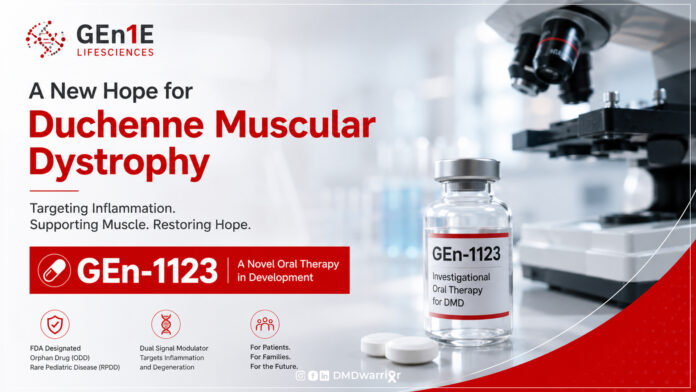
The U.S. Food and Drug Administration (FDA) has granted both Orphan Drug Designation (ODD) and Rare Pediatric Disease Designation (RPDD) to GEn-1123, an investigational Duchenne Muscular Dystrophy (DMD) therapy being developed by GEn1E Lifesciences, a Phase 2 clinical-stage biotechnology company specializing in AI-driven precision medicine.
Table of Contents
What Is GEn1E Lifesciences?
GEn1E Lifesciences is a biotechnology company based in Palo Alto, California, focused on developing precision medicines for inflammatory, immune-mediated, and rare diseases. The company combines artificial intelligence (AI), biomarker analysis, multi-omics data, and patient-specific disease profiling to identify new treatment opportunities.
Its proprietary GRID Platform is designed to analyze complex biological data and help researchers develop targeted therapies that address the underlying mechanisms of disease rather than only managing symptoms.
Understanding Duchenne Muscular Dystrophy (DMD)
What Is DMD?
Duchenne Muscular Dystrophy (DMD) is a rare genetic disorder caused by mutations in the dystrophin gene. Without functional dystrophin protein, muscles become progressively damaged and weakened over time. Read More: What is Duchenne?
DMD affects skeletal muscles, the heart, and respiratory muscles, leading to increasing disability and serious health complications.
Why Does DMD Progress?
The progression of DMD is not caused solely by the lack of dystrophin. Several biological processes contribute to ongoing muscle damage, including:
- Chronic inflammation
- Immune-cell infiltration
- Muscle fiber death
- Impaired muscle regeneration
- Fibrosis (scar tissue formation)
Together, these mechanisms accelerate muscle deterioration and functional decline.
What Is GEn-1123?
A Novel Oral Precision Therapy
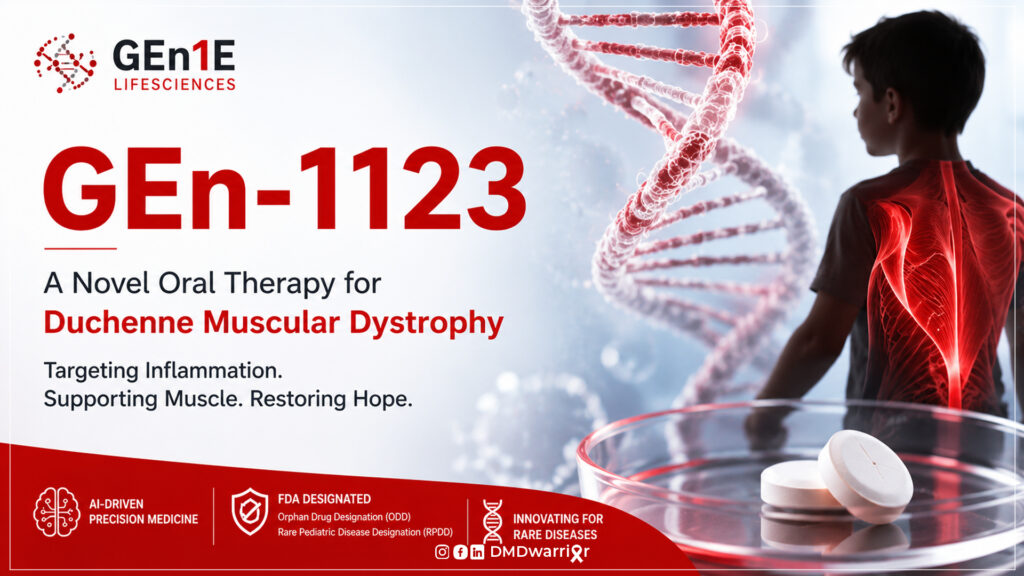
GEn-1123 is an investigational oral small-molecule therapy being developed by GEn1E Lifesciences for Duchenne Muscular Dystrophy.
Unlike therapies that focus directly on restoring dystrophin production, GEn-1123 aims to address key biological processes that drive disease progression.
The treatment is currently under development and has received both FDA Orphan Drug Designation and Rare Pediatric Disease Designation.
How Does GEn-1123 Work?
Targeting Inflammation and Muscle Degeneration
GEn-1123 is described as a “dual signal modulator.”
Its goal is to help rebalance abnormal inflammatory signaling pathways that contribute to muscle damage in DMD.
The therapy is designed to:
Reduce Harmful Inflammation
DMD muscles are characterized by excessive inflammatory activity. Persistent inflammation contributes to muscle breakdown and tissue damage.
GEn-1123 aims to modulate pro-inflammatory pathways that may worsen disease progression.
Promote Muscle Survival
The treatment is also designed to support pro-survival biological pathways that may help protect muscle cells from ongoing damage.
Support Regenerative Processes
Muscles affected by DMD have limited ability to repair themselves over time.
GEn-1123 seeks to promote regenerative mechanisms that may improve the body’s natural repair response.
Potentially Reduce Fibrosis
Fibrosis replaces healthy muscle tissue with scar tissue, reducing muscle function.
By targeting pathways involved in degeneration and inflammation, GEn-1123 may help limit fibrosis-related progression.
Why Is GEn-1123 Different?
Mutation-Independent Potential
Many current DMD therapies target specific genetic mutations.
GEn-1123 focuses on inflammatory and degenerative processes that are common across many DMD patients, potentially making it relevant regardless of a patient’s mutation type.
This approach could potentially broaden the number of patients who may benefit if future clinical studies confirm safety and efficacy.
Oral Administration
Another distinguishing feature is that GEn-1123 is being developed as an oral therapy.
Oral treatments may offer practical advantages for patients and families compared with therapies that require intravenous administration.
FDA Recognition: Why It Matters
Orphan Drug Designation (ODD)
The U.S. Food and Drug Administration (FDA) grants Orphan Drug Designation to therapies intended to treat rare diseases affecting fewer than 200,000 people in the United States.
Benefits may include:
- Development incentives
- Potential tax credits
- Reduced regulatory fees
- Up to seven years of market exclusivity after approval
Rare Pediatric Disease Designation (RPDD)
The FDA also granted GEn-1123 Rare Pediatric Disease Designation.
This designation is reserved for serious diseases that primarily affect children.
If the therapy ultimately receives regulatory approval and meets FDA requirements, GEn1E may become eligible for a Priority Review Voucher (PRV), which can help accelerate future drug development programs.
Current Development Status
Is GEn-1123 Approved?
No.
GEn-1123 remains an investigational therapy and has not yet been approved by the FDA or other regulatory agencies for the treatment of Duchenne Muscular Dystrophy.
Additional clinical studies will be needed to determine:
- Safety
- Effectiveness
- Optimal dosing
- Long-term benefits and risks
What Could GEn-1123 Mean for the DMD Community?
DMD remains a progressive disease with significant unmet medical needs.
While gene therapies and exon-skipping treatments have expanded therapeutic options for some patients, many individuals continue to experience disease progression.
GEn-1123 represents a different therapeutic strategy by targeting inflammation, degeneration, and impaired regeneration—biological processes that contribute to muscle loss throughout the course of the disease.
If future clinical trials demonstrate positive outcomes, GEn-1123 could potentially become an important addition to the evolving DMD treatment landscape.
Key Takeaways
- GEn1E Lifesciences is developing GEn-1123, an investigational oral therapy for Duchenne Muscular Dystrophy.
- GEn-1123 is designed to modulate harmful inflammation while promoting muscle survival and regeneration.
- The therapy targets disease-driving biological pathways rather than dystrophin restoration.
- FDA has granted both Orphan Drug Designation and Rare Pediatric Disease Designation.
- GEn-1123 is still under clinical development and has not yet received regulatory approval.
- The treatment may have mutation-independent potential, making it relevant to a broad range of DMD patients.
Follow This Page >>> All Clinical Trials for Duchenne