

Enlarged calf muscles in Duchenne muscular dystrophy are one of the most recognizable early signs of this progressive genetic condition. Parents often notice enlarged calves in Duchenne muscular dystrophy, sometimes described as unusually firm or bulky legs, even before a formal diagnosis. While this may appear to indicate strength, it is actually a hallmark feature known as pseudohypertrophy, reflecting underlying muscle degeneration rather than true growth. Understanding why enlarged calf muscles in Duchenne muscular dystrophy occur—and what they mean clinically—is essential for early recognition, monitoring, and care planning.
Table of Contents
What Are Enlarged Calf Muscles in Duchenne Muscular Dystrophy?
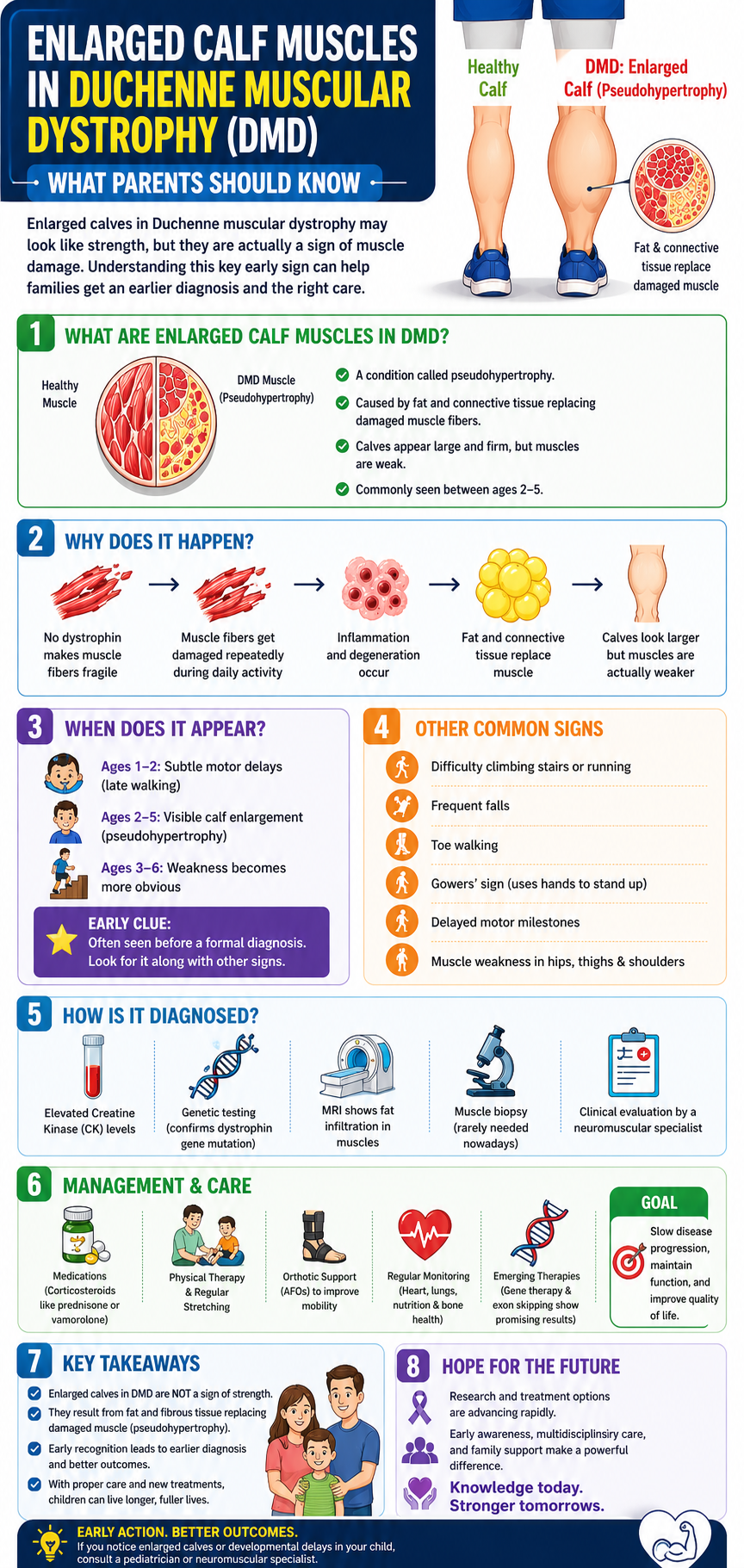
Enlarged calf muscles in Duchenne muscular dystrophy refer to an apparent increase in calf size caused by fat and connective tissue replacing damaged muscle fibers. This phenomenon is medically termed calf pseudohypertrophy.
In healthy individuals, muscle enlargement (hypertrophy) occurs due to increased muscle fiber size from exercise or growth. However, in Duchenne muscular dystrophy, the absence of the protein dystrophin leads to progressive muscle fiber breakdown. The body attempts repair, but instead of regenerating functional muscle tissue, it accumulates fibrofatty tissue. Read More: Dystrophin Gene

Key Characteristics:
- Calves appear large, rounded, and firm
- Muscle strength is reduced despite size
- Often symmetrical in both legs
- Commonly observed between ages 2–5
Why Do Enlarged Calves Occur in Duchenne Muscular Dystrophy?
The mechanism behind enlarged calf muscles in Duchenne muscular dystrophy is rooted in dystrophin deficiency.
Pathophysiology Explained
Dystrophin is a structural protein that stabilizes muscle cell membranes. Without it:
- Muscle fibers become fragile
- Repeated damage occurs during normal movement
- Inflammation and degeneration follow
- Muscle tissue is replaced by fat and fibrotic tissue
This process leads to the characteristic “false enlargement” seen in enlarged calves in Duchenne muscular dystrophy.
Pseudohypertrophy vs True Muscle Growth
| Feature | True Hypertrophy | Pseudohypertrophy |
|---|---|---|
| Cause | Exercise / training | Muscle degeneration |
| Tissue type | Muscle fibers | Fat + connective tissue |
| Strength | Increased | Decreased |
| Seen in DMD | ❌ | ✅ |
This distinction is critical for both clinicians and families. Enlarged calf muscles in Duchenne muscular dystrophy can be misleading without proper evaluation.
When Do Enlarged Calf Muscles Appear?
Enlarged calves in Duchenne muscular dystrophy typically appear early in childhood, often before diagnosis.
Timeline
- Ages 1–2: Subtle motor delays (late walking)
- Ages 2–5: Visible calf enlargement begins
- Ages 3–6: Weakness becomes more evident
Because enlarged calf muscles in Duchenne muscular dystrophy may be one of the first visible signs, they play an important role in early detection.
Clinical Signs Associated with Enlarged Calves
Enlarged calf muscles in Duchenne muscular dystrophy rarely occur in isolation. They are usually accompanied by other hallmark symptoms:
Common Associated Features
- Difficulty climbing stairs
- Frequent falls
- Toe walking
- Gowers’ sign (using hands to stand up)
- Delayed motor milestones
Gowers’ Sign
A classic diagnostic indicator where a child uses their hands to “walk up” their thighs to stand due to proximal muscle weakness.
Read More: Early Signs of Duchenne
Diagnostic Significance of Enlarged Calf Muscles
Enlarged calves in Duchenne muscular dystrophy are not just a cosmetic feature—they are diagnostically valuable.
Diagnostic Workup
- Creatine kinase (CK) levels – markedly elevated
- Genetic testing – confirms dystrophin gene mutation
- Muscle biopsy (less common now)
- MRI imaging – shows fat infiltration
Clinical Insight
Studies indicate that calf pseudohypertrophy is present in up to 90% of boys with DMD (Bushby et al., Lancet Neurology, 2010).
Do Enlarged Calves Mean Stronger Muscles?
No. This is one of the most common misconceptions.
Despite their size, enlarged calf muscles in Duchenne muscular dystrophy:
- Are functionally weak
- Contribute to mobility limitations
- May mask the severity of disease progression early on
This paradox—large but weak muscles—is central to understanding DMD pathology.
Impact on Mobility and Function
As the disease progresses, enlarged calves in Duchenne muscular dystrophy can:
- Alter gait mechanics
- Contribute to toe walking
- Increase risk of contractures
- Reduce balance and coordination
Eventually, most patients lose ambulation in early adolescence without intervention.
Imaging Findings in Calf Muscles
Advanced imaging provides deeper insights into enlarged calf muscles in Duchenne muscular dystrophy.
MRI Findings
- Increased fat signal intensity
- Muscle volume may appear preserved or enlarged
- Progressive replacement pattern
A study by Mercuri et al. (Neuromuscular Disorders, 2002) demonstrated that MRI can detect early pseudohypertrophy before clinical symptoms become pronounced.
Histological Perspective
Under microscopic examination:
- Muscle fibers are degenerated
- Fat cells infiltrate muscle tissue
- Fibrosis is prominent
These findings explain why enlarged calves in Duchenne muscular dystrophy do not translate into functional strength.
Differential Diagnosis
Not all enlarged calves indicate Duchenne muscular dystrophy. Differential diagnoses include:
- Becker muscular dystrophy
- Limb-girdle muscular dystrophy
- Pompe disease
- Athletic hypertrophy
However, the combination of weakness + pseudohypertrophy + elevated CK strongly points toward DMD.
Management and Monitoring
While enlarged calf muscles in Duchenne muscular dystrophy cannot be reversed, their progression can be managed.
Therapeutic Approaches
- Corticosteroids (e.g., prednisone, vamorolone)
- Physical therapy
- Orthotic support
- Gene therapy (emerging)
Monitoring Strategies
- Regular functional assessments
- Imaging follow-ups
- CK level tracking
How should massage be performed for enlarged calves?
Massage can support comfort in people with enlarged calves, but it does not reduce calf size in conditions like Duchenne muscular dystrophy. In DMD, the enlargement (pseudohypertrophy) comes from fat and fibrotic tissue replacing muscle, so massage cannot reverse it. That said, gentle massage may improve circulation, ease tightness, and provide short-term relief from stiffness—useful as part of a broader physiotherapy plan.
How to perform calf massage safely:
- Position: Have the person lie face down or sit with the leg supported and relaxed.
- Warm-up strokes: Apply a small amount of lotion; use light, long strokes (effleurage) from the ankle toward the knee for 2–3 minutes.
- Gentle kneading: Use soft, rhythmic squeezing (petrissage) of the calf muscle—avoid deep pressure.
- Circular motions: With fingertips or thumbs, make small circles along the muscle belly, staying comfortable and pain-free.
- Duration: 5–10 minutes per calf, once daily or as advised by a therapist.
- Finish: End with light upward strokes to encourage circulation.

Precautions: Avoid deep tissue pressure, painful areas, or joints; stop if there’s discomfort, redness, or swelling. For DMD, follow guidance from a physiotherapist to prevent muscle damage and overexertion.
Role of Early Intervention
Early recognition of enlarged calves in Duchenne muscular dystrophy allows for:
- Earlier diagnosis
- Timely treatment initiation
- Slower disease progression
- Improved quality of life
According to World Health Organization, early intervention in genetic disorders significantly improves long-term outcomes.
Psychological and Social Considerations
The visible nature of enlarged calf muscles in Duchenne muscular dystrophy can impact:
- Body image
- Social interactions
- Family anxiety
Education is key to helping families understand that this is a clinical symptom, not a sign of strength.
Recent Research and Advances
Gene Therapy
Emerging therapies aim to restore dystrophin production, potentially altering the progression of pseudohypertrophy.
Exon Skipping
Targets specific mutations to produce partially functional dystrophin.
Try Now: DMD or BMD? Exon Check Tool
Prognostic Value of Calf Enlargement
While enlarged calf muscles in Duchenne muscular dystrophy are an early sign, their progression correlates with:
- Disease severity
- Muscle degeneration rate
- Functional decline
However, they are not a standalone prognostic marker.
FAQ: Enlarged Calf Muscles in DMD
Why are calf muscles enlarged in Duchenne muscular dystrophy?
Enlarged calf muscles in Duchenne muscular dystrophy occur due to a process called pseudohypertrophy. Instead of true muscle growth, damaged muscle fibers are gradually replaced by fat and connective tissue. This makes the calves look bigger and firmer, but they are actually weaker. The root cause is the lack of dystrophin, a protein essential for maintaining muscle integrity.
Are enlarged calves an early sign of Duchenne muscular dystrophy?
Yes, enlarged calves in Duchenne muscular dystrophy are often one of the earliest visible signs, typically appearing between ages 2 and 5. Parents may notice unusually bulky calves before significant weakness becomes obvious. However, this symptom usually appears alongside early motor delays, such as difficulty running, climbing stairs, or frequent falls.
Do bigger calf muscles mean stronger muscles in Duchenne muscular dystrophy?
No, enlarged calf muscles in Duchenne muscular dystrophy do not indicate strength. Despite their size, these muscles are weak because they contain fat and fibrotic tissue instead of functional muscle fibers. This is why children with visibly large calves may still struggle with basic physical activities.
How can you tell if calf enlargement is due to Duchenne muscular dystrophy?
Calf enlargement related to Duchenne muscular dystrophy is usually accompanied by other signs such as muscle weakness, Gowers’ sign, toe walking, and delayed motor milestones. A definitive diagnosis requires medical evaluation, including blood tests showing elevated creatine kinase (CK) levels and genetic testing to confirm mutations in the dystrophin gene.
Can enlarged calf muscles in Duchenne muscular dystrophy be treated or reversed?
Currently, enlarged calf muscles in Duchenne muscular dystrophy cannot be reversed because they result from permanent muscle damage and replacement by fat tissue. However, treatments such as corticosteroids, physical therapy, and emerging gene therapies can slow disease progression and help maintain muscle function for longer.
Do all children with Duchenne muscular dystrophy have enlarged calves?
Most children with Duchenne muscular dystrophy develop enlarged calves at some stage, but not all cases are identical. The degree of enlargement can vary depending on disease progression and individual differences. In some cases, calf pseudohypertrophy may be subtle or appear later.
What should parents do if they notice enlarged calves in their child?
If parents notice enlarged calves in Duchenne muscular dystrophy or suspect abnormal muscle development, they should seek medical evaluation promptly. Early diagnosis allows for timely intervention, genetic counseling, and access to treatments that can slow progression and improve quality of life. A pediatric neurologist or neuromuscular specialist is typically involved in the diagnostic process.
How should I massage enlarged calves?
Massage for enlarged calves should be performed gently, focusing on relaxation and circulation rather than deep pressure. Start with light, upward strokes from the ankle toward the knee using a small amount of oil to reduce friction. Continue with soft kneading and slow circular motions, avoiding any painful or stiff areas. In conditions like Duchenne muscular dystrophy, deep tissue massage is not recommended, as it may cause muscle damage. Sessions should last around 5–10 minutes per calf and be guided by a physiotherapist when possible.
Final Thoughts
Enlarged calf muscles in Duchenne muscular dystrophy are a key early sign. These enlarged calves in Duchenne muscular dystrophy reflect pseudohypertrophy, not strength. Early recognition supports timely diagnosis. It also enables earlier access to care and therapies. Understanding this symptom reduces confusion for families. Clinical monitoring helps track disease progression. Advances in treatment offer growing hope. Multidisciplinary care improves outcomes and quality of life. Awareness remains critical for earlier intervention. Informed decisions can make a meaningful difference.
Academic Sources and References
- Bushby, K., Finkel, R., Birnkrant, D. J., et al. (2010). Diagnosis and management of Duchenne muscular dystrophy, part 2: implementation of multidisciplinary care. The Lancet Neurology, 9(2), 177–189.
- Mendell, J. R., Sahenk, Z., Lehman, K., et al. (2020). Assessment of systemic delivery of rAAVrh74.MHCK7.micro-dystrophin in children with Duchenne muscular dystrophy. The New England Journal of Medicine, 383(24), 2261–2272.
- Mercuri, E., Pichiecchio, A., Allsop, J., et al. (2007). Muscle MRI in inherited neuromuscular disorders: past, present, and future. Journal of Magnetic Resonance Imaging, 25(2), 433–440.
- Hoffman, E. P., Brown, R. H., & Kunkel, L. M. (1987). Dystrophin: the protein product of the Duchenne muscular dystrophy locus. Cell, 51(6), 919–928.
- Ryder, S., Leadley, R. M., Armstrong, N., et al. (2017). The burden, epidemiology, costs and treatment for Duchenne muscular dystrophy: an evidence review. Orphanet Journal of Rare Diseases, 12(1), 79.
- McDonald, C. M., Henricson, E. K., Abresch, R. T., et al. (2013). The 6-minute walk test and other clinical endpoints in Duchenne muscular dystrophy. Muscle & Nerve, 48(3), 343–356.
- Emery, A. E. H. (2002). The muscular dystrophies. The Lancet, 359(9307), 687–695.
- Birnkrant, D. J., Bushby, K., Bann, C. M., et al. (2018). Diagnosis and management of Duchenne muscular dystrophy, part 1–3 update. The Lancet Neurology, 17(3–5), 251–267.
- Hollingsworth, K. G., de Sousa, P. L., Straub, V., & Carlier, P. G. (2012). Towards harmonization of quantitative MRI in muscle disease: a review of methods. Neuromuscular Disorders, 22(S2), S80–S85.
- Mendell, J. R., Rodino-Klapac, L. R., Sahenk, Z., et al. (2013). Eteplirsen for the treatment of Duchenne muscular dystrophy. Annals of Neurology, 74(5), 637–647.
- Allen, D. G., Whitehead, N. P., & Froehner, S. C. (2016). Absence of dystrophin disrupts skeletal muscle signaling. Physiological Reviews, 96(1), 253–305.
- Mah, J. K., Korngut, L., Fiest, K. M., et al. (2014). A systematic review and meta-analysis on the epidemiology of Duchenne muscular dystrophy. Neuromuscular Disorders, 24(6), 482–491.