
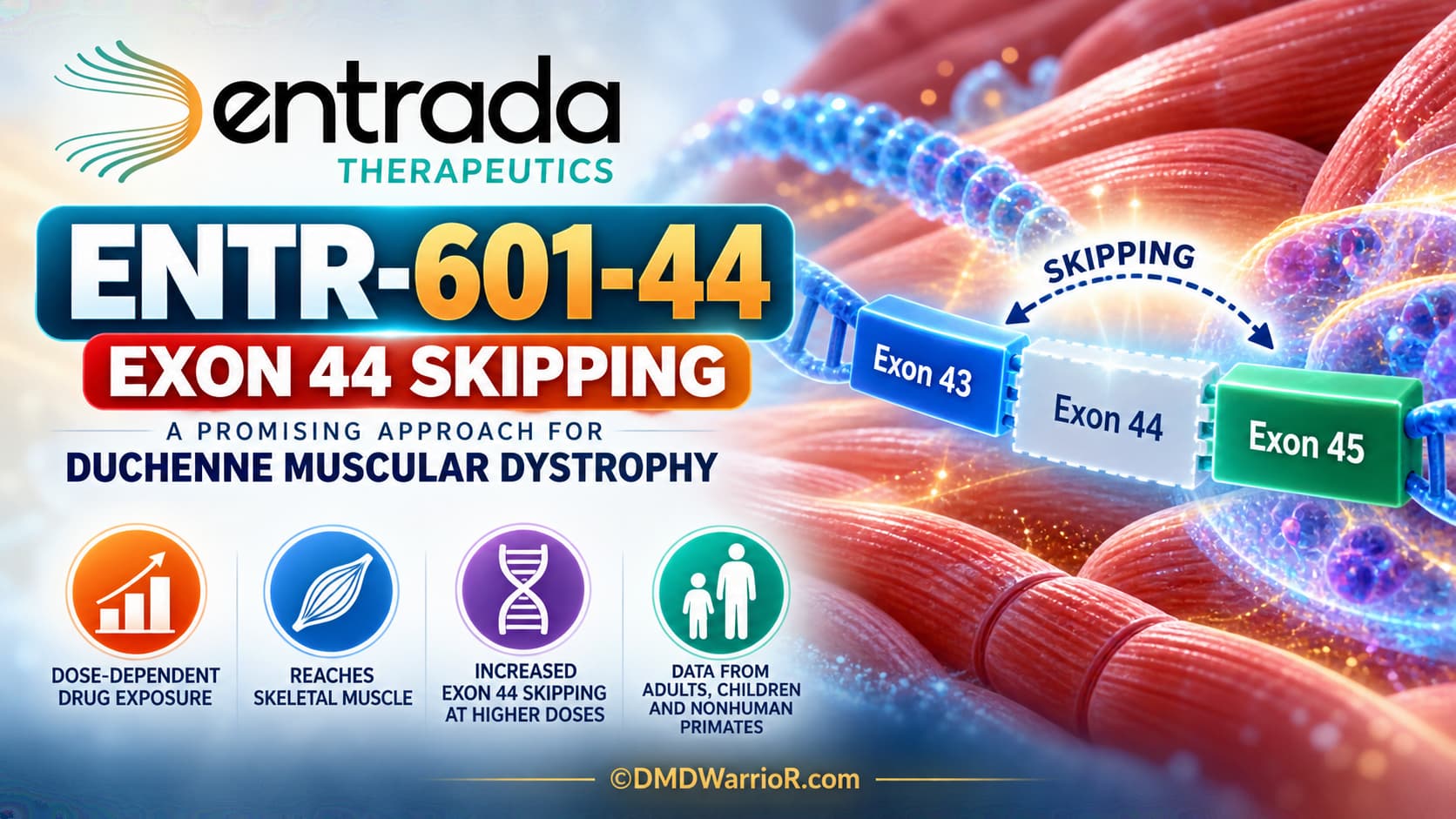
Entrada Therapeutics’ ENTR-601-44 is an investigational therapy designed for patients with Duchenne muscular dystrophy (DMD) whose mutations are amenable to exon 44 skipping. New data presented at the 31st Annual Congress of the World Muscle Society in Hiroshima, Japan, examined how ENTR-601-44 behaves in the body and how its exposure relates to exon 44 skipping.
What Is ENTR-601-44?
ENTR-601-44 is an Endosomal Escape Vehicle–phosphorodiamidate morpholino oligomer (EEV-PMO) conjugate. It is designed to improve delivery of a PMO into muscle cells and ultimately reach the nucleus, where it targets dystrophin pre-messenger RNA.
The treatment is intended to cause exon 44 skipping, with the goal of allowing production of a near-full-length and potentially functional dystrophin protein. Earlier nonclinical studies showed exon 44 skipping in patient-derived cells, increased dystrophin production in a DMD mouse model, and exon 44 skipping in nonhuman primates.
The WMS 2026 poster focused specifically on pharmacokinetic and pharmacodynamic data from nonhuman primates, healthy adult volunteers, and pediatric participants with exon 44 skipping-amenable DMD. Learn More: Mutations and Deletions Amenable to Exon 44 Skipping Therapies
ENTR-601-44 Exposure Increased With Dose
The data showed that plasma exposure to ENTR-601-44 increased as the dose increased in both nonhuman primates and healthy volunteers.
At comparable body-weight-adjusted doses, exposure in adult healthy volunteers appeared to be approximately two to three times higher than in adult nonhuman primates. Repeated dosing in participants with DMD did not show evidence of accumulation of ENTR-601-44 in plasma.
The drug itself was cleared relatively quickly from plasma, with a reported half-life of approximately 2–4 hours. However, the final PMO-containing metabolite remained in plasma much longer, with a half-life of more than 100 hours.
Differences Between Pediatric and Adult Participants
The poster also identified differences between pediatric participants with DMD and adult healthy volunteers after administration of a 6 mg/kg dose.
In pediatric participants, the maximum concentration of the drug in plasma was approximately 43 percent lower, while the area under the concentration-time curve, which reflects overall drug exposure over time, was approximately 58 percent lower than in adult healthy volunteers.
Similar differences between juvenile and adult animals were observed in nonhuman primate studies.
ENTR-601-44 Reached Skeletal Muscle
One of the key findings was the detection of the final PMO-containing metabolite in skeletal muscle.
Dose-dependent concentrations were observed in both healthy volunteers and nonhuman primates. At comparable doses, muscle exposure appeared to be approximately three times higher in healthy volunteers than in nonhuman primates.
Importantly, in participants with DMD, the final PMO-containing metabolite was still detectable in muscle tissue six weeks after the third dose.
The metabolite was also detected in urine in both healthy volunteers and nonhuman primates. At the 6 mg/kg dose, no clinically significant findings related to kidney function were reported in healthy volunteers or participants with DMD. Learn More: Upcoming Exon 44 Skipping Therapies for the Treatment of DMD
Higher Exposure May Produce Greater Exon Skipping
In juvenile nonhuman primates, exon 44 skipping increased with increasing ENTR-601-44 exposure. The increase was not linear, with a particularly pronounced effect observed at the highest dose tested.
Based on these findings, the researchers suggest that the higher exposures expected with doses of 12 mg/kg or more in later cohorts of the ongoing ELEVATE-44-201 study could potentially produce greater pharmacodynamic effects.
What the Data Show
The WMS 2026 poster provides early pharmacokinetic and pharmacodynamic evidence that ENTR-601-44 produces dose-dependent exposure, reaches skeletal muscle, and generates a PMO-containing metabolite that can remain in muscle for an extended period.
The data also show differences between pediatric and adult participants and suggest a stronger exon-skipping effect at higher exposures in juvenile nonhuman primates. The ongoing Phase 1/2b ELEVATE-44-201 study is evaluating ENTR-601-44 in people with exon 44 skipping-amenable DMD, including higher-dose cohorts.
Importantly, these results are early PK/PD findings. The poster does not provide evidence of clinical functional benefit or establish that ENTR-601-44 slows DMD progression. The poster reports that no serious adverse events or clinically relevant changes in kidney function have been observed to date in the described clinical studies.
Discover More: Duchenne Clinical Trial Locations Map