
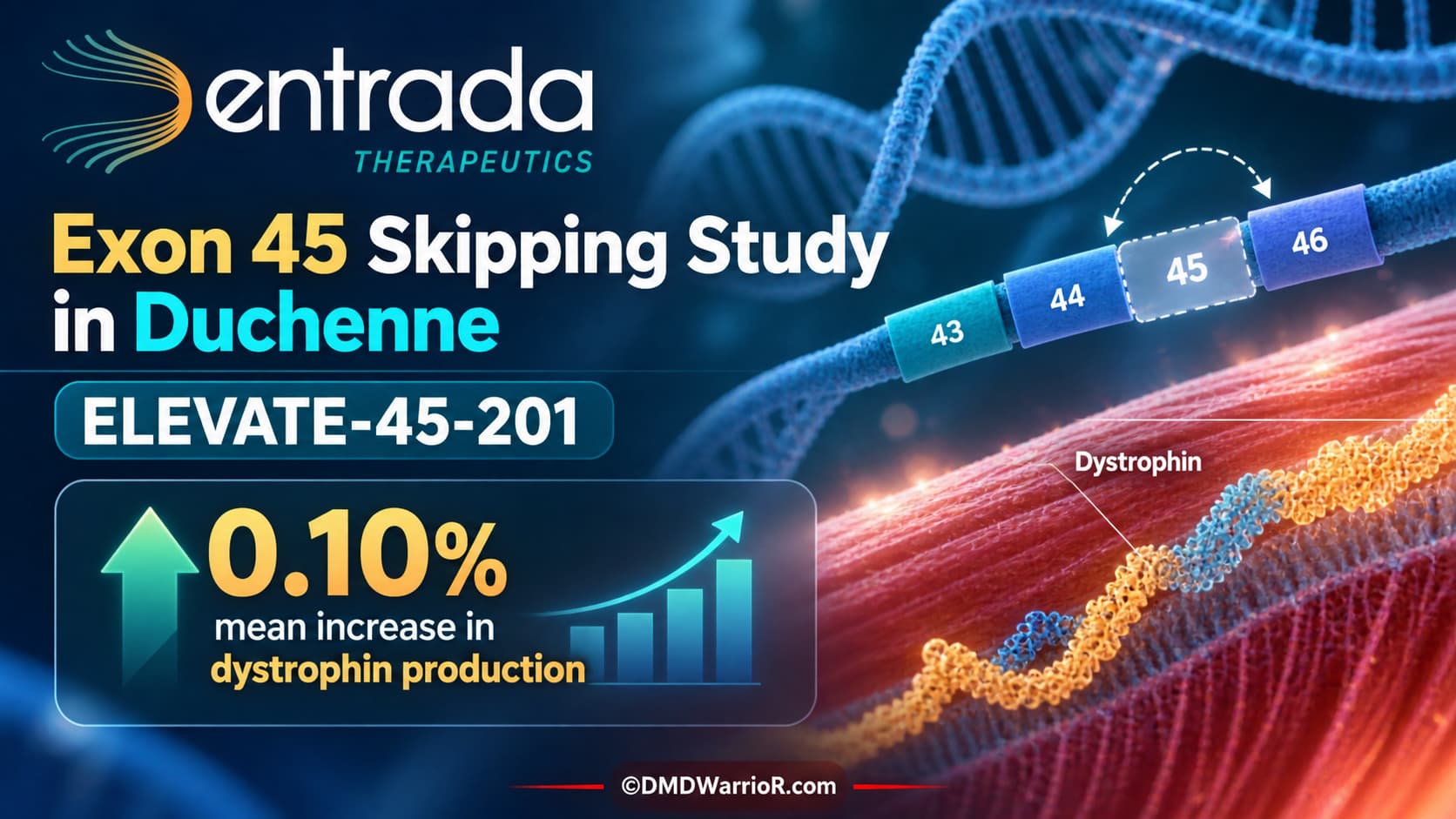
Entrada Therapeutics has announced positive initial results from its Exon 45 Skipping Study, ELEVATE-45-201, evaluating ENTR-601-45 in people with Duchenne muscular dystrophy (Duchenne). The first group of participants showed a favorable safety profile and a small increase in dystrophin production after receiving the initial dose. The findings are an early step in evaluating the treatment, with higher doses planned to assess whether they can produce greater amounts of dystrophin.
The Phase 1/2 study is evaluating ENTR-601-45 in ambulatory participants with confirmed DMD gene mutations that are amenable to exon 45 skipping.
Table of Contents
What Did the First Cohort Show?
The first cohort included eight participants: six received ENTR-601-45 at a dose of 5 mg/kg, while two received a placebo. Participants received three doses during the multiple-ascending-dose portion of the study.
The results met the study’s primary objectives for safety and tolerability. The secondary objectives also showed changes in dystrophin production and exon skipping among participants who received the treatment.
Dystrophin Production Increased by 0.10%
The most important finding was a mean increase of 0.10% in dystrophin production from baseline among the six participants treated with ENTR-601-45.
In comparison, the placebo group showed a mean decrease of 0.02% in dystrophin from baseline.
The treated group also showed a mean increase of 0.15% in exon skipping, compared with a mean decrease of 0.04% in the placebo group.
These findings provide an early indication that ENTR-601-45 is producing the intended biological effects. However, the observed increase in dystrophin production at this initial dose was small, and further studies are needed to understand the effects of higher doses.
Safety and Tolerability Results
ENTR-601-45 showed a favorable safety and tolerability profile at the initial dose of 5 mg/kg.
Headache was the most common treatment-emergent adverse event, with five events reported in two participants. One participant experienced two serious treatment-emergent adverse events: vomiting and fever. Both events subsequently resolved.
No participants discontinued the study, and all enrolled in the open-label extension.
The company also reported no concerns related to low magnesium levels or kidney safety. Kidney markers, including estimated glomerular filtration rate (eGFR) and cystatin C, were within normal ranges in treated participants. Magnesium levels were also within the normal range.
Drug Exposure Matched Expectations
The measured levels of ENTR-601-45 in the blood were consistent with predictions based on previous studies in juvenile non-human primates.
According to the company, these results support its expectations that higher doses may produce greater drug exposure and increased dystrophin production.
What Comes Next for ENTR-601-45?
The company expects higher doses to help determine whether ENTR-601-45 can produce a more substantial increase in dystrophin production and potentially provide functional benefits.
The second cohort, evaluating a dose of 10 mg/kg, has completed enrollment. Entrada Therapeutics expects to report data from this cohort in the first half of 2027.
A third cohort is planned to evaluate doses of up to 15 mg/kg.
Participants in the first cohort have also progressed to the open-label Phase 2 portion of the study, where they will receive six doses of ENTR-601-45 at 5 mg/kg.
No observable functional benefit was expected or reported after three doses in the first cohort. The treatment’s functional impact will be assessed at higher doses and over longer treatment periods in future cohorts and open-label studies. Learn More: DMDWarrior Exon Deletion Tool
A Potentially Less Frequent Dosing Schedule
ENTR-601-45 is designed to be administered once every six weeks. This schedule could mean approximately nine administrations per year, compared with more than 50 administrations for a weekly treatment schedule.
The potential for less frequent dosing is an important aspect of the treatment under investigation. However, its long-term safety, effectiveness, and functional benefits remain to be established through further clinical studies.
Conclusion
The first cohort of the ELEVATE-45-201 study met its initial safety and tolerability objectives and showed a mean increase of 0.10% in dystrophin production with ENTR-601-45 at 5 mg/kg. Exon skipping also increased from baseline.
These are early biological findings, not evidence of established clinical or functional benefit. The next important milestone will be the results from higher doses, beginning with the 10 mg/kg cohort, expected in the first half of 2027.
Discover More: Duchenne Clinical Trial Locations Map