

Deletions amenable to exon 44 skipping are specific genetic changes in the DMD gene for which skipping exon 44 may restore the reading frame and allow muscle cells to produce a shorter, potentially functional dystrophin protein. For families affected by Duchenne muscular dystrophy (DMD), understanding whether a child’s particular mutation is among the deletions amenable to exon 44 skipping can be important when evaluating emerging exon-skipping therapies and clinical trials.
DMD is caused by pathogenic variants in the DMD gene, which provides instructions for producing dystrophin. Many DMD deletions disrupt the gene’s reading frame, resulting in little or no functional dystrophin. Exon skipping is designed to remove an additional exon from the messenger RNA so that the remaining sequence can once again be read in-frame. Research into deletions amenable to exon 44 skipping has therefore become increasingly important as exon-44-targeted therapies advance through clinical development. Learn Now: What is DMD Gene?
Table of Contents
Which DMD Deletions Are Amenable to Exon 44 Skipping?
The deletions amenable to exon 44 skipping requested for this reference include:
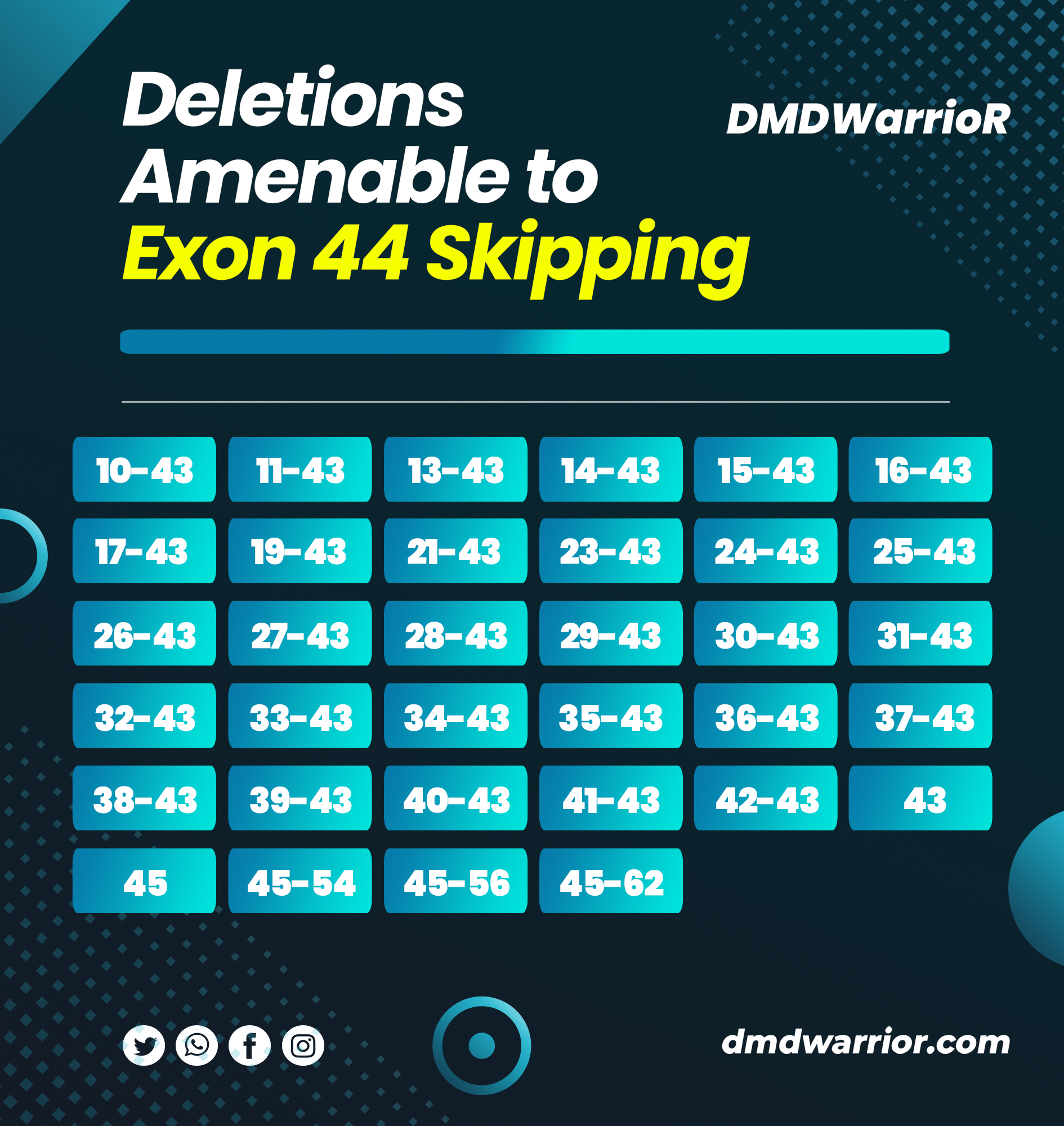
DMD Deletion List for Exon 44 Skipping: 10-43, 11-43, 13-43, 14-43, 15-43, 16-43, 17-43, 19-43, 21-43, 23-43, 24-43, 25-43, 26-43, 27-43, 28-43, 29-43, 30-43, 31-43, 32-43, 33-43, 34-43, 35-43, 36-43, 37-43, 38-43, 39-43, 40-43, 41-43, 42-43, 43, 45, 45-54, 45-56, and 45-62.
Why Does Skipping Exon 44 Matter?
The fundamental principle behind deletions amenable to exon 44 skipping is reading-frame restoration. If a deletion disrupts the normal three-base reading structure of the DMD gene, the resulting messenger RNA can produce a severely truncated or absent dystrophin protein. Removing exon 44 may compensate for the original deletion and restore an in-frame transcript.
The resulting dystrophin is not expected to be full length. Instead, exon skipping aims to produce a shorter dystrophin that retains important functional regions. This approach is sometimes described as attempting to convert a Duchenne-like genetic defect into a milder, Becker-like molecular outcome. However, the clinical effect cannot be predicted solely from the deletion boundaries. Read More: What is Exon Skipping?
Current Exon 44 Skipping Clinical Trials
The development of exon 44 skipping therapy has progressed into human clinical studies. Entrada Therapeutics’ ENTR-601-44 is being evaluated in the Phase 1/2 ELEVATE-44 study in participants with DMD who are amenable to exon 44 skipping. ClinicalTrials.gov lists the study as an interventional Phase 1/2 trial evaluating safety, tolerability, pharmacokinetics, pharmacodynamics and efficacy.
Another exon-44 program, AOC 1044, has also been studied in participants with DMD mutations amenable to exon 44 skipping. The EXPLORE44 program evaluated the safety, tolerability, pharmacokinetics and pharmacodynamic effects of the investigational therapy.
These programs demonstrate why information about deletions amenable to exon 44 skipping is increasingly relevant to families. Nevertheless, investigational therapies should not be interpreted as approved treatments, and clinical-trial eligibility must always be determined from the official protocol. Learn More: Active DMD Clinical Studies
How Can a Family Determine Whether a DMD Mutation Is Amenable?
The first step is to obtain the child’s complete genetic report. A statement such as “deletion of exon 42-43” is relatively straightforward, but larger deletions may require careful interpretation of the exact exon boundaries. Discover Now: DMD or BMD? Exon Check Tool
Families should not rely solely on the name of a deletion found in an online list of deletions amenable to exon 44 skipping. A neuromuscular specialist, molecular geneticist or genetic counselor should review the precise variant and determine whether exon 44 skipping is predicted to restore the reading frame.
It is also important to distinguish genetic amenability from access to treatment. A mutation may theoretically respond to exon 44 skipping while no approved exon-44-skipping medicine is available in a particular country. Similarly, a clinical trial may have additional requirements unrelated to the mutation itself.
Learn More: Upcoming Exon 44 Skipping Therapies for the Treatment of Duchenne
Exon 45 Deletion and Exon 44 Skipping
Among the most important deletions amenable to exon 44 skipping is deletion of exon 45. Exon 45 deletion is a well-established exon-44-skipping genotype and has received considerable attention in natural-history and molecular studies.
Researchers have reported that some individuals with exon 45 deletion show endogenous exon 44 skipping, producing an in-frame transcript without therapeutic intervention. Studies of the Duchenne Registry also found that people with exon-44-skipping-amenable mutations, particularly those with exon 45 deletions, showed differences in age at loss of ambulation compared with several other DMD mutation groups.
This observation does not mean that exon 45 deletion is a mild condition or that spontaneous exon skipping provides sufficient dystrophin. Rather, it illustrates how alternative splicing can influence the phenotype and provides biological support for therapeutically targeting exon 44.
Academic Sources and References
- Van den Bergen JC, Ginjaar HB, Niks EH, Aartsma-Rus A, Verschuuren JJGM. Prolonged Ambulation in Duchenne Patients with a Mutation Amenable to Exon 44 Skipping. Journal of Neuromuscular Diseases. 2014;1(1):91–94.
- Dwianingsih EK, Malueka RG, Nishida A, Itoh K, Lee T, Yagi M, Iijima K, Takeshima Y, Matsuo M. A novel splicing silencer generated by DMD exon 45 deletion junction could explain upstream exon 44 skipping that modifies dystrophinopathy. Journal of Human Genetics. 2014;59:423–429.
- Lu QL, Cirak S, Partridge T. What Can We Learn from Clinical Trials of Exon Skipping for DMD? Journal of Neuromuscular Diseases. 2014. This work provides important context on exon-skipping strategies and their potential to restore dystrophin expression in DMD.
- Lim KRQ, Maruyama R, Yokota T. Efficacy and limitations of antisense oligonucleotide-mediated exon skipping for Duchenne muscular dystrophy. International Journal of Molecular Sciences. 2017. This review discusses the molecular basis, therapeutic potential, and limitations of exon-skipping approaches.
- Brogna C, et al. North Star Ambulatory Assessment changes in ambulant Duchenne boys amenable to skip exons 44, 45, 51, and 53: A 3 year follow up. Neuromuscular Disorders. 2021. The study included 34 patients with deletions amenable to exon 44 skipping and provides useful natural-history data for this specific genetic subgroup.