

Duchenne Muscular Dystrophy (DMD) is a debilitating and progressive genetic disorder that primarily affects boys, causing muscle weakness and degeneration due to mutations in the dystrophin gene. Over the years, therapeutic advancements have been made to halt the progression of DMD, with one of the most promising being exon skipping therapies. These therapies aim to bypass faulty exons in the dystrophin gene, allowing the production of a functional dystrophin protein, even in the presence of genetic mutations. Exon 53 skipping is one such targeted therapy that has garnered significant attention in the treatment of DMD. In this article, we will explore which mutations and deletions in the dystrophin gene are amenable to exon 53 skipping therapies and how this approach offers hope for affected patients. – Learn More: What is Duchenne? –
Table of Contents
Exon Skipping: A Breakthrough Approach for DMD
Exon skipping is a form of gene therapy aimed at “skipping” over defective sections (exons) of the dystrophin gene during the RNA splicing process. The goal is to restore the reading frame of the gene and enable the production of a shortened but functional version of the dystrophin protein. This approach is particularly useful for patients with specific deletions in the dystrophin gene that result in the disruption of the reading frame, which typically produces a nonfunctional dystrophin protein. – Read More: What is exon skipping? –
By skipping certain exons, such as exon 53, the therapy re-establishes the correct reading frame, allowing the production of a functional dystrophin protein that can help maintain muscle cell stability and function. Exon skipping does not cure DMD, but it can slow disease progression and improve the quality of life for patients.
How Exon 53 Skipping Works for DMD
Exon 53 skipping specifically targets a region of the dystrophin gene that is important for producing the dystrophin protein. Exon 53 skipping has become a key therapeutic approach because it addresses a subset of patients who have deletions involving exon 53 or surrounding regions of the gene. These mutations disrupt the reading frame, leading to a dysfunctional or absent dystrophin protein.
When exon 53 is skipped during RNA splicing, the reading frame is restored, and a truncated but functional dystrophin protein can be produced. This shortened dystrophin is not as large or as efficient as the full-length protein but still provides enough stability to protect muscle cells from damage. This restoration of dystrophin production can slow the progression of the disease, improve muscle strength, and delay the loss of motor function.
Deletions Amenable for Exon 53 Skipping
Exon 53 skipping represents a targeted therapeutic strategy for a subset of Duchenne Muscular Dystrophy patients, specifically those with deletions involving exons: 3-52, 4-52, 5-52, 6-52, 9-52, 10-52, 11-52, 13-52, 14-52, 15-52, 16-52, 17-52, 19-52, 21-52, 23-52, 24-52, 25-52, 26-52 27-52, 28-52, 29-52, 30-52, 31-52, 32-52, 33-52, 34-52, 35-52, 36-52, 37-52, 38-52, 39-52, 40-52, 41-52, 42-52, 43-52, 45-52, 47-52, 48-52, 49-52, 50-52, 52, 54-58, 54-61, 54-63, 54-64, 54-66, 54-76, 54-77.
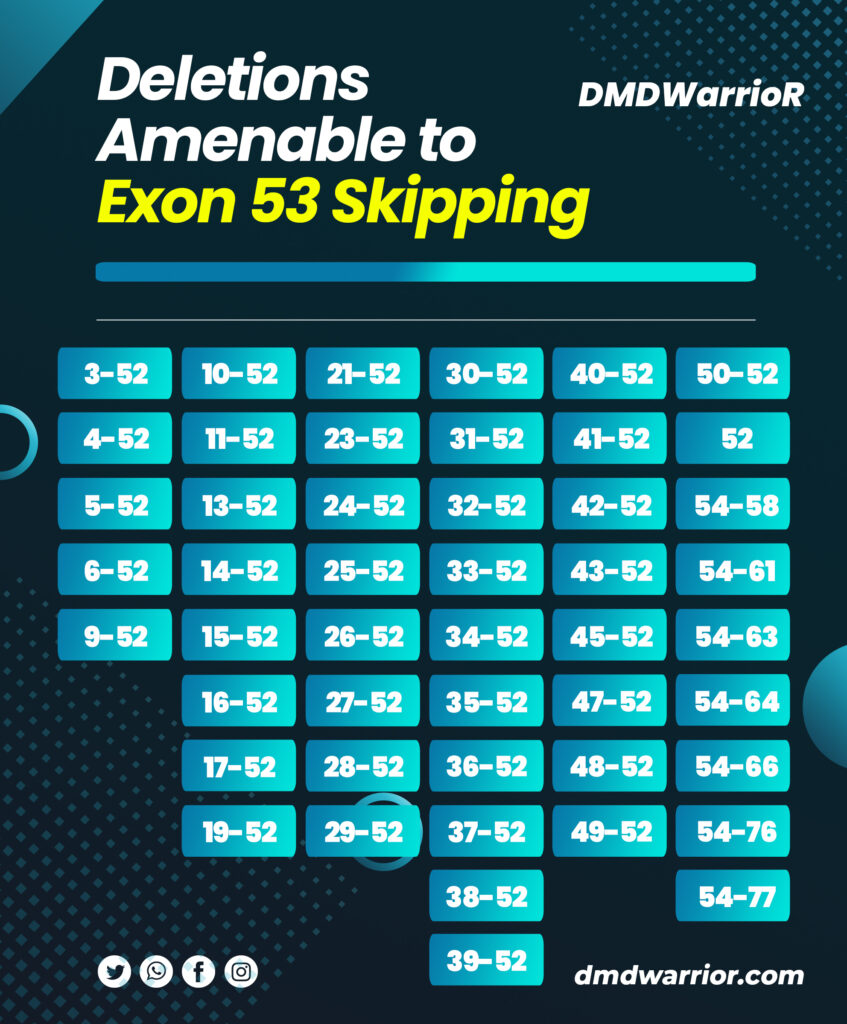
To be a candidate for exon 53 skipping, a patient must have a frameshifting deletion that can be corrected by skipping exon 53. The goal is to bring the DMD gene back into the correct reading frame.
Common Deletions Amenable to Exon 53 Skipping
Exon 53 skipping is effective for DMD patients with specific genetic deletions that disrupt the reading frame of the dystrophin gene. The most common deletions amenable to this therapy include:
Exon 52 Deletion: A direct deletion of exon 52 leads to a frameshift mutation, producing a nonfunctional dystrophin protein. Skipping this exon restores the gene’s reading frame, allowing for the production of a functional dystrophin.
Deletions Spanning Exons 45 to 52: Deletions affecting exons 45 through 52 can also be corrected by skipping exon 53, restoring dystrophin production and stabilizing muscle function.
Deletions Between Exons 50 to 52: This type of deletion results in a frameshift that can be repaired by skipping exon 53, allowing for the expression of a truncated but functional dystrophin protein.
Mutations Amenable to Exon 53 Skipping
Mutations amenable to exon 53 skipping in Duchenne muscular dystrophy include the following exons: 3-52, 4-52, 5-52, 6-52, 9-52, 10-52, 11-52, 13-52, 14-52, 15-52, 16-52, 17-52, 19-52, 21-52, 23-52, 24-52, 25-52, 26-52 27-52, 28-52, 29-52, 30-52, 31-52, 32-52, 33-52, 34-52, 35-52, 36-52, 37-52, 38-52, 39-52, 40-52, 41-52, 42-52, 43-52, 45-52, 47-52, 48-52, 49-52, 50-52, 52, 54-58, 54-61, 54-63, 54-64, 54-66, 54-76, 54-77.
Golodirsen: A Leading Exon 53 Skipping Cure
Golodirsen (Vyondys 53) is an FDA-approved antisense oligonucleotide (AON) that promotes exon 53 skipping. By binding to the RNA transcript of the dystrophin gene, golodirsen forces the splicing machinery to skip exon 53 during the RNA processing, effectively restoring the gene’s reading frame. This enables the production of a functional but truncated dystrophin protein. (Patients with DMD who have a deletion of exon 52 may be treated with a therapy that skips either exon 51 or exon 53.) – Read More –
Clinical Trials and Results
In clinical trials, golodirsen has demonstrated a significant increase in dystrophin levels in muscle biopsies, which is a crucial indicator of the therapy’s efficacy. Although the amount of dystrophin produced is less than the full-length version found in healthy muscle tissue, it is enough to protect muscle fibers from further damage and slow the progression of the disease.
Efficacy:
- Clinical trials showed that golodirsen successfully increased dystrophin expression in patients with exon 53 deletions.
- While dystrophin levels remained lower than in normal muscle tissue, the amount produced was sufficient to provide a functional substitute, reducing the severity of muscle weakness.
Safety Profile:
- The safety profile of golodirsen has been favorable, with mild to moderate side effects, including injection site reactions and respiratory infections. These are common for drugs administered via intravenous infusion.
Benefits of Exon 53 Skipping Therapy for DMD Patients
Exon 53 skipping therapies like golodirsen offer several key benefits for patients with DMD:
- Slows Disease Progression: By restoring some dystrophin production, exon skipping can slow the degeneration of muscle fibers, helping to maintain muscle strength and function.
- Improved Quality of Life: With improved muscle function, many patients may experience less fatigue and greater mobility, allowing them to maintain independence for longer periods.
- Targeted Treatment for Specific Mutations: Exon 53 skipping is highly specific to patients with deletions surrounding exon 52 regions, providing a tailored therapeutic approach for this group of DMD patients.
Future Prospects: Expanding Exon Skipping Therapies
While exon 53 skipping represents a significant breakthrough for patients with specific mutations, the potential for exon skipping extends beyond exon 53. Researchers are working on therapies targeting other exons in the dystrophin gene, including exons 51, 45, and 44. As genetic testing advances, more personalized therapies will emerge, offering hope for a broader range of DMD patients.
Combination therapies, such as pairing exon skipping with gene editing techniques like CRISPR, may further enhance the effectiveness of these treatments. By using multiple approaches in tandem, researchers hope to restore full or near-full dystrophin function and provide longer-lasting benefits for patients. – Read More: CRISPR –
Summary: Is My Son a Candidate for Exon 53 Skipping?
If your child has been diagnosed with DMD and has a mutation near exon 52, such as a deletion of exons 45 through 52, there is a possibility they could benefit from exon 53 skipping therapy.
🔍 Key Takeaways:
- Exon 53 skipping helps restore the dystrophin reading frame in specific deletions.
- About %8 of DMD patients are eligible.
- Genetic testing is essential to determine eligibility.
- Therapies like Golodirsen (Vyondys 53) are FDA-approved for exon 53-amenable mutations.
Conclusion
Exon 53 skipping therapies represent an exciting frontier in the treatment of Duchenne Muscular Dystrophy, particularly for patients with deletions that impact exon 53. Golodirsen, the first FDA-approved drug targeting exon 53, has shown promise in clinical trials, offering hope for slowing disease progression and improving quality of life. As research continues, exon skipping may become an integral part of a broader therapeutic strategy for DMD, providing more tailored, effective treatments for individuals affected by this devastating condition.
With continued advancements in genetic therapies and personalized medicine, the future looks brighter for those living with Duchenne Muscular Dystrophy.
Read More: Clinical Trials for Duchenne (List of All Researches)