

Elevidys, the only gene therapy approved by the FDA for Duchenne muscular dystrophy (DMD), has disappointed DMD communities and investors following the release of three years of data from patients. Marketed at a price of $2.9 million American dollars, the product has raised several questions for families of children with DMD: ‘How effective is Elevidys gene therapy, how much does it increase children’s lifespan, and is it accurate to judge a therapy’s effectiveness solely based on NSAA scores?’ >>> Learn More: What is NSAA?
Table of Contents
Sarepta Really Needs Something to Freshen up the Story
Sarepta recently published data that did not include creatine kinase levels, one of the most important biomarkers for Duchenne muscular dystrophy. Families campaigning for access to Elevidys gene therapy are angry that this technical information was not shared. The vast majority of families who have tirelessly raised funds through campaigns for access to the therapy say, “We are the ones giving you millions of dollars, but you are giving us nothing in return; the facts, the data, and the science. You are only taking our money.” >>> Learn More: Sarepta Reported 3-Year Topline Data of ELEVIDYS
When two Elevidys-related deaths happened in the spring of 2025, Sarepta’s stock started to fall. Over the summer, word surfaced of a third fatality, connected to an investigational gene treatment for limb-girdle muscular dystrophy that uses the same AAV vector as Elevidys. Overall, the company’s share price fell 80% from the start of the year to its lowest level in almost ten years.
Does Elevidys work or not?
Company management, thinking that the newly disclosed 2025 financial statement and updated three-year statistics on Elevidys will ease the situation, may be disappointed. Although Sarepta sees a 4-point increase in NSAA as indication that the gene therapy is beneficial, the therapy’s cost and 4-point NSAA score raise concerns. Families of children with DMD are waiting for replies from Sarepta to these questions:
Discover More: What is Creatine Kinase (CK)?
Questions from Families Organizing Fundraising Events
- Does the 4-point increase in the NSAA really cost $2.9 million?
- Three years ago, what was the creatine kinase level of a child with DMD who was a candidate for Elevidys, and what was the creatine kinase level 3 years after receiving Elevidys?
- If creatine kinase levels don’t decrease after taking Elevidys, doesn’t that mean muscle damage is proceeding?
- Did you take muscle biopsy samples to measure creatine kinase levels in children receiving Elevidys gene therapy?
Elevidys, the first gene therapy for Duchenne muscular dystrophy approved by the FDA (but not by the EMA), is facing new competitors very soon. The closest to entering the market is REGENXBIO, which announced last month that it plans to apply for approval of its RGX-202 gene therapy by mid-2026. SolidBio’s SGT-003 gene therapy is also an ambitious alternative, and if these options enter the market, it would not be surprising if DMD patients and their families opted out of Elevidys for cure. >>> Read More: Creatine Kinase (CK), Dystrophin Level and NSAA Score in Elevidys Gene Therapy
Sarepta may have even harder times ahead because sales are going down, competition is getting tougher, and there isn’t enough clear and reassuring scientific data. The German representative for DMDWarrior thinks that the biotechnology company is becoming less appealing as a potential acquisition target, even for a big pharmaceutical company, because its brand is damaged and its patients are unhappy. >>> Ask Yourselves: ‘One-Time’ Gene Therapies or Exon-Skipping Therapies
Which DMD Gene Therapy Should You Choose?
DMD patients and their families may soon have to make tough choices because Elevidys uses the same vector as newer therapies like REGENXBIO’s RGX-202 and Solid Biosciences’ SGT-003.
Families who are organizing campaigns need to be reminded again: “You can only use AAV once!” “So, if you choose Elevidys gene therapy, you might miss out on other options.” For this reason, it might be a good idea for families who still have time to slow down their campaigns or even put them off for a while.
Discover More: Frequently Asked Questions About Elevidys
Sarepta’s 1 Year Share Price
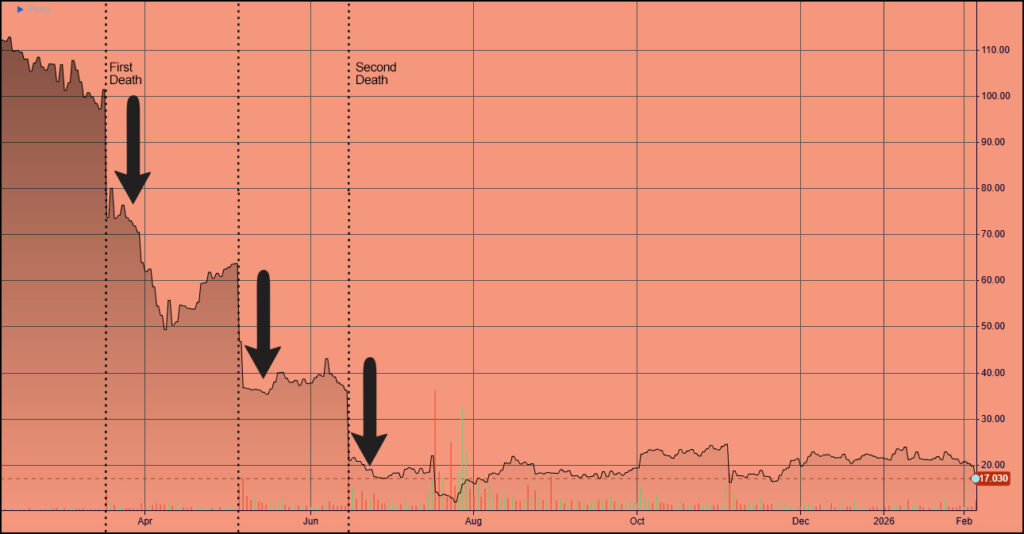
Despite the encouraging EMBARK update, Sarepta Therapeutics’ recent share price performance has been weak, with a 7 day share price return of 8.53% and a year to date share price return decline of 4.83%. Meanwhile, the 1 year total shareholder return decline of 82.22% and 3 year total shareholder return decline of 83.21% highlight how much sentiment has cooled, even after a 90 day share price return of 8.62% suggests some short term momentum is trying to rebuild.