

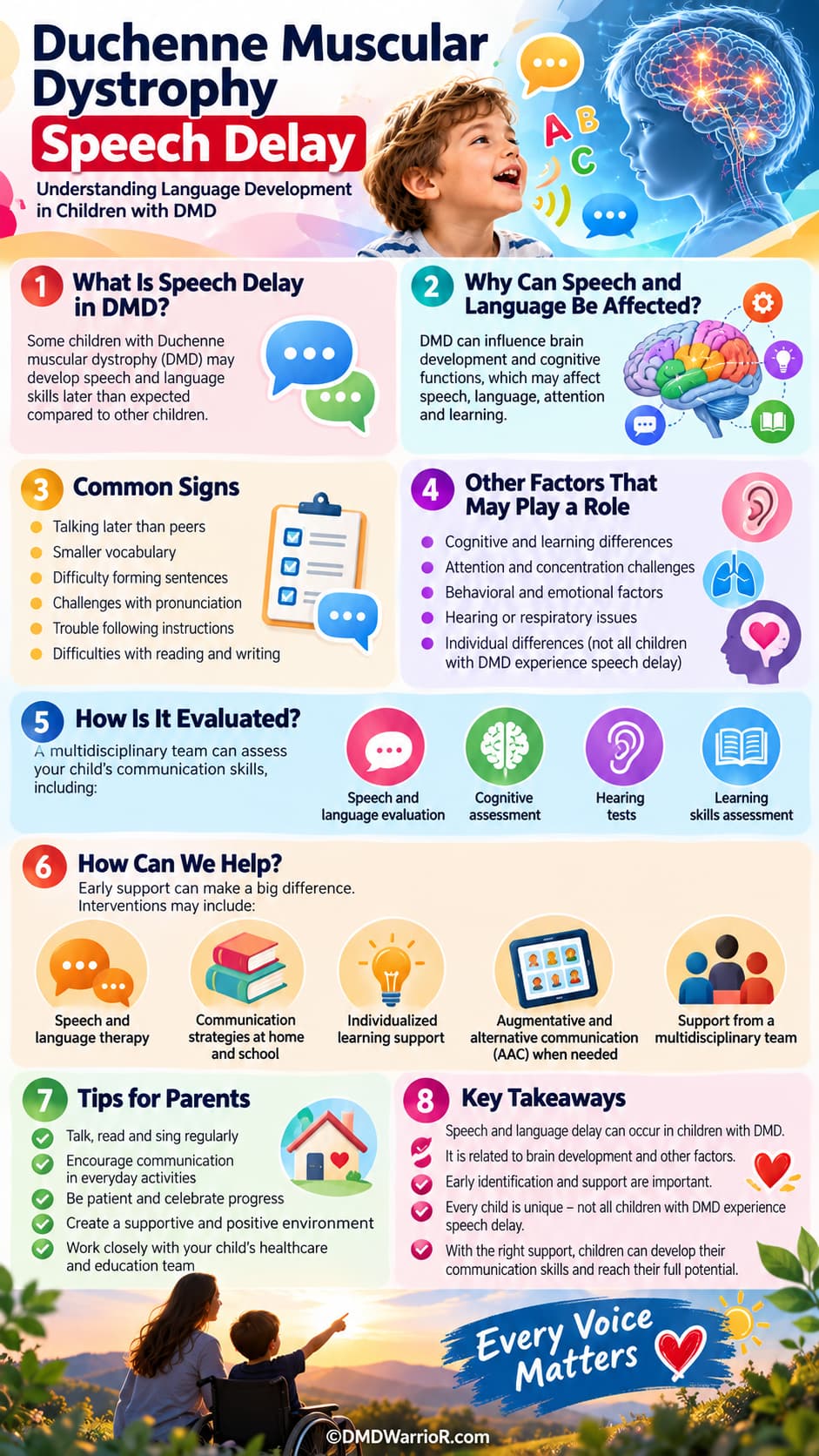
Duchenne muscular dystrophy speech delay is an important developmental concern that families and healthcare professionals should recognize. Although Duchenne muscular dystrophy (DMD) is primarily known as a genetic neuromuscular condition causing progressive muscle weakness, research has shown that some boys with DMD can also experience differences or delays in language, speech, cognition, attention, behavior, and other areas of development.
For parents, noticing that a child is talking later than expected, having difficulty forming sentences, or struggling to pronounce longer words can raise many questions. Is this part of DMD? Does it indicate an intellectual disability? Will the child catch up? And what kind of support can help?
The answers vary from child to child. Importantly, Duchenne muscular dystrophy speech delay does not mean that every child with DMD will have significant communication difficulties. However, because language and communication differences occur more frequently in DMD than in the general population, developmental monitoring and early support are important parts of comprehensive care.

Table of Contents
Is Speech Delay Common in Duchenne Muscular Dystrophy?
Research indicates that language and speech delays are recognized features of DMD. A study published in The Journal of Pediatrics examined developmental milestones in 130 children with DMD and 59 unaffected siblings. Parents reported that children with DMD were more frequently delayed in language milestones, including saying their first words and speaking in full sentences. – Learn More
In that study, 38 percent of children with DMD were reported as late in speaking, while 43 percent were reported as late in speaking in sentences. These figures should not be interpreted as a prediction for an individual child, because the study relied on retrospective parental reports and developmental outcomes vary considerably between children.
More recent research supports the broader observation that DMD can involve developmental differences beyond muscle function. A 2024 systematic review covering 55 studies found evidence of difficulties across motor, cognitive, language, behavioral, and social-emotional developmental domains in young boys with DMD, while emphasizing substantial variability between individuals. – Learn More
Duchenne Muscular Dystrophy and Language Development
Language development involves several related abilities. A child must learn to understand spoken language, use words, construct sentences, remember verbal information, and communicate effectively with other people.
In DMD, these abilities do not necessarily develop in the same way or at the same pace.
For example, a child may understand what adults are saying but have difficulty expressing himself verbally. Another child may know many words but struggle to pronounce longer or more complicated words. Some children may experience difficulties with sentence construction, verbal memory, attention, or processing language.
A preschool study involving boys with DMD found that many participants had relatively preserved lexical and syntactic comprehension and naming abilities, while difficulties were frequently observed in articulation, repetition of long words, and sentence repetition. The study also identified differences in auditory attention.
This illustrates an important point for families: language development in DMD is not a single, uniform pattern.
What Are the Early Developmental Signs of DMD?
DMD is often recognized because of motor symptoms such as difficulty running, jumping, climbing stairs, getting up from the floor, or keeping up with peers. However, developmental research has demonstrated that non-motor milestones can also be affected.
A study examining early developmental milestones found that delays involving communication, adaptive behavior, fine motor skills, and social development could occur in young boys with DMD. Some differences were detectable during the first years of life.
A comprehensive review of early signs reported that between approximately 36 percent and 67 percent of children in some studies were described as late in milestones such as speaking, forming sentences, bladder or bowel training, or reading. Learn More: Early Signs of Duchenne
Possible developmental signs may therefore include:
- Speaking first words later than expected
- Taking longer to begin combining words
- Difficulty developing age-appropriate sentences
- Problems pronouncing longer or more complex words
- Difficulty repeating sentences or verbal information
- Delayed reading or learning skills
- Difficulty maintaining attention during verbal activities
- Differences in verbal memory
- Difficulties with communication despite apparently adequate understanding
Discover More: Learning Disabilities in DMD
These signs are not diagnostic of DMD by themselves. Many children without DMD experience speech or language delays for a variety of reasons.
Duchenne Muscular Dystrophy Speech Delay and Cognitive Development
Parents sometimes worry that speech delay automatically means their child has an intellectual disability. This is not necessarily the case.
Most people with Duchenne have an IQ within the normal range, although children with DMD have an increased risk of cognitive difficulties and may have a distinctive pattern of strengths and weaknesses. Overall IQ also does not always capture specific learning or communication difficulties.
Research has nevertheless identified associations between early developmental delays and later cognitive performance. In the study of developmental milestones mentioned above, children described as late talkers performed less well on some measures of cognitive functioning than children who acquired speech milestones on time. The researchers emphasized that these differences were statistically significant but represented relatively subtle variations in performance.
This is one reason developmental assessment should not wait until a child has obvious difficulties at school.
Why Can Language Difficulties Occur in DMD?
DMD is caused by mutations in the DMD gene, which results in deficiency of the dystrophin protein. Although dystrophin is particularly important in muscle, different dystrophin isoforms are also expressed in the brain. Read More: Isoform Deficiencies in DMD
Researchers have therefore investigated whether differences in brain dystrophin expression may contribute to the neurodevelopmental features observed in some boys with DMD.
A study of 700 individuals with DMD reported language and speech delays in 24.4 percent of the cohort and found associations between certain mutation locations and neurodevelopmental symptoms. Learn More: How Does Duchenne Muscular Dystrophy Affect the Brain?
However, the relationship between genotype, brain dystrophin isoforms, cognition, and language remains an active area of research. A particular mutation should not be interpreted as determining exactly how a child’s language or cognitive development will progress.
Does Duchenne Muscular Dystrophy Cause Language Delay?
The evidence indicates that DMD is associated with an increased frequency of language and communication difficulties, but saying that DMD causes the same type or degree of language delay in every child would be inaccurate.
The 2024 systematic review of early development found considerable variation among boys with DMD. Researchers concluded that DMD can involve a broader developmental profile than motor impairment alone, but the extent and combination of developmental difficulties differ between individuals.
This variability is important for families. One child may have relatively mild articulation difficulties, another may experience delayed sentence development, while another may have broader cognitive, attention, or learning difficulties.
What Should Parents Do If Their Child Has a Speech Delay?
Parents should discuss developmental concerns with their child’s DMD care team rather than simply waiting to see whether the child catches up.
A comprehensive evaluation can help determine whether the difficulty involves:
- Speech production
- Language comprehension
- Expressive language
- Articulation
- Auditory processing or attention
- Verbal memory
- Cognitive development
- Social communication
- Learning or school-related skills
A speech-language pathologist (SLP) can assess communication skills and determine whether therapy or other interventions may be appropriate.
The Duchenne care recommendations specifically support referral to a speech-language pathologist when speech or language development is suspected to be delayed.
Early assessment does not mean that a child will necessarily require intensive therapy. Instead, it provides families and professionals with a clearer understanding of the child’s strengths and needs.
How Can Speech Therapy Help Children With DMD?
Speech and language therapy can be individualized according to the child’s specific difficulties.
Depending on the assessment, therapy may address:
- Vocabulary development
- Sentence formation
- Pronunciation and articulation
- Understanding spoken instructions
- Verbal memory
- Communication strategies
- Attention during communication
- Classroom communication
- Alternative or augmentative communication when needed
The goal is not simply to make a child speak more. Effective intervention should help the child communicate more successfully and participate more fully at home, at school, and socially.
As children with DMD grow older, speech-language professionals may also become involved in areas such as voice, respiratory support for speech, oral-motor function, and swallowing when clinically indicated.
What About School and Learning?
Speech and language difficulties can affect classroom participation even when a child’s overall intelligence is within the normal range.
A child may understand a lesson but struggle to express an answer quickly. Another may need additional time to process verbal instructions or remember information presented verbally.
Teachers should therefore be informed about the child’s individual communication profile.
Depending on the child’s needs, useful accommodations may include:
- Shorter and clearer instructions
- Repetition of important information
- Visual instructions
- Additional response time
- Checking understanding rather than assuming it
- Written or visual reinforcement of verbal information
- Individualized educational support when appropriate
Developmental interventions should focus on the specific skills that are difficult for the individual child rather than making assumptions based solely on the DMD diagnosis. Learn More: Guide to DMD for Parents and Teachers at School
When Should Families Seek Professional Evaluation?
Families should consider discussing an evaluation with the DMD team whenever they notice that their child’s communication development appears significantly different from that of peers or is interfering with everyday activities.
Particular attention may be appropriate when a child:
- Is significantly late to begin speaking
- Has difficulty forming age-appropriate sentences
- Is difficult to understand
- Frequently struggles to find or use words
- Has difficulty following verbal instructions
- Has noticeable problems repeating or remembering verbal information
- Experiences communication difficulties at preschool or school
- Shows changes or regression in previously acquired communication abilities
A developmental concern does not necessarily indicate a serious cognitive problem. The purpose of assessment is to identify the child’s individual strengths and needs and provide appropriate support as early as possible.
What Parents Can Do at Home for Speech Delay in Children with DMD
- Talk during everyday activities: Describe what you and your child are doing while eating, dressing, bathing, or playing. Everyday routines provide natural opportunities to hear and use language.
- Create more conversational turns: Instead of simply talking to your child, encourage back-and-forth interaction. Ask simple questions, respond to your child’s sounds or words, and give him time to answer. Research in children with language difficulties suggests that conversational turn-taking and child vocalizations are particularly relevant to language development.
- Read together every day: Look at picture books and discuss the characters, objects, and actions. Ask questions such as “What is this?” or “What happens next?” and encourage your child to point, gesture, or answer verbally.
- Expand what your child says: If your child says “car,” you might respond, “Yes, a red car” or “The car is going fast.” This models slightly more advanced language without forcing the child to repeat it.
- Give enough response time: Avoid finishing sentences immediately. A child with language difficulties may need additional time to understand a question and formulate a response.
- Use visual support when helpful: Pictures, gestures, objects, and simple visual choices can make communication easier, particularly when verbal instructions are difficult to process.
- Follow your child’s interests: Talk about favorite toys, animals, games, books, or activities. Communication is often easier when the subject is motivating and familiar.
- Practice consistently rather than intensely: Short, enjoyable language activities incorporated throughout the day are preferable to turning communication practice into a stressful “lesson.” Parent-implemented speech and language programs show potential benefits, particularly when parents receive appropriate professional training and coaching.
- Work with a speech-language pathologist: Ask the DMD care team for a speech-language evaluation if there is a noticeable delay. DMD Care Considerations specifically recommend speech-language assessment for children with suspected speech or language delays.
Important: Parents should not attempt specialized oral-motor, speech-strengthening, swallowing, or respiratory exercises without guidance from an appropriately trained clinician. Children with neuromuscular disorders can have additional speech, voice, and swallowing considerations, and current expert recommendations emphasize individualized speech-language management.
Discover More: Orton-Gillingham Approach in Duchenne
FAQs: Speech Delay in DMD
Is speech delay common in Duchenne muscular dystrophy?
Speech and language delays are more frequently reported in boys with DMD than in unaffected children in several studies. However, the degree of difficulty varies considerably, and not every child with DMD experiences a clinically significant speech delay.
Does DMD affect language development?
Yes. Research has identified differences in language development, speech production, verbal memory, and related neurodevelopmental abilities in some children with DMD. These difficulties can range from relatively specific speech problems to broader developmental challenges.
Does speech delay mean a child with DMD has an intellectual disability?
No. Speech or language delay does not automatically indicate intellectual disability. Children with DMD have a wide range of cognitive abilities, and specific communication difficulties can occur even when overall cognitive ability is within the normal range.
Can speech therapy help children with DMD?
Speech-language therapy can help address specific communication difficulties. An assessment by a qualified speech-language pathologist can identify which areas require support and whether therapy, communication strategies, educational accommodations, or other interventions would be useful.
Should parents wait for a child to catch up?
Families should discuss significant developmental concerns with the child’s healthcare team rather than relying solely on a wait-and-see approach. Early identification allows professionals to understand the child’s needs and introduce appropriate support when necessary.
The Importance of Looking Beyond Muscle Symptoms
Duchenne muscular dystrophy is a complex condition that affects more than physical strength. While progressive muscle weakness remains the defining clinical feature, research increasingly demonstrates the importance of monitoring cognitive, language, behavioral, social-emotional, and developmental health as part of comprehensive DMD care.
Recognizing Duchenne muscular dystrophy speech delay does not mean assuming that a child will have a particular cognitive outcome. Instead, it means recognizing a potential area of need early enough to evaluate it properly.
For parents, the most important message is simple: if your child with DMD is experiencing speech or language difficulties, raise the concern with the DMD care team. A speech-language assessment can help distinguish between different types of communication difficulties and identify practical strategies to support the child’s development.
Early attention to communication can help children participate more confidently in family life, education, friendships, and the wider community. In DMD, comprehensive care means supporting the whole child—not only the muscles.
Academic Sources and References
- Cyrulnik, S. E., et al. (2007). Delayed Developmental Language Milestones in Children with Duchenne’s Muscular Dystrophy. The Journal of Pediatrics.
- van Dommelen, P., van Dijk, O., de Wilde, J. A., & Verkerk, P. H. (2020). Early Developmental Milestones in Duchenne Muscular Dystrophy. Developmental Medicine & Child Neurology.
- Chieffo, D. P. R., et al. (2022). Language Development in Preschool Duchenne Muscular Dystrophy Boys. Brain Sciences.
- Darmahkasih, A. J., et al. (2020). Neurodevelopmental, Behavioral, and Emotional Symptoms Common in Duchenne Muscular Dystrophy. Muscle & Nerve.
- Birnkrant, D. J., et al. (2018). Diagnosis and Management of Duchenne Muscular Dystrophy, Part 3: Primary Care, Emergency Management, Psychosocial Care, and Transitions of Care Across the Lifespan. The Lancet Neurology.