

The Orton-Gillingham approach in Duchenne muscular dystrophy is gaining attention as families and clinicians seek structured, evidence-informed strategies to address learning challenges in boys with DMD. Also referred to as multisensory structured literacy in Duchenne muscular dystrophy, this method may help mitigate reading and language deficits commonly observed in this population. As cognitive and neurodevelopmental profiles of DMD become better understood, targeted educational interventions like Orton-Gillingham are increasingly relevant in holistic care. Learn More: Learning Disabilities in Duchenne Muscular Dystrophy
Table of Contents
What is the Orton-Gillingham approach?
The Orton-Gillingham (OG) approach is a highly structured, multisensory method of teaching reading, writing, and spelling. Originally developed by neurologist Samuel Torrey Orton and educator Anna Gillingham in the early 20th century, the approach was designed primarily for individuals with dyslexia and language-based learning disorders.
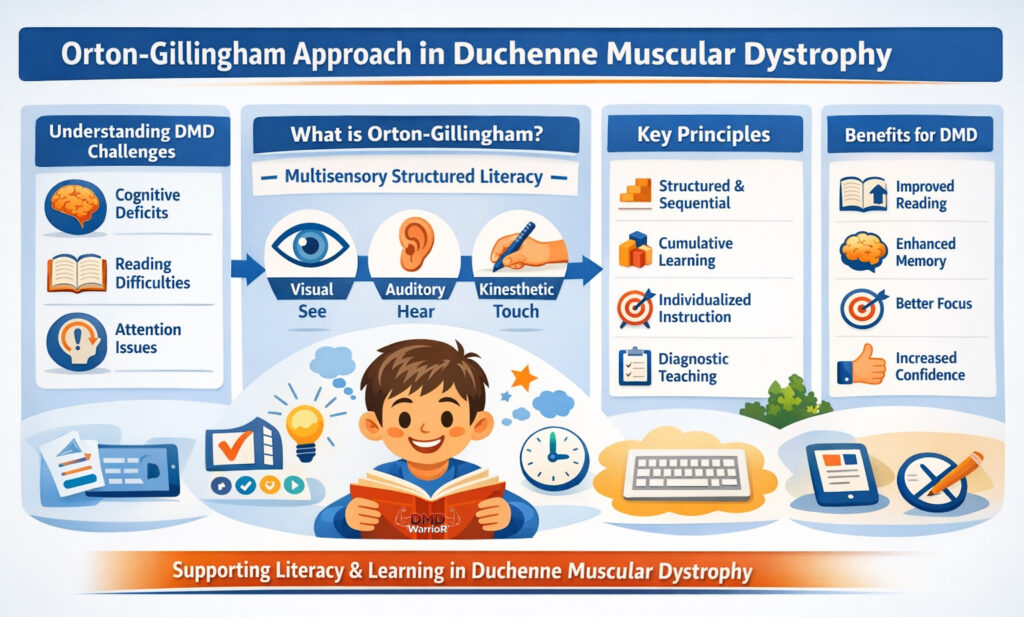
At its core, Orton-Gillingham approach is:

- Explicit: Skills are directly taught rather than inferred
- Sequential: Concepts are introduced in a logical progression
- Cumulative: New learning builds upon previously mastered skills
- Multisensory: Engages visual, auditory, and kinesthetic pathways
- Diagnostic and prescriptive: Instruction adapts continuously based on learner performance
Unlike conventional literacy instruction, Orton-Gillingham approach emphasizes phonological awareness, decoding, encoding, and language structure in a systematic manner.
Why it matters for neurological conditions
The Orton-Gillingham approach aligns well with populations experiencing neurodevelopmental differences, including:
- Dyslexia
- ADHD (Attention-Deficit/Hyperactivity Disorder)
- Autism spectrum disorders
- Neuromuscular conditions like Duchenne muscular dystrophy
This is because OG addresses language processing deficits, which are increasingly recognized in DMD.
What are the 5 principles of Orton-Gillingham?
The OG method is grounded in several pedagogical principles that distinguish it from standard literacy instruction.
1. Multisensory instruction
Students simultaneously engage:
- Visual (seeing letters/words)
- Auditory (hearing sounds)
- Kinesthetic/tactile (writing, tracing)
This reinforces neural pathways and improves retention.
2. Structured and sequential learning
Content follows a predefined order:
- Phonemes → syllables → words → sentences
Each stage builds systematically on the previous one.
3. Cumulative reinforcement
Previously learned material is continuously reviewed, ensuring long-term mastery rather than short-term memorization.
4. Individualized instruction
Teaching is tailored to:
- Cognitive profile
- Learning pace
- Specific deficits
This is particularly important in DMD, where variability in cognitive involvement is significant.
5. Diagnostic teaching
Instruction evolves based on:
- Ongoing assessment
- Error patterns
- Response to intervention
Teachers constantly adjust strategies to optimize outcomes.
The benefits of the Orton-Gillingham approach
The Orton-Gillingham approach in Duchenne muscular dystrophy offers multiple cognitive and academic advantages, especially for children with learning differences.
1. Improved reading accuracy and fluency
Numerous studies show OG-based instruction enhances:
- Phonological processing
- Decoding skills
- Reading comprehension
2. Strengthened spelling and writing
Because OG integrates encoding (spelling) with decoding (reading), students develop stronger written language skills.
3. Enhanced working memory and attention
The structured nature of OG reduces cognitive load, which benefits:
- Children with ADHD
- Individuals with executive function deficits
4. Increased confidence and motivation
Success in reading often leads to:
- Improved self-esteem
- Greater academic engagement
5. Neuroplasticity support
Multisensory learning stimulates multiple brain regions, promoting adaptive neural changes—particularly relevant in neurodevelopmental disorders. Read More: Brain and Duchenne
What are the drawbacks of Orton-Gillingham?
While effective, the OG approach is not without limitations.
1. Resource-intensive
- Requires trained specialists
- Often delivered one-on-one
- Can be costly
2. Time commitment
- Progress may be gradual
- Requires consistent, long-term intervention
3. Limited scalability
Implementing OG in large classroom settings can be challenging due to its individualized nature.
4. Evidence variability
Although widely supported, some meta-analyses suggest:
- Mixed results depending on implementation fidelity
- Need for more large-scale randomized controlled trials
5. Not a universal solution
OG primarily targets literacy skills and may not address:
- Broader cognitive impairments
- Behavioral or emotional challenges
Does the Orton-Gillingham approach have a positive impact on DMD patients?
Understanding cognitive involvement in Duchenne muscular dystrophy
Duchenne muscular dystrophy (DMD) is traditionally known as a progressive neuromuscular disorder caused by mutations in the dystrophin gene. However, research over the past two decades has clearly demonstrated central nervous system involvement.
Common cognitive and learning challenges in DMD include:
- Verbal memory deficits
- Language processing difficulties
- Dyslexia-like reading impairments
- Attention deficits (ADHD-like symptoms)
- Executive function challenges
Why Orton-Gillingham may be particularly suitable for DMD
The OG approach directly targets many of the deficits observed in DMD:
| DMD Cognitive Feature | OG Intervention Benefit |
|---|---|
| Phonological deficits | Explicit phonics instruction |
| Working memory issues | Structured repetition |
| Language delays | Sequential language development |
| Attention difficulties | Multisensory engagement |
Scientific evidence and emerging research
Although research specifically examining OG in DMD is limited, related evidence supports its potential:
- Hinton et al. (2001): Identified verbal working memory deficits in boys with DMD, suggesting need for structured language interventions
- Snow et al. (2013): Highlighted reading and phonological processing difficulties in DMD
- Bresolin et al. (1994): Reported cognitive impairment in approximately one-third of DMD patients
In parallel:
- Ritchey & Goeke (2006): Found OG-based interventions effective in improving literacy in dyslexic learners
- Galuschka et al. (2014): Meta-analysis confirming benefits of structured literacy programs
Clinical interpretation
Given that DMD-related cognitive issues overlap significantly with dyslexia profiles, OG represents a mechanistically appropriate intervention, even if direct DMD-specific trials remain scarce.
Practical outcomes observed by families
Anecdotal and clinical reports suggest:
- Improved reading confidence
- Better school performance
- Reduced frustration and behavioral issues
Is Orton-Gillingham good for ADHD?
Yes, the OG approach is often beneficial for individuals with ADHD due to its structured and engaging nature.
Why OG works for ADHD
Children with ADHD typically struggle with:
- Sustained attention
- Working memory
- Organization
OG addresses these challenges through:
- Short, focused lessons
- Repetitive and predictable structure
- Multisensory engagement
Learn More: Stress and Anxiety in Duchenne Muscular Dystrophy
Evidence base
- Tamm et al. (2017): Structured literacy improves attention and academic outcomes
- DuPaul & Stoner (2014): Emphasize explicit instruction for ADHD learners
Implications for DMD
Since ADHD symptoms are more prevalent in DMD populations, OG may provide dual benefits:
- Literacy improvement
- Behavioral and attentional regulation
Expanded Clinical and Educational Perspective
The neurological basis linking DMD and learning difficulties
Dystrophin is not only expressed in muscle tissue but also in the brain, particularly in:
- Hippocampus
- Cerebral cortex
- Cerebellum
Its absence affects:
- Synaptic plasticity
- GABAergic signaling
- Cognitive processing
This explains why DMD is associated with:
- Learning disabilities
- Behavioral disorders
- Neurodevelopmental differences
Integrating Orton-Gillingham into DMD care plans
Multidisciplinary approach
Effective implementation requires coordination between:
- Neurologists
- Neuropsychologists
- Special education teachers
- Speech-language therapists
Learn More: Multidisciplinary Neuromuscular Team in Duchenne
Assessment before intervention
Key evaluations include:
- Neuropsychological testing
- Reading and phonological assessments
- ADHD screening
Individualized education plans (IEPs)
OG can be integrated into IEPs by:
- Setting measurable literacy goals
- Allocating specialized instruction time
- Monitoring progress with standardized tools
Adaptations of OG for physical limitations in DMD
As DMD progresses, motor limitations may affect traditional OG delivery.
Recommended adaptations
- Use of digital tools (tablets, speech-to-text)
- Reduced writing load
- Assistive technology integration
- Shorter sessions to reduce fatigue
Comparison with other literacy interventions
| Approach | Strengths | Limitations |
|---|---|---|
| Orton-Gillingham | Structured, multisensory | Resource-intensive |
| Balanced literacy | Flexible | Less effective for dyslexia |
| Phonics-based programs | Evidence-based | Less individualized |
| Whole language | Naturalistic | Weak for decoding deficits |
OG remains one of the most clinically robust approaches for structured literacy.
FAQ: Orton-Gillingham Approach in Duchenne
Can children with Duchenne muscular dystrophy benefit from the Orton-Gillingham approach?
The Orton-Gillingham Approach (OG), a structured, multisensory reading technique designed for dyslexia, can be an effective intervention to address reading and writing difficulties, which are qualitatively similar to dyslexia in boys with DMD.
DMD is not only a physical condition but also affects brain function, particularly in areas related to language processing, verbal memory, and attention. The OG approach directly targets these domains through structured, multisensory instruction.
At what age should OG intervention start for a child with DMD?
Early intervention is strongly recommended. Ideally, OG-based instruction should begin as soon as early signs of reading difficulty or language delay are identified—often between ages 5 and 7, when formal literacy instruction begins. However, it is never too late to start. Older children and even adolescents with DMD can still benefit from OG, particularly if they have persistent decoding or spelling challenges. Early implementation is advantageous because it leverages brain plasticity and prevents secondary issues such as academic frustration, low self-esteem, and school avoidance.
How is OG adapted for children with physical limitations in DMD?
As DMD progresses, muscle weakness and fatigue can make traditional handwriting-heavy instruction difficult. Fortunately, the OG approach is flexible and can be adapted using assistive technologies. For example, children may use tablets, speech-to-text tools, or typing instead of handwriting. Lessons can be shortened to reduce fatigue, and tactile activities can be modified to require less physical effort. Educators may also incorporate visual and auditory components more heavily. These adaptations ensure that the child continues to receive effective instruction without being limited by physical constraints.
Does the Orton-Gillingham approach help with attention problems or ADHD in DMD?
Yes, the OG approach can be particularly helpful for children with attention difficulties, including those with ADHD-like symptoms often seen in DMD. Its structured, predictable format reduces cognitive overload and helps children stay focused. Lessons are typically broken into short, manageable segments, which align well with limited attention spans. Additionally, the multisensory nature of OG keeps learners actively engaged, reducing distractibility. While OG is not a treatment for ADHD itself, it supports better academic functioning and can indirectly improve attention during learning tasks.
How long does it take to see results with OG instruction?
The timeline for progress varies depending on the child’s cognitive profile, severity of learning difficulties, and consistency of instruction. Some children may show improvements in decoding and phonological awareness within a few months, while others may require a year or more of consistent intervention. OG is a cumulative approach, meaning that mastery builds gradually over time. For children with DMD, progress may also be influenced by attention, fatigue, and neurological factors. Regular assessment and individualized pacing are essential to ensure steady and meaningful gains.
Is the Orton-Gillingham approach enough on its own for children with DMD?
In most cases, OG should be part of a broader, multidisciplinary intervention plan rather than a standalone solution. While it effectively addresses literacy challenges, children with DMD may also need additional support such as speech-language therapy, occupational therapy, psychological support, and individualized education plans (IEPs). Addressing attention, executive function, and emotional well-being is equally important. Combining OG with other targeted interventions provides a more comprehensive approach, maximizing both academic success and overall quality of life.
The Orton-Gillingham approach in Duchenne muscular dystrophy offers a structured, multisensory solution for reading challenges. Also known as multisensory structured literacy in DMD, it targets language deficits. Discover how this method supports learning and cognitive development.
Final Thoughts
The Orton-Gillingham approach in Duchenne muscular dystrophy offers a structured path to improve literacy skills. It aligns well with the cognitive profile seen in DMD. Multisensory learning strengthens reading, spelling, and attention. Early intervention can maximize outcomes. Adaptations ensure accessibility despite physical limitations. Evidence from related fields supports its effectiveness. Families often report better confidence and school performance. It should be part of a multidisciplinary care plan. Consistency is key for long-term success. Overall, OG is a valuable tool in DMD education. Learn More: OG Approach