
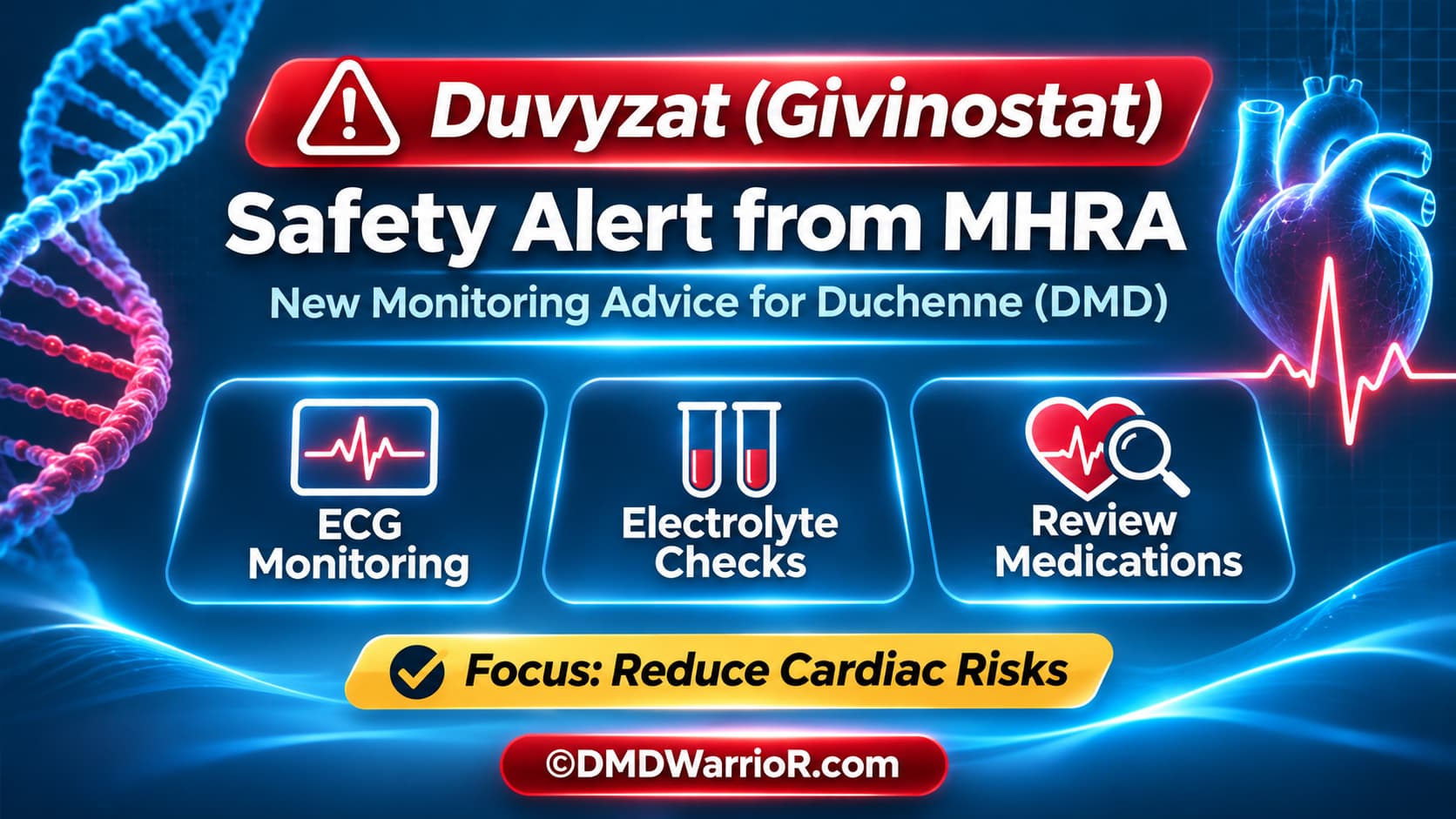
The UK Medicines and Healthcare products Regulatory Agency (MHRA) has issued an important drug safety update concerning Duvyzat (givinostat), a treatment for Duchenne muscular dystrophy (DMD), following reports of several deaths internationally among patients receiving the medication. The announcement highlights the need for enhanced cardiac monitoring and more frequent blood tests to reduce potentially serious treatment-related risks.
Importantly, the reported deaths do not, by themselves, establish that givinostat caused them. The MHRA has reviewed the available cases and reached a decision on proposed changes to the medicine’s monitoring requirements. However, implementation remains subject to an independent review, and the current recommendations are interim measures.
Table of Contents
Key Safety Concern: QTc Prolongation and Cardiac Arrhythmias
One of the main concerns is that givinostat can prolong the QTc interval, an electrical measurement of the heart’s activity. Significant QTc prolongation can increase the risk of dangerous ventricular arrhythmias, potentially leading to life-threatening complications.
The MHRA advises against using Duvyzat in patients at increased risk of ventricular arrhythmias, particularly those with:
- Congenital long QT syndrome.
- Coronary artery disease.
- Electrolyte imbalances, particularly involving potassium, magnesium, or calcium.
- Concurrent use of medications known to prolong the QT interval.
These risk factors require careful assessment before treatment begins and throughout therapy.
Essential Risk Mitigation and Monitoring Recommendations
The MHRA highlights several measures that healthcare professionals should implement to improve patient safety.
1. Regular ECG Monitoring
Electrocardiograms (ECGs) should be performed:
- Before starting givinostat treatment.
- Within 2–4 weeks after treatment initiation.
- Every 6 months thereafter.
- Whenever clinically indicated, including following dose changes.
Additionally, the MHRA recommends 24-hour ambulatory ECG (Holter) monitoring before treatment and repeating it once the patient has reached a stable medication dose.
2. More Frequent Electrolyte Testing
Blood tests measuring potassium, magnesium, and calcium levels should be performed according to the following schedule:
- Every 2 weeks during the first 2 months.
- At month 3.
- Every 3 months thereafter.
These tests are essential because electrolyte imbalances can increase susceptibility to cardiac arrhythmias.
3. Review All Concomitant Medications
Healthcare professionals should carefully review all medications taken by patients, including newly prescribed drugs and changes to existing treatments. Particular attention should be given to medications that may prolong the QT interval.
4. Specialist Cardiac Assessment
Patients should receive appropriate cardiac evaluation, with cardiology involvement when ECG findings or clinical circumstances indicate increased risk. Treatment initiation and continuation should follow established QTc safety thresholds.
What Should Patients and Families Do?
The MHRA advises patients not to stop taking Duvyzat independently. Patients should continue treatment as prescribed, attend all scheduled monitoring appointments, and inform their Duchenne specialist team about every medication they take.
Families should also promptly discuss any new symptoms or concerns with their healthcare team rather than waiting for the next scheduled appointment.
All suspected adverse drug reactions should be reported through the appropriate national pharmacovigilance system. In the UK, this is the MHRA Yellow Card scheme.