
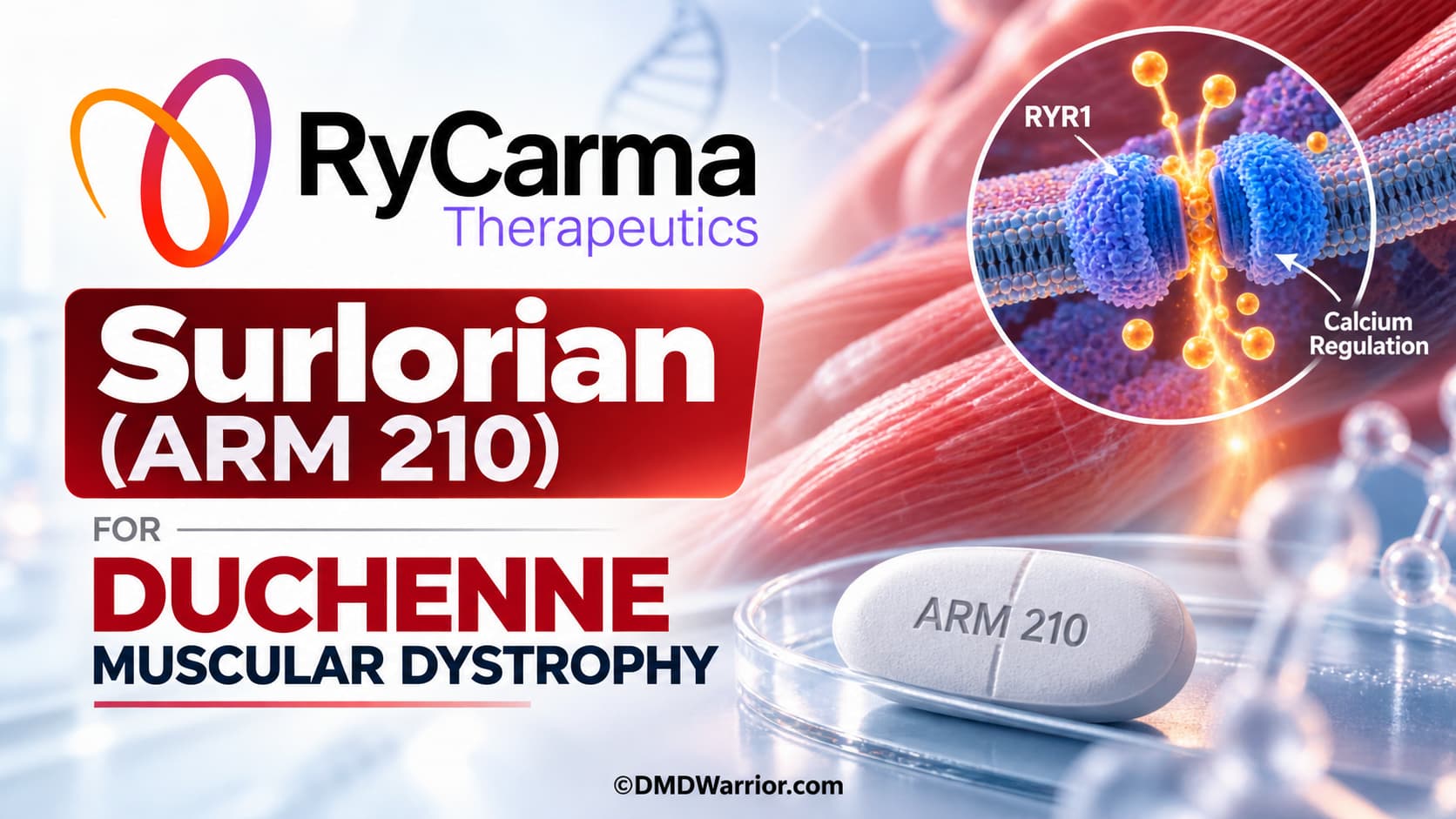
RyCarma Therapeutics is developing Surlorian (ARM 210), an experimental drug that may also be evaluated in Duchenne muscular dystrophy (DMD). In its October 26, 2026, announcement, the company confirmed that the first patient had received treatment in a Phase 2 clinical trial for RYR1-related myopathy. RyCarma also confirmed that it has an open Investigational New Drug (IND) application to evaluate Surlorian in people with Duchenne muscular dystrophy.
Table of Contents
What Is Surlorian (ARM 210)?
Surlorian is an experimental, once-daily oral small-molecule drug designed to improve muscle function by targeting ryanodine receptors (RyRs), which help control calcium release inside muscle cells.
These receptors play an important role in muscle contraction. Surlorian is designed to stabilize the receptors and reduce abnormal calcium leakage, potentially helping muscle cells function more effectively. Unlike gene therapies, Surlorian does not aim to replace the missing dystrophin protein directly.
Surlorian and Duchenne Muscular Dystrophy
RyCarma’s DMD Program Is Phase 2 Ready
According to RyCarma’s official pipeline, the Duchenne muscular dystrophy program is listed as “Phase 2 ready”. The company’s latest announcement also confirms that it has an open IND to evaluate Surlorian in DMD patients. Learn More: RyCarma Pipeline
This is an important development because it shows that RyCarma is pursuing the drug beyond its initial RYR1-related myopathy program. However, the company has not yet announced a DMD trial start date, study design, or patient eligibility criteria.
What Do We Know About Surlorian’s Clinical Results?
In an earlier Phase 1b study involving patients with RYR1-related myopathy, participants receiving the higher dose showed improvements in proximal muscle strength and reported less fatigue. Earlier studies also reported a favorable safety and tolerability profile.
These findings are preliminary and come from studies in RYR1-related myopathy, not Duchenne muscular dystrophy. They do not establish that Surlorian will be effective or safe in people with DMD.
What Happens Next?
RyCarma is currently advancing its Phase 2 study in RYR1-related myopathy, with initial results expected in the second half of 2027. The company’s next steps for Duchenne will be important to watch, particularly the announcement of a clinical trial protocol and plans for patient enrollment.
For the DMD community, Surlorian represents another potential research approach to monitor. However, it remains an investigational treatment, and further clinical studies will be needed to determine whether it can provide meaningful benefits for people living with Duchenne muscular dystrophy.