
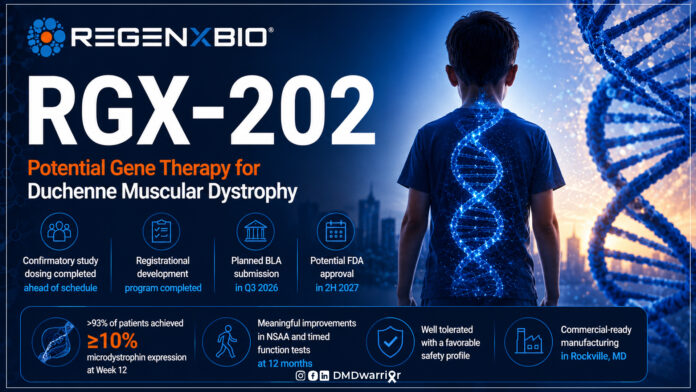
REGENXBIO has announced the completion of patient dosing in the confirmatory study of RGX-202, its investigational gene therapy for Duchenne Muscular Dystrophy (DMD). This important milestone marks the completion of the company’s registrational development program and supports a planned Biologics License Application (BLA) submission to the U.S. Food and Drug Administration (FDA) in the third quarter of 2026.
The company expects that, if approved, RGX-202 could become one of the next gene therapies available for people living with Duchenne Muscular Dystrophy.
RGX-202 Development Program Completed Ahead of Schedule
According to REGENXBIO, enrollment and dosing in the confirmatory study were completed earlier than expected due to strong interest from both patients and clinical investigators.
The completion of this study allows the company to move forward with its planned BLA submission under the FDA’s accelerated approval pathway. Read More: What Does BLA Mean in FDA Drug Approvals?
What Is the Accelerated Approval Pathway?
The accelerated approval pathway is designed to help promising treatments for serious diseases reach patients more quickly. Under this process, therapies can receive approval based on surrogate endpoints—such as biomarkers—that are reasonably likely to predict clinical benefit.
REGENXBIO believes RGX-202 meets these requirements based on its microdystrophin expression data, functional outcomes, and safety profile.
Planned FDA Submission in Q3 2026
REGENXBIO plans to begin its BLA submission during the third quarter of 2026.
The application is expected to include:
- Safety data from 63 participants enrolled in the AFFINITY DUCHENNE® pivotal and confirmatory studies.
- Efficacy data from 30 participants in the pivotal study.
- Twelve-month functional assessment results for at least half of the pivotal study participants.
If the FDA review proceeds as expected, the company believes RGX-202 could potentially receive approval during the second half of 2027.
Key Results from the RGX-202 Pivotal Study
The recently reported pivotal study data showed encouraging results for RGX-202.
Primary Endpoint Successfully Achieved
RGX-202 met its primary endpoint, with more than 93 percent of patients achieving at least 10 percent microdystrophin expression at Week 12 after treatment. Read More: RGX-202 Shows NSAA Gains, But Key Biomarker Data Missing
Microdystrophin is a shortened version of the dystrophin protein that gene therapies aim to produce in muscle cells. Dystrophin deficiency is the underlying cause of Duchenne Muscular Dystrophy.
Improvements in Functional Outcomes
Among patients who completed 12-month follow-up assessments, researchers observed meaningful improvements across several functional measures.
These included:
- Timed function tests
- North Star Ambulatory Assessment (NSAA) scores
- Overall physical performance indicators
The company reported a strong magnitude of improvement compared with baseline measurements.
Strong Correlation Between Microdystrophin and Function
REGENXBIO also reported a strong relationship between microdystrophin expression at Week 12 and functional improvements observed one year after treatment.
This finding supports the use of microdystrophin as a surrogate endpoint that may help predict long-term clinical benefit for Duchenne patients.
Safety Profile of RGX-202
The company stated that RGX-202 was generally well tolerated throughout the study.
Researchers reported a favorable safety profile, which REGENXBIO believes differentiates RGX-202 from other potential treatment options currently under development.
Continued monitoring will provide additional long-term safety information as patients remain in follow-up.
REGENXBIO Preparing for Potential Commercial Launch
In anticipation of a possible FDA approval, REGENXBIO has already begun preparing its manufacturing and commercial infrastructure.
The company is using its Manufacturing Innovation Center in Rockville, Maryland, where production intended for future commercial supply began last year.
This manufacturing readiness could help support broader patient access if RGX-202 receives regulatory approval.
What This Means for Duchenne Families
The completion of the confirmatory study represents a significant step forward for RGX-202 and the Duchenne community.
With a planned FDA submission in Q3 2026 and a potential approval decision expected in the second half of 2027, Duchenne families will be closely watching upcoming regulatory developments.
If approved, RGX-202 could become an additional gene therapy option for patients living with Duchenne Muscular Dystrophy, expanding treatment choices and potentially improving long-term outcomes.
Frequently Asked Questions (FAQ)
What is RGX-202?
RGX-202 is an investigational gene therapy being developed by REGENXBIO for the treatment of Duchenne Muscular Dystrophy (DMD).
When will REGENXBIO submit RGX-202 to the FDA?
The company plans to initiate its Biologics License Application (BLA) submission in the third quarter of 2026.
What were the main results of the study?
More than 93 percent of patients achieved at least 10 percent microdystrophin expression at Week 12, and early functional data showed meaningful improvements after one year.
When could RGX-202 be approved?
If the FDA review process proceeds as expected, REGENXBIO believes RGX-202 could potentially receive approval in the second half of 2027.
How many patients are included in the BLA package?
The planned submission is expected to include safety data from 63 participants and efficacy data from 30 participants in the pivotal study.