
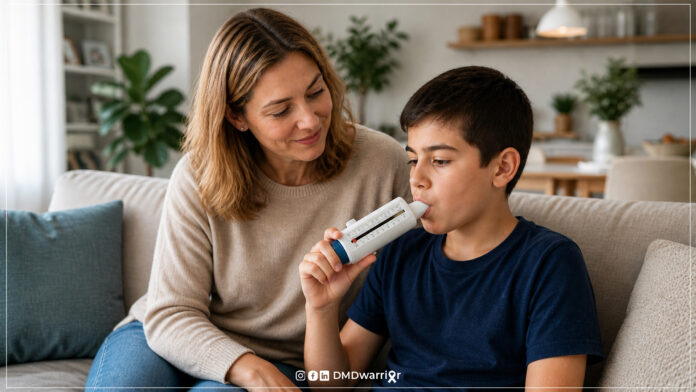
Peak flow meter in Duchenne muscular dystrophy (DMD) is an increasingly important topic in respiratory care, as clinicians and families seek practical ways to monitor lung function decline in patients with Duchenne muscular dystrophy. Measuring peak expiratory flow (PEF) and peak cough flow (PCF) using a peak flow meter in Duchenne muscular dystrophy provides valuable insights into respiratory muscle weakness, disease progression, and the need for timely interventions. In neuromuscular diseases like DMD, where respiratory complications are a leading cause of morbidity and mortality, tools such as peak flow meters, spirometry, and cough flow assessment devices play a critical role in both clinical and home monitoring strategies.
Table of Contents
What is Peak Flow in Duchenne Muscular Dystrophy?
Peak flow refers to the maximum speed of expiration, typically measured in liters per minute (L/min). In the context of Duchenne muscular dystrophy, peak flow measurements—especially peak cough flow (PCF)—are more clinically relevant than standard peak expiratory flow alone.
DMD is characterized by progressive muscle degeneration due to the absence of dystrophin, and this includes the respiratory muscles, such as the diaphragm and intercostal muscles. As these muscles weaken over time, patients experience:

- Reduced ability to inhale deeply
- Ineffective coughing
- Increased risk of respiratory infections
Peak flow meters provide a simple, low-cost, and accessible method to quantify this decline. Learn More: Respiratory Health Care in Duchenne
At What Age Is a Peak Flow Meter Suitable for Children with Duchenne Muscular Dystrophy (DMD)?
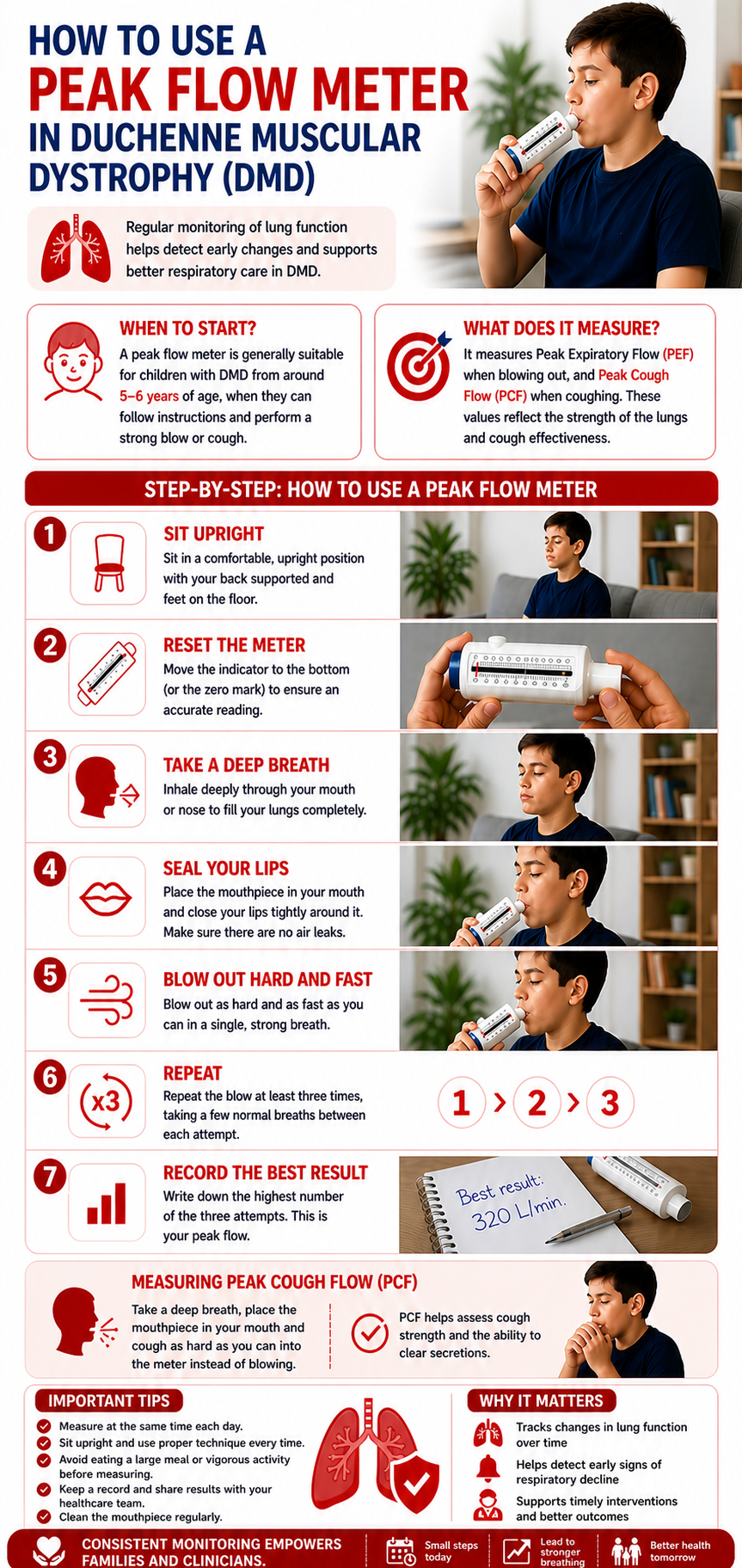
In Duchenne muscular dystrophy (DMD), a peak flow meter is generally suitable once a child can understand instructions and perform a coordinated, forceful exhalation or cough. In practice, this usually begins around 5–6 years of age, though it varies by developmental maturity and cooperation.
Practical Age Guidance
- Under 5 years:
Most children cannot reliably perform the maneuver, so peak flow measurements are usually not accurate or recommended. - Ages 5–7 years:
Many children can begin using a peak flow meter with training and supervision. Results may be variable, so consistency and technique coaching are critical. - Ages 7+ years:
Peak flow meter use becomes more reliable and clinically useful, especially for tracking peak cough flow (PCF) over time.
Why Age Alone Is Not Enough
Suitability depends less on chronological age and more on:
- Ability to follow multi-step instructions
- Ability to seal lips tightly around the mouthpiece
- Ability to perform a maximal effort blow or cough
- Cognitive and behavioral readiness
How to Measure Peak Flow in Duchenne Muscular Dystrophy
Measuring peak flow in Duchenne muscular dystrophy requires proper technique and consistency to ensure accurate and reproducible results.
How is a peak flow meter used step by step in Duchenne muscular dystrophy (DMD)?
- Sit upright in a comfortable position.
- Reset the peak flow meter to zero.
- Ensure the mouthpiece is clean and properly attached.
- Take a deep breath to fill the lungs completely.
- Place the mouthpiece in the mouth and seal lips tightly around it.
- Blow out as hard and as fast as possible in a single breath.
- Repeat the measurement at least three times.
- Record the highest value obtained.
- Perform measurements at the same time each day for consistency.
- For peak cough flow (PCF): Take a deep breath and cough forcefully into the device instead of blowing.
For peak cough flow (PCF):
- The patient performs a maximal cough instead of a forced exhalation
Clinical Considerations
- Use nose clips if necessary
- Ensure proper calibration of the device
- Perform measurements at the same time daily
In advanced DMD, measurements may require assistance or adapted devices.
Peak Flow Meter Use in Neuromuscular Disease
The application of peak flow meter in Duchenne muscular dystrophy extends from broader practices in neuromuscular disease management.
Why It Matters
Neuromuscular diseases impair respiratory muscles before lung tissue itself is affected. This leads to:
- Reduced lung volumes
- Ineffective airway clearance
- Progressive hypoventilation
Peak flow meters help clinicians:
- Detect early respiratory decline
- Monitor disease progression longitudinally
- Evaluate response to interventions
Monitoring Respiratory Decline in DMD Patients
Respiratory decline in DMD typically follows a predictable trajectory:
- Early stage: Normal lung function
- Mid stage: Decline in forced vital capacity (FVC)
- Late stage: Severe reduction in cough effectiveness
Peak flow meter in Duchenne muscular dystrophy becomes particularly valuable during the transition from ambulatory to non-ambulatory stages, where respiratory compromise accelerates.
Key Indicators
- Declining peak cough flow
- Frequent respiratory infections
- Reduced oxygen saturation
Peak Cough Flow Thresholds in Duchenne Muscular Dystrophy
Peak cough flow (PCF) is one of the most clinically significant metrics in DMD respiratory care.
Important Thresholds
- >270 L/min → Effective cough
- 160–270 L/min → At risk, requires monitoring
- <160 L/min → Ineffective cough, intervention needed
Patients below 270 L/min often benefit from airway clearance techniques, while those below 160 L/min may require mechanical cough assist devices.
Home Respiratory Monitoring in Duchenne Muscular Dystrophy
One of the strongest advantages of using a peak flow meter in Duchenne muscular dystrophy is its suitability for home-based monitoring.
Benefits
- Early detection of deterioration
- Reduced hospital visits
- Empowerment of caregivers
Best Practices
- Keep a daily log of peak flow values
- Monitor during illness or fatigue
- Share data with healthcare providers
Peak Flow Meter for Cough Assessment in DMD
Unlike asthma, where peak flow meters measure airflow limitation, in DMD they are often used to evaluate cough strength.
Clinical Importance
An ineffective cough leads to:
- Secretion retention
- Atelectasis
- Pneumonia
Peak flow meter in Duchenne muscular dystrophy allows clinicians to quantify cough effectiveness objectively.
Respiratory Muscle Weakness in Duchenne Muscular Dystrophy
Respiratory muscle weakness is progressive and inevitable in DMD.
Affected Muscles
- Diaphragm
- Intercostal muscles
- Abdominal muscles
This results in:
- Reduced inspiratory capacity
- Weak cough
- Sleep-disordered breathing
Lung Function Decline in Duchenne Muscular Dystrophy
Lung function decline correlates strongly with disease progression.
Key Measurements
- Forced Vital Capacity (FVC)
- Peak Expiratory Flow (PEF)
- Peak Cough Flow (PCF)
Peak flow meter in Duchenne muscular dystrophy complements spirometry by offering quick and repeatable assessments.
Forced Vital Capacity vs Peak Flow in DMD
Both FVC and peak flow measurements are essential but serve different purposes.
| Measurement | Purpose | Limitation |
|---|---|---|
| FVC | Overall lung capacity | Requires spirometry |
| Peak Flow | Airflow/cough strength | Less comprehensive |
Peak flow is especially useful for frequent monitoring, while FVC is used in clinical settings.
Noninvasive Respiratory Monitoring in DMD
Modern DMD care emphasizes noninvasive monitoring tools, including:
- Peak flow meters
- Pulse oximeters
- Capnography
These tools allow earlier intervention and improved outcomes.
Peak Flow Meter Accuracy in DMD
Accuracy can vary due to:
- Patient effort
- Device quality
- Technique
To improve reliability:
- Use consistent technique
- Calibrate devices regularly
- Compare with spirometry periodically
Cough Peak Flow Measurement Devices
While peak flow meters are widely used, specialized devices for cough assessment also exist.
Alternatives
- Digital spirometers
- Mechanical insufflation-exsufflation devices
However, peak flow meter in Duchenne muscular dystrophy remains the most accessible option globally.
Spirometry vs Peak Flow Meter in Duchenne Muscular Dystrophy
Spirometry provides comprehensive lung function data, but:
- Requires clinical setting
- Needs trained personnel
Peak flow meters:
- Are portable
- Enable daily monitoring
The two methods are complementary rather than competitive.
Peak Flow Monitoring at Home in Neuromuscular Patients
Routine home monitoring improves outcomes by:
- Detecting early decline
- Preventing complications
- Guiding therapy adjustments
Families should be trained in correct technique and interpretation.
Respiratory Assessment Tools in Duchenne Muscular Dystrophy
A comprehensive respiratory assessment includes:
- Peak flow meter in Duchenne muscular dystrophy
- Spirometry
- Blood gas analysis
- Sleep studies
FAQs: Peak Flow Meter in Duchenne Muscular Dystrophy
What is a peak flow meter in Duchenne muscular dystrophy?
A peak flow meter in Duchenne muscular dystrophy is a handheld device used to measure how fast air can be expelled from the lungs, helping assess respiratory muscle strength. In DMD, it is especially useful for tracking peak expiratory flow (PEF) and peak cough flow (PCF), which indicate how effectively a patient can breathe out and cough. Since respiratory muscles weaken over time in Duchenne muscular dystrophy, regular use of a peak flow meter allows early detection of decline and helps guide timely interventions such as cough assist devices or noninvasive ventilation.
Why is peak cough flow important in Duchenne muscular dystrophy?
Peak cough flow is critical because it measures how strong a patient’s cough is, which directly affects their ability to clear mucus from the lungs. In Duchenne muscular dystrophy, weak respiratory muscles lead to ineffective coughing, increasing the risk of infections like pneumonia. Clinically, values above 270 L/min are considered effective, while values below 160 L/min indicate a high risk of secretion retention and may require assisted airway clearance techniques.
How often should peak flow be measured in DMD patients?
Peak flow in Duchenne muscular dystrophy should typically be measured daily or several times per week, especially in the non-ambulatory stages or when respiratory decline begins. During illness, fatigue, or noticeable breathing changes, measurements should be taken more frequently. Consistent tracking over time provides a trend that is more valuable than a single reading and helps clinicians make informed decisions.
What is a normal peak flow value in Duchenne muscular dystrophy?
There is no single “normal” peak flow value in Duchenne muscular dystrophy because results vary based on age, height, and disease stage. However, in clinical practice, peak cough flow thresholds are more important than absolute peak expiratory flow values. A peak cough flow above 270 L/min is generally considered adequate, while lower values indicate increasing respiratory compromise and the need for intervention.
Can a peak flow meter detect early respiratory decline in DMD?
Yes, a peak flow meter in Duchenne muscular dystrophy can help detect early respiratory decline by identifying gradual reductions in airflow and cough strength. Although spirometry remains the gold standard for lung function testing, peak flow monitoring provides a simple, accessible, and frequent assessment tool that can reveal subtle changes before symptoms become severe.
Is peak flow meter monitoring enough instead of spirometry in DMD?
No, peak flow meter monitoring should not replace spirometry in Duchenne muscular dystrophy. While peak flow meters are useful for daily home monitoring, spirometry provides a more comprehensive evaluation of lung function, including forced vital capacity (FVC). The two methods should be used together, with peak flow for routine tracking and spirometry for clinical assessments.
How do you use a peak flow meter correctly in Duchenne muscular dystrophy?
To use a peak flow meter correctly, the patient should sit upright, take a deep breath to full lung capacity, and blow out as forcefully and quickly as possible into the device. This should be repeated at least three times, and the highest value recorded. For peak cough flow, the patient performs a strong cough instead of a forced exhalation. Proper technique is essential for accurate and reliable results.
When should a cough assist device be used in DMD?
A cough assist device is typically recommended when peak cough flow falls below 270 L/min, and it becomes essential when values drop below 160 L/min. At these levels, patients are unable to clear secretions effectively, increasing the risk of respiratory complications. Early use of cough assist devices can significantly improve airway clearance and reduce hospitalizations.
Can peak flow monitoring be done at home for Duchenne patients?
Yes, peak flow monitoring at home is strongly recommended for patients with Duchenne muscular dystrophy. It allows families to track respiratory function regularly, detect early signs of decline, and communicate changes to healthcare providers. Home monitoring is especially valuable because it enables proactive management rather than reactive treatment.
What are the limitations of a peak flow meter in Duchenne muscular dystrophy?
While useful, a peak flow meter in Duchenne muscular dystrophy has limitations. Results depend heavily on patient effort and technique, and the device does not measure all aspects of lung function, such as lung volume or gas exchange. Additionally, in advanced stages of DMD, patients may struggle to perform the test accurately. Therefore, peak flow meters should be used alongside other clinical assessments for a complete evaluation.
Final Thoughts
Peak flow meter in Duchenne muscular dystrophy is a practical tool for tracking respiratory decline. It enables early detection of weakening cough strength and airflow. Regular monitoring supports timely interventions and better outcomes. Families can use it easily at home with proper guidance. It complements spirometry, not replaces it. Consistent data helps clinicians adjust care plans. Tracking trends is more valuable than single readings. Early action can reduce complications and hospitalizations. Integrating it into daily care improves long-term management. Overall, it empowers proactive and informed Duchenne care.
Academic Sources and References
- Bushby K, et al. Diagnosis and management of Duchenne muscular dystrophy, part 2: respiratory care. Lancet Neurology, 2010.
- Finder JD, et al. Respiratory care of the patient with Duchenne muscular dystrophy. ATS Guidelines, 2004.
- Birnkrant DJ, et al. DMD Care Considerations (2018 update). Lancet Neurology.
- Toussaint M, et al. Cough augmentation in neuromuscular disorders. European Respiratory Journal.
- Chatwin M, et al. Airway clearance techniques in neuromuscular disease. Thorax Journal.