
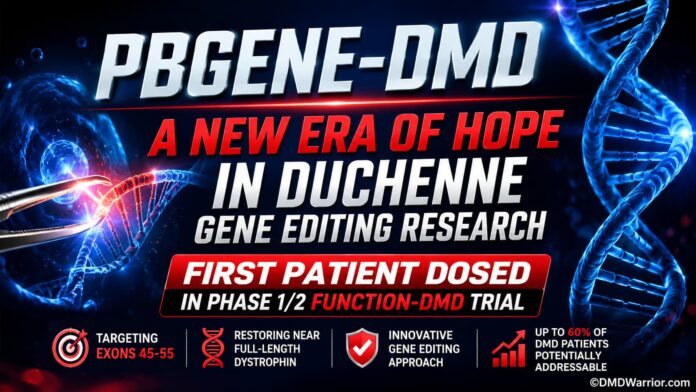
Precision BioSciences has reached an important milestone in Duchenne muscular dystrophy (DMD) gene editing. The company announced on August 24, 2026, that the first patient has been dosed in the Phase 1/2 FUNCTION-DMD clinical trial evaluating PBGENE-DMD, an investigational in vivo gene-editing therapy for Duchenne. The first dose was administered at Arkansas Children’s Hospital, a specialized Duchenne care center.
Table of Contents
What Is PBGENE-DMD?
PBGENE-DMD is designed to address the underlying genetic defect rather than simply delivering a shortened dystrophin protein. The treatment uses two complementary ARCUS nucleases, delivered through a single AAV vector, to excise exons 45–55 from the DMD gene. The goal is to restore the reading frame and enable production of a near full-length functional dystrophin protein.
This strategy is scientifically significant because gene editing has previously been investigated as a way to remove disruptive regions of the dystrophin gene and restore dystrophin expression. Experimental studies have demonstrated exon 45–55 deletion and restoration of dystrophin expression in DMD models. Learn More: PBGENE-DMD
Why Exons 45–55 Matter in Duchenne
The exon 45–55 region represents a major DMD mutation hotspot. Precision BioSciences estimates that mutations in this region may make approximately 60 percent of boys with DMD potentially addressable by PBGENE-DMD.
However, genetic eligibility should not be confused with clinical effectiveness. A patient may have a mutation within the target region and still require additional evaluation before determining whether a clinical trial or future therapy is appropriate.
FUNCTION-DMD Phase 1/2 Trial Begins
The FUNCTION-DMD study is currently enrolling ambulatory DMD patients aged 2–7 years with mutations between exons 45 and 55. Multiple specialized U.S. Duchenne clinical sites are involved, and initial safety data are expected by the end of 2026. Discover Now: Duchenne Exon Deletion Tool
The immediate priority is safety. Because PBGENE-DMD permanently modifies DNA, the clinical program must establish not only whether editing occurs, but also whether the treatment produces an acceptable safety profile and meaningful biological and functional effects.
This distinction is critical. Preclinical success does not establish clinical efficacy. FDA guidance for DMD drug development emphasizes the importance of clinically meaningful outcomes and encourages assessment across skeletal, respiratory and cardiac manifestations where feasible.Learn More: PBGENE-DMD Phase 1/2a Clinical Trial
How PBGENE-DMD Differs From Microdystrophin
One of the central distinctions is the intended source of dystrophin. PBGENE-DMD aims to edit the patient’s own DMD gene, potentially allowing endogenous production of a near full-length dystrophin protein. This differs from microdystrophin approaches, which introduce a shortened dystrophin construct.
Precision BioSciences has reported encouraging preclinical findings, including dystrophin restoration and functional improvements in animal models. These findings remain preclinical and therefore cannot establish whether comparable benefits will occur in humans.
What Should DMD Families Watch Next?
The most important milestones will be clinical safety data, dystrophin restoration, functional outcomes and durability. Families should distinguish carefully between company-reported preclinical results and peer-reviewed human clinical evidence.
DMD is a multisystem disease involving skeletal, cardiac and respiratory muscle, making comprehensive assessment essential.
The first patient dosing therefore represents a beginning, not a conclusion. PBGENE-DMD has now moved from laboratory development into human clinical testing. The next question is whether this gene-editing strategy can safely translate its biological promise into durable, meaningful benefits for people living with Duchenne.
Discover More: Explore Duchenne Clinical Trials