

A creatine kinase level in Duchenne muscular dystrophy (DMD) is often one of the earliest and most important laboratory findings that leads physicians toward a diagnosis. Before muscle weakness becomes obvious, many children already have a creatine kinase level high enough to raise concern during routine blood tests. Parents frequently search online for answers after hearing that their child’s creatine kinase level is high, wondering whether it is caused by exercise, an infection, muscle injury, or a serious neuromuscular disease such as Duchenne muscular dystrophy.
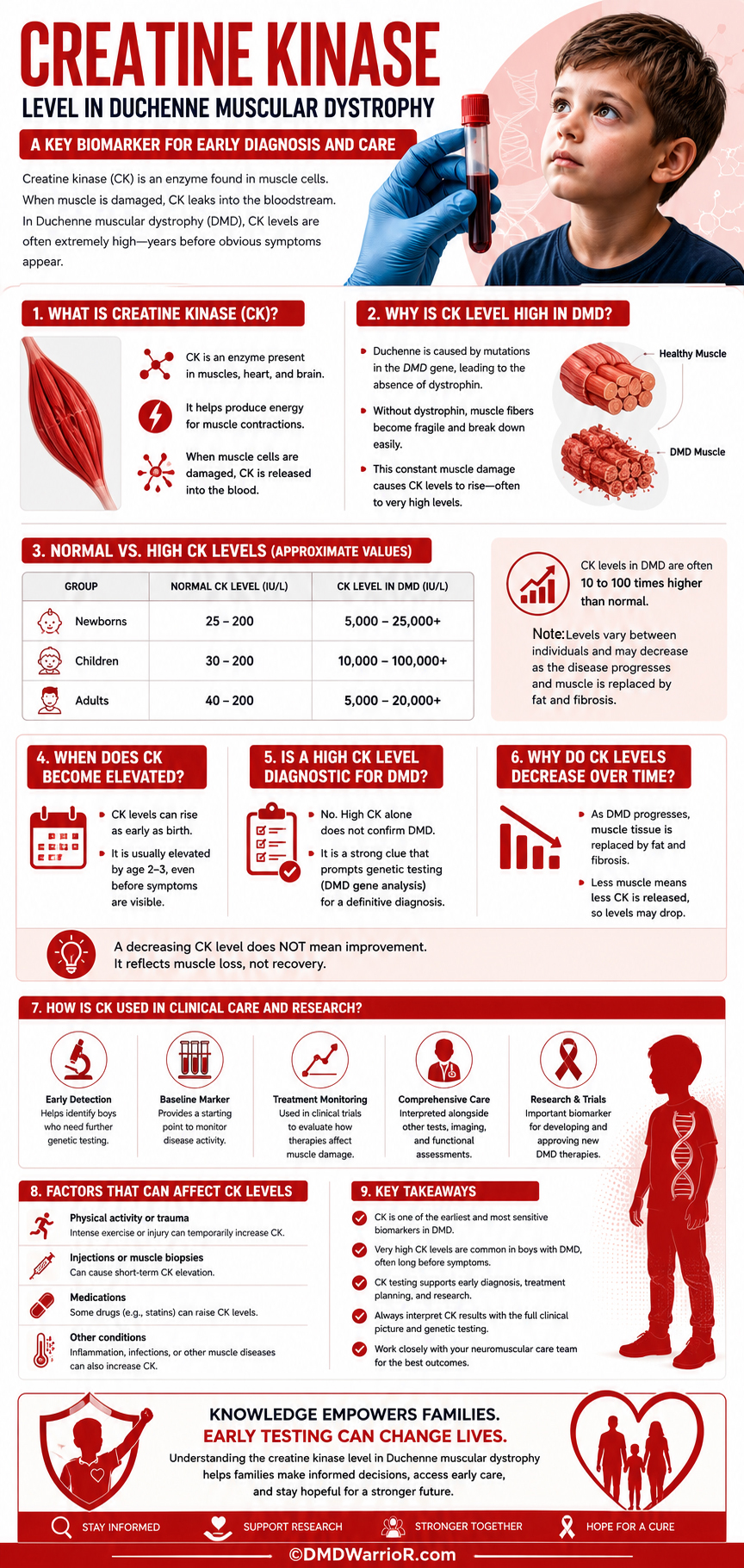
Understanding the creatine kinase level in Duchenne muscular dystrophy is essential because this blood marker reflects ongoing muscle damage. In healthy individuals, creatine kinase (CK), also known as creatine phosphokinase (CPK), remains inside muscle cells. However, in Duchenne muscular dystrophy, the absence of functional dystrophin makes muscle fibers fragile. Even normal daily activities cause microscopic muscle tears, allowing large amounts of CK to leak into the bloodstream. As a result, children with Duchenne often have CK levels 10 to 100 times higher than normal, sometimes long before the first clinical symptoms appear.
Many families ask questions such as “What is normal creatine kinase level?”, “What level of creatine kinase is dangerous?”, “What causes a high creatine kinase level?”, and “Can a high CK level diagnose Duchenne muscular dystrophy?”. This guide answers these questions using current medical evidence, explains how CK testing is used in diagnosis, discusses why CK levels change over time, and explores how this biomarker fits into the modern management of Duchenne muscular dystrophy.
Table of Contents
Understanding Creatine Kinase (CK)
What Is Creatine Kinase?
Creatine kinase (CK) is an enzyme that helps muscles produce and recycle energy during movement. It plays a critical role in rapidly regenerating ATP, the molecule that powers muscle contraction. Because skeletal muscles require enormous amounts of energy, they contain very high concentrations of CK.
Under normal conditions, only a small amount of CK enters the bloodstream. When muscle fibers become damaged, however, CK leaks into circulation, causing blood levels to rise.
For this reason, CK is widely used as a laboratory marker of muscle injury. Learn More: What Is Creatine Kinase?
The Three Main Types of Creatine Kinase
There are three major CK isoenzymes.
CK-MM
- Found primarily in skeletal muscles
- Represents approximately 95% of total CK
- Most relevant in Duchenne muscular dystrophy
CK-MB
- Primarily associated with cardiac muscle
- Historically used to diagnose heart attacks
- Now largely replaced by cardiac troponins
CK-BB
- Found mainly in the brain and nervous system
- Rarely measured in routine clinical practice
For Duchenne muscular dystrophy, physicians are primarily interested in CK-MM, which reflects skeletal muscle damage.
What Is the Normal Creatine Kinase Level?
Normal CK values vary depending on several factors:
- Age
- Sex
- Muscle mass
- Ethnicity
- Laboratory reference ranges
- Recent exercise
Typical adult reference ranges include:
| Population | Typical CK Range |
|---|---|
| Adult males | 40–200 U/L |
| Adult females | 25–170 U/L |
| Children | Often slightly higher than adults |
Some laboratories use upper reference limits around 250 U/L, while pediatric laboratories may have different normal values.
Because CK varies naturally, physicians always interpret results alongside the patient’s age, symptoms, and medical history.
Why Does Creatine Kinase Increase?
What Causes a High Creatine Kinase Level?
A creatine kinase level high does not automatically indicate Duchenne muscular dystrophy. Many conditions can temporarily elevate CK.
Common causes include:
Exercise
Intense exercise may increase CK several-fold for one to three days.
Examples include:
- marathon running
- weight lifting
- CrossFit
- military training
- competitive sports
Muscle Injury
Muscle trauma frequently causes elevated CK.
Examples include:
- falls
- fractures
- crush injuries
- surgery
- injections
- prolonged immobilization
Medications
Certain medications can damage muscle tissue.
Examples include:
- statins
- colchicine
- corticosteroids (rarely)
- antipsychotic medications
Viral Infections
Influenza, COVID-19, enteroviruses, and other viral illnesses may temporarily raise CK levels because of muscle inflammation. Learn More: Infections in DMD
Autoimmune Muscle Diseases
Inflammatory myopathies such as polymyositis and dermatomyositis often produce elevated CK values.
Endocrine Disorders
Several endocrine diseases affect muscle metabolism.
Examples include:
- hypothyroidism
- hyperthyroidism
- adrenal disorders
Genetic Muscle Diseases
Inherited muscle disorders frequently produce chronically elevated CK.
Examples include:
- Duchenne muscular dystrophy
- Becker muscular dystrophy
- Limb-girdle muscular dystrophy
- Emery-Dreifuss muscular dystrophy
- Dysferlinopathy
Among these disorders, Duchenne muscular dystrophy typically produces some of the highest CK values observed in pediatric medicine.
Why Is Creatine Kinase So High in Duchenne Muscular Dystrophy?
The Role of Dystrophin
To understand the creatine kinase level in Duchenne muscular dystrophy, it is important to understand dystrophin.
Dystrophin acts like a shock absorber for muscle cells. Read More: Dystrophin Gene
Every time muscles contract, dystrophin stabilizes the muscle cell membrane.
Without dystrophin:
- muscle membranes become fragile
- microscopic tears develop
- muscle proteins leak into the bloodstream
- creatine kinase escapes from muscle cells
- chronic inflammation develops
- muscle fibers die
- fat and scar tissue gradually replace muscle
Since muscle damage occurs every day—even during walking, standing, or climbing stairs—CK continuously leaks into the bloodstream.
Why CK Rises Before Symptoms
One remarkable feature of Duchenne muscular dystrophy is that CK becomes elevated months or even years before parents notice muscle weakness.
A child may:
- appear healthy
- meet developmental milestones
- have no obvious weakness
Yet laboratory testing may already reveal a CK concentration that is tens of thousands of units above normal.
This makes CK one of the earliest biochemical markers of Duchenne muscular dystrophy.
How High Can Creatine Kinase Levels Become in Duchenne?
Unlike temporary elevations caused by exercise or infections, the creatine kinase level in Duchenne muscular dystrophy is often dramatically elevated.
Typical findings include:
| Condition | Typical CK Level |
|---|---|
| Healthy child | 30–250 U/L |
| After strenuous exercise | 500–3,000 U/L |
| Viral myositis | 1,000–10,000 U/L |
| Duchenne muscular dystrophy | 10,000–30,000+ U/L |
Some infants with Duchenne have CK levels exceeding 50,000 U/L at diagnosis.
It is important to understand that the exact number does not indicate how severe the disease will become. Instead, it reflects the amount of muscle membrane damage occurring at that moment.
A child with a CK level of 18,000 U/L does not necessarily have milder disease than a child with a CK level of 28,000 U/L.
Can High CK Alone Diagnose Duchenne Muscular Dystrophy?
The Short Answer: No
Although the creatine kinase level in Duchenne muscular dystrophy is usually extremely high, CK testing alone cannot confirm the diagnosis. Read More: Newly Diagnosed Patients with Duchenne
Many other conditions—including viral muscle inflammation, rhabdomyolysis, metabolic myopathies, Becker muscular dystrophy, and several limb-girdle muscular dystrophies—can also produce markedly elevated CK levels.
Instead, CK serves as a screening biomarker that alerts clinicians to the possibility of an underlying neuromuscular disorder. When a child has persistent, unexplained CK elevations—particularly values reaching thousands or tens of thousands of units per liter—further evaluation is essential.
The Recommended Diagnostic Pathway
Current international practice generally follows this sequence:
- Clinical history and physical examination.
- Creatine kinase (CK) blood test.
- Repeat CK test if temporary causes (such as recent strenuous exercise or viral illness) are suspected.
- Genetic testing of the DMD gene using techniques such as MLPA (Multiplex Ligation-dependent Probe Amplification) and next-generation sequencing. Read More: DMD Genetic Testing
- Muscle biopsy only when genetic testing does not provide a definitive diagnosis or additional pathological information is required.
Today, advances in molecular diagnostics mean that genetic testing has largely replaced muscle biopsy as the gold standard for confirming Duchenne muscular dystrophy.
Why Do Creatine Kinase Levels Decrease as Duchenne Muscular Dystrophy Progresses?
One of the most misunderstood aspects of the creatine kinase level in Duchenne muscular dystrophy is that CK values often decline over time. Many parents assume that a lower CK level means the disease is improving or that treatment is working. Unfortunately, this is usually not the case.
Why Does CK Fall in Later Stages?
Creatine kinase is released only from living muscle fibers. As Duchenne muscular dystrophy progresses, healthy muscle tissue is gradually replaced by:
- Fat (adipose tissue)
- Fibrous scar tissue
- Connective tissue
With fewer functioning muscle fibers remaining, there is less muscle tissue available to leak CK into the bloodstream. Consequently, blood CK concentrations may fall—even though muscle weakness continues to worsen.
This is why a decreasing CK level should never be interpreted in isolation.
A Simplified Example
Imagine a leaking water tank:
- Early Duchenne: The tank is large and has many holes, so a great deal of water leaks out (very high CK).
- Advanced Duchenne: The tank has become much smaller because much of it has disappeared. Although leaks still exist, there is far less water available to escape (lower CK).
The leak appears smaller, but only because the tank itself has diminished.
Why Functional Assessments Matter More
For long-term monitoring, clinicians rely on several measures in addition to CK, including:
- Motor function assessments (such as the North Star Ambulatory Assessment [NSAA])
- Six-Minute Walk Test (6MWT)
- Timed function tests (e.g., time to rise, stair climbing)
- Pulmonary function tests (forced vital capacity)
- Cardiac imaging (echocardiography and cardiac MRI)
- Muscle MRI to evaluate fat replacement
- Quantitative dystrophin expression (in selected clinical trials)
These assessments provide a more accurate picture of disease progression than CK alone.
Is Creatine Kinase a Biomarker for Duchenne Muscular Dystrophy?
Yes. Creatine kinase is considered one of the earliest and most sensitive biochemical biomarkers of muscle damage in Duchenne muscular dystrophy.
However, it is important to distinguish between diagnostic biomarkers and treatment-response biomarkers.
CK as a Diagnostic Biomarker
CK is extremely valuable for:
- Identifying children who may have a neuromuscular disorder.
- Prompting early referral to a pediatric neurologist.
- Supporting decisions to perform genetic testing.
- Detecting muscle damage before obvious clinical symptoms develop.
In many cases, a markedly elevated CK level is the first clue that ultimately leads to a Duchenne diagnosis.
CK as a Disease Monitoring Biomarker
Although CK reflects ongoing muscle injury, it is not an ideal marker for disease progression because:
- CK varies considerably between individuals.
- Exercise, infections, and trauma can temporarily increase CK.
- CK naturally decreases in later disease stages as muscle mass is lost.
- CK does not consistently correlate with functional ability.
For these reasons, most clinical trials use CK as a supportive biomarker rather than a primary efficacy endpoint.
How Is Creatine Kinase Used in Duchenne Clinical Trials?
Many investigational therapies aim to reduce muscle damage by restoring dystrophin production or improving muscle stability.
Examples include:
- Gene replacement therapy
- Exon-skipping therapies
- Gene-editing approaches (CRISPR-based therapies)
- Cell therapies
- Utrophin modulation
- Anti-inflammatory therapies
- Myostatin inhibition
- Muscle-protective small molecules
Researchers often measure CK before and after treatment to determine whether muscle membrane damage appears to be decreasing.
However, regulators such as the U.S. Food and Drug Administration (FDA) and the European Medicines Agency (EMA) generally require additional evidence, including:
- Dystrophin protein expression
- Functional motor outcomes
- Patient-reported outcomes
- Safety data
- Long-term follow-up
A reduction in CK alone is not sufficient to demonstrate clinical benefit. >>> Explore Duchenne Clinical Trials
Why DMDWarrior Encourages Greater Biomarker Transparency
Families affected by Duchenne muscular dystrophy deserve access to comprehensive clinical trial data—not just summary statements that a treatment “met expectations.”
While many clinical studies report improvements in motor function or dystrophin production, biomarkers such as:
- Creatine kinase (CK)
- Aspartate aminotransferase (AST)
- Alanine aminotransferase (ALT)
are not always presented in sufficient detail.
Publishing these laboratory findings can help families, clinicians, and researchers better understand:
- Whether muscle damage appears to decrease over time.
- How biomarker changes compare with functional improvements.
- Whether laboratory findings align with dystrophin expression.
- How individual patients respond to treatment.
Although CK should never be interpreted alone, transparent reporting contributes to a more complete understanding of therapeutic effects. Learn More: Why CK, AST, and ALT Data Matter
Creatine Kinase vs AST vs ALT
Many parents become alarmed when routine blood tests show elevated AST and ALT because these enzymes are commonly associated with liver disease.
However, in Duchenne muscular dystrophy, elevated AST and ALT often originate from skeletal muscle, not the liver.
Understanding the Differences
| Marker | Primary Source | Why It May Be Elevated in Duchenne |
|---|---|---|
| Creatine kinase (CK) | Skeletal muscle | Muscle fiber damage |
| AST | Muscle and liver | Muscle injury releases AST |
| ALT | Mostly liver, also muscle | Muscle damage can increase ALT |
Because CK is highly specific for skeletal muscle injury, physicians interpret AST and ALT together with CK before concluding that liver disease is present.
A Common Clinical Scenario
A toddler undergoes routine blood work for an unrelated illness.
Results show:
- AST: Elevated
- ALT: Elevated
Concerned about possible liver disease, the pediatrician orders additional tests.
A CK measurement is then obtained and reveals a value of 18,000 U/L.
This dramatically elevated CK suggests that the abnormal AST and ALT are most likely the result of muscle damage, prompting referral for neuromuscular evaluation and genetic testing.
Recognizing this pattern can significantly shorten the time to diagnosis.
Can Exercise Increase Creatine Kinase Levels?
Yes.
One of the most common reasons for a creatine kinase level high in healthy individuals is vigorous physical activity.
Activities that may temporarily increase CK include:
- Marathon running
- Heavy resistance training
- High-intensity interval training
- Competitive sports
- Military exercises
- Long-distance cycling
In healthy people, CK usually peaks 24–72 hours after exercise and gradually returns to baseline over several days.
Does Exercise Explain Extremely High CK Levels?
Usually not.
While strenuous exercise can raise CK into the low thousands, persistent values in the 10,000–30,000 U/L range—particularly in infants or young children—should prompt evaluation for an underlying neuromuscular disorder such as Duchenne muscular dystrophy.
Can Viral Infections Raise CK?
Yes.
Viruses such as influenza, enteroviruses, COVID-19, and others may cause temporary inflammation of skeletal muscle (viral myositis).
In these cases:
- CK rises during the illness.
- Muscle pain is often prominent.
- CK generally returns to normal within days or weeks after recovery.
Persistent or repeatedly elevated CK values should not be attributed to viral illness without appropriate follow-up.
Newborn Screening and Creatine Kinase
One of the most promising developments in Duchenne muscular dystrophy is the expansion of newborn screening programs.
Several regions have investigated measuring CK from dried blood spots collected shortly after birth.
Why Screen Newborns?
Most children with Duchenne appear healthy at birth.
Diagnosis often occurs only after:
- Delayed walking
- Frequent falls
- Difficulty climbing stairs
- Enlarged calf muscles
- Gowers’ sign
- Elevated liver enzymes
Unfortunately, this delay can postpone access to:
- Corticosteroid therapy
- Cardiac monitoring
- Respiratory surveillance
- Physical therapy
- Genetic counseling
- Clinical trials
Early identification provides families with valuable time to plan care and consider emerging treatment options.
Limitations of CK-Based Screening
Although CK is highly sensitive, it is not perfectly specific.
False-positive results may occur because of:
- Birth trauma
- Difficult delivery
- Temporary muscle injury
- Other neuromuscular disorders
Therefore, abnormal newborn CK screening should always be followed by confirmatory genetic testing.
Creatine Kinase After Gene Therapy
Gene therapies aim to deliver a functional micro-dystrophin gene to muscle cells.
If successful, newly produced dystrophin may stabilize muscle membranes and reduce CK leakage.
What Do Researchers Expect?
Following treatment, investigators often monitor:
- CK
- AST
- ALT
- Troponin
- Immune markers
- Liver function
- Platelet counts
Some patients demonstrate reductions in CK after treatment.
However:
- The magnitude of CK reduction varies.
- Timing differs between individuals.
- Lower CK does not automatically indicate improved muscle function.
Clinical benefit must still be confirmed using functional outcomes and long-term follow-up.
FAQs: Creatine Kinase Level in DMD
What is the normal creatine kinase level?
Normal ranges vary by age, sex, muscle mass, and laboratory methods. In many laboratories, healthy adults have CK values between approximately 25–200 U/L, while children may have slightly higher reference ranges.
What level of creatine kinase is considered dangerous?
There is no universal “dangerous” CK threshold. Physicians interpret CK in the context of symptoms and the underlying cause. Extremely high levels—often above 5,000–10,000 U/L—may require urgent evaluation because they can occur with severe muscle injury or rhabdomyolysis. In Duchenne muscular dystrophy, however, chronically elevated CK reflects ongoing muscle membrane damage rather than an acute emergency.
Can high creatine kinase diagnose Duchenne muscular dystrophy?
No. A markedly elevated CK strongly suggests muscle injury and may raise suspicion for Duchenne, but genetic testing is required to confirm the diagnosis.
Why is creatine kinase elevated before symptoms appear?
Muscle fibers begin leaking CK long before weakness becomes noticeable. This is why CK can be elevated in infants and toddlers who still appear healthy.
Why does CK decrease later in Duchenne?
As muscle tissue is progressively replaced by fat and fibrotic tissue, fewer functioning muscle fibers remain to release CK into the bloodstream.
Can girls have elevated CK if they carry a DMD mutation?
Yes. Some female carriers of DMD gene variants have mildly to moderately elevated CK levels, although many remain asymptomatic. Others may experience muscle weakness or cardiomyopathy, highlighting the importance of individualized evaluation and genetic counseling. Learn More: Duchenne Carriers
Should CK be repeated after an abnormal result?
Yes. If temporary causes such as recent strenuous exercise or a viral illness are suspected, clinicians often repeat the test. Persistent elevation—especially in children—should prompt referral to a neuromuscular specialist.
Is CK useful after a Duchenne diagnosis?
Yes, but mainly as a supportive biomarker. Long-term care focuses more heavily on functional assessments, cardiac monitoring, respiratory evaluation, and emerging molecular biomarkers.
What causes a high creatine kinase level besides Duchenne muscular dystrophy?
A creatine kinase level high is not specific to Duchenne muscular dystrophy. Other causes include:
• Strenuous exercise
• Muscle injuries or trauma
• Viral myositis
• Rhabdomyolysis
• Autoimmune inflammatory myopathies
• Hypothyroidism
• Certain medications (e.g., statins)
• Becker muscular dystrophy
• Limb-girdle muscular dystrophy
• Metabolic muscle disorders
A physician will interpret CK alongside symptoms, medical history, and additional laboratory or genetic tests.
Does a higher CK level mean more severe Duchenne muscular dystrophy?
Not necessarily.
Although CK reflects muscle membrane damage, the absolute CK value does not reliably predict disease severity. Two children with similar clinical symptoms may have very different CK concentrations.
As Duchenne progresses, CK often declines because muscle tissue is replaced by fat and fibrosis.
Can adults with Duchenne still have elevated CK?
Yes.
Adults living with Duchenne muscular dystrophy often continue to have elevated CK levels, although values are generally lower than during early childhood because much of the skeletal muscle has been replaced by connective and fatty tissue.
Can creatine kinase return to normal in Duchenne?
Generally, no.
While CK may decrease over time or after successful treatment, it rarely returns to completely normal levels because the underlying genetic defect remains present.
Does corticosteroid treatment lower CK?
Sometimes.
Corticosteroids such as prednisone or deflazacort may reduce muscle inflammation and stabilize muscle fibers, leading to modest reductions in CK in some patients.
However, the primary goal of steroid therapy is preserving muscle function—not lowering CK.
Is CK useful for monitoring treatment success?
CK provides useful supportive information, but it should never be used alone.
Treatment response should also include:
• Functional motor assessments
• Cardiac evaluation
• Respiratory function
• Quality of life measures
• Dystrophin expression (when applicable)
• Imaging studies
Should siblings of a child with Duchenne have CK testing?
In some situations, yes.
If there is a known family history of Duchenne muscular dystrophy, physicians may recommend:
• CK testing
• Carrier testing
• Genetic counseling
• Molecular genetic testing
The most appropriate evaluation depends on the family’s genetic history.
Can female carriers have normal CK levels?
Yes.
Many female carriers have completely normal CK values.
Others may have mildly elevated CK without symptoms.
Therefore, normal CK does not exclude carrier status.
Genetic testing remains the definitive method for determining carrier status.
Is CK measured during every clinic visit?
Not necessarily.
After diagnosis, CK may be measured periodically, but routine follow-up often focuses more on:
• Cardiac function
• Lung function
• Growth and nutrition
• Mobility
• Bone health
• Treatment safety
Why do doctors order AST and ALT together with CK?
AST and ALT can originate from both liver and muscle.
When CK is markedly elevated, increased AST and ALT may simply reflect muscle damage rather than liver disease.
CK helps physicians correctly interpret these laboratory abnormalities.
Conclusion
The creatine kinase level in Duchenne muscular dystrophy is one of the earliest and most sensitive indicators of muscle damage, often becoming elevated years before obvious symptoms develop. While a creatine kinase level high strongly suggests ongoing muscle injury, it is not diagnostic of Duchenne muscular dystrophy on its own.
Persistent CK elevation should prompt timely genetic testing to identify the underlying cause and enable early intervention. It is also important to recognize that CK levels often decline as Duchenne progresses because muscle tissue is gradually replaced by fat and fibrosis—not because the disease is improving.
Today, clinicians evaluate CK alongside genetic testing, functional assessments, cardiac and respiratory monitoring, imaging, and other biomarkers to gain a comprehensive understanding of disease status. As newborn screening expands and innovative therapies such as gene therapy and exon-skipping continue to advance, CK remains a valuable biomarker for diagnosis, research, and clinical care. Families who understand what CK measures and how it changes over time are better equipped to interpret test results, ask informed questions, and work with their healthcare team to achieve the best possible outcomes.
Academic Sources and References
- Birnkrant DJ, et al. Diagnosis and management of Duchenne muscular dystrophy. Lancet Neurology. 2018;17(3):251–267.
- Aartsma-Rus A, et al. The importance of genetic diagnosis for Duchenne muscular dystrophy. Journal of Medical Genetics.
- GeneReviews. Dystrophinopathies.
- Parent Project Muscular Dystrophy. Care Considerations.
- Muscular Dystrophy Association. Duchenne Muscular Dystrophy.
- Mendell JR, et al. Clinical studies on dystrophin restoration and biomarker evaluation in Duchenne muscular dystrophy.
- National Institute of Neurological Disorders and Stroke. Duchenne Muscular Dystrophy.
- National Center for Biotechnology Information (NCBI). Creatine Kinase. NCBI Bookshelf.
- U.S. National Library of Medicine. ClinicalTrials.gov.