

As of recent years, exon skipping has emerged as a promising therapeutic strategy for certain types of mutations in the dystrophin gene. Exon 45 skipping is one of the most investigated strategies for addressing specific mutations in DMD. So, do you wonder the mutations amenable to exon 45 skipping? This approach aims to skip a faulty exon during the process of RNA splicing to restore the reading frame of the dystrophin gene, allowing for the production of a truncated but functional dystrophin protein. The restoration of this protein function can slow disease progression and improve muscle function in patients with specific mutations.
Deletions amenable to exon 45 skipping are specific changes in the DMD gene that may potentially be treated by removing exon 45 from the dystrophin messenger RNA. For families affected by Duchenne muscular dystrophy (DMD), understanding whether a child’s genetic mutation is amenable to exon 45 skipping can be important when considering mutation-specific treatment options. However, the presence of a particular deletion in a genetic report does not by itself establish treatment eligibility. The complete genetic result should be reviewed by a neuromuscular specialist or genetic counselor. Read More: What is Exon Skipping
Table of Contents
What Is Exon 45 Skipping in Duchenne Muscular Dystrophy?
Duchenne muscular dystrophy is caused by pathogenic variants in the DMD gene, which provides instructions for producing dystrophin, a protein that helps protect muscle fibers during contraction. Large deletions are among the most common types of disease-causing DMD variants. Learn Now: What is DMD Gene?
Some deletions disrupt the reading frame of the gene. When this happens, the resulting messenger RNA may not provide the correct instructions for producing functional dystrophin. Exon skipping is designed to remove a specific exon during RNA processing so that the remaining sequence can be brought back into an in-frame configuration.
In exon 45 skipping, an antisense oligonucleotide is designed to bind to exon 45 of dystrophin pre-mRNA and promote its exclusion during RNA processing. The objective is to allow production of a shorter dystrophin protein that may retain important functional properties.
This approach is mutation-specific. Exon 45 must be present in the patient’s DMD gene for an exon 45 skipping strategy to work.
Which DMD Deletions Are Amenable to Exon 45 Skipping?
Common deletions amenable to exon 45 skipping, described as theoretically amenable in clinical and therapeutic references, include:
7-44, 12-44, 18-44, 44, 46, 46-47, 46-48, 46-49, 46-51, 46-53, 46-55, 46-57, 46-59, 46-60, 46-67, 46-69, 46-75, and 46-78.
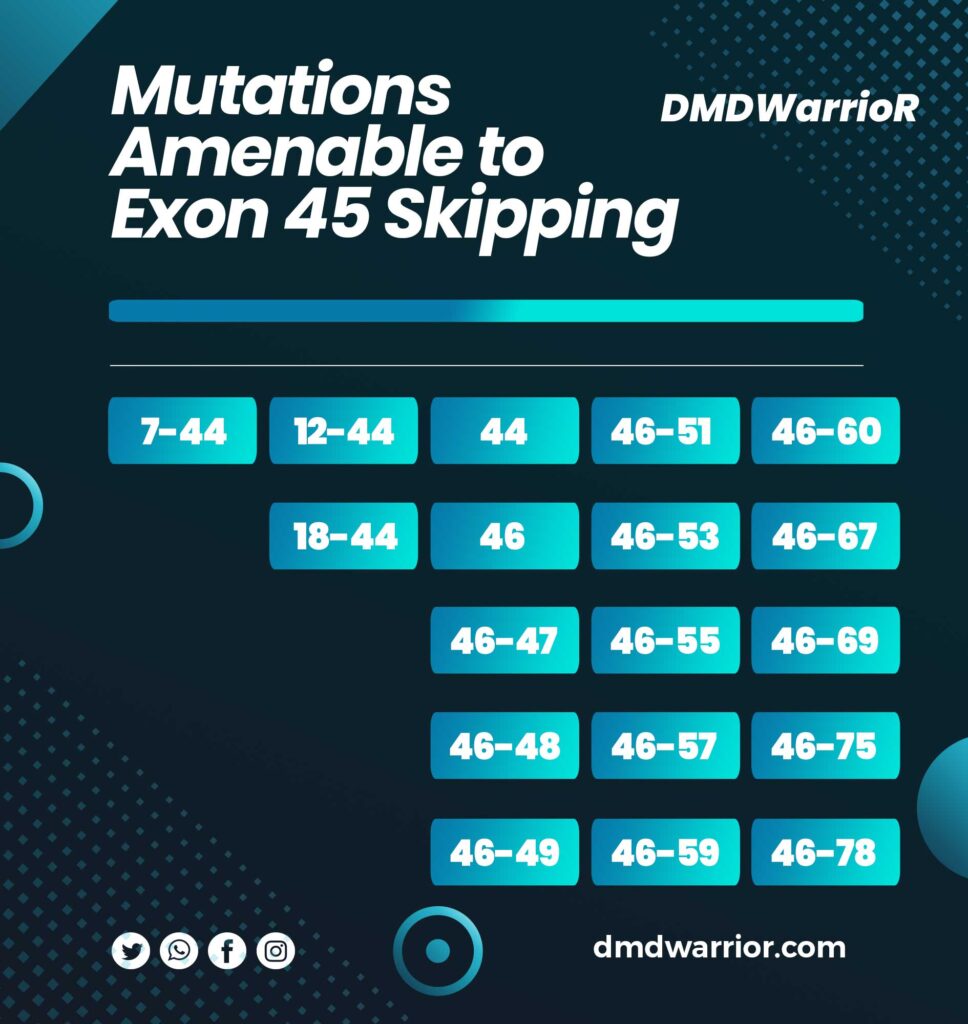
This list is also reflected in educational resources concerning casimersen and in published descriptions of mutations considered amenable to exon 45 skipping.
The notation describes the exons that are deleted. For example, 46-49 means that exons 46, 47, 48 and 49 are absent. In contrast, a single 44 means that exon 44 is deleted.
Importantly, this list should not be interpreted as a substitute for genetic interpretation. Similar-looking deletion reports can have different consequences depending on exactly which exons are missing and whether the resulting transcript is in-frame or out-of-frame.
Why Does the Reading Frame Matter?
The central concept behind exon skipping is the reading-frame rule. When a deletion disrupts the three-base reading frame used to translate messenger RNA into protein, the resulting dystrophin may be severely shortened or absent. Skipping an additional exon can sometimes restore the reading frame.
For example, researchers have described a deletion of exons 46-49 as amenable to exon 45 skipping. By contrast, a deletion involving exons 45-47 can produce an in-frame transcript and therefore would not be expected to benefit from skipping exon 45 in the same way.
This distinction is particularly important for families reading a genetic test report. Seeing “exon 46 deletion,” for example, is not enough to determine the appropriate therapy. The laboratory report should identify the complete deletion and its predicted consequence.
Which DMD Mutations Can Be Treated by Exon 45 Skipping?
The phrase DMD mutations amenable to exon 45 skipping generally refers to mutations in which skipping exon 45 is expected to restore the reading frame or otherwise generate a potentially functional dystrophin transcript.
Large deletion patterns involving exons 46 and beyond are particularly important in this context. The published list includes 46-47, 46-48, 46-49, 46-51, 46-53, 46-55, 46-57, 46-59, 46-60, 46-67, 46-69, 46-75 and 46-78. Deletions extending from earlier exons to exon 44, including 7-44, 12-44 and 18-44, are also included in commonly cited lists of theoretically exon-45-skip-amenable deletions.
Scientific studies support the importance of evaluating deletion structure rather than simply identifying an individual missing exon. A 2021 Scientific Reports study demonstrated why this matters: deletion of a flanking exon can correspond to different underlying deletion patterns, with one potentially amenable to exon skipping and another not amenable.
Is My DMD Mutation Amenable to Exon 45 Skipping?
Families frequently ask, “Is my DMD mutation amenable to exon 45 skipping?” The answer requires looking at the precise genetic diagnosis.
The first step is to obtain the complete DMD genetic test report. The report should identify whether the mutation is a deletion, duplication, small sequence variant, or another type of genetic change. If the mutation is a deletion, the exact exon boundaries are particularly important. Learn More: DMD Genetic Testing
For example, “exon 46 deletion” and “exons 46-49 deletion” are not equivalent descriptions. The latter provides substantially more information about the structure of the mutation and its predicted reading-frame consequence.
A specialist should also confirm that exon 45 itself is present. Clinical resources specifically emphasize that exon 45 needs to remain in the DMD gene for exon 45 skipping to be applicable. Discover Now: DMD or BMD? Exon Check Tool
Exon 45 Skipping Treatment: Casimersen
One of the best-known exon 45 skipping therapies is casimersen, marketed in the United States as AMONDYS 45. The U.S. Food and Drug Administration approved casimersen in 2021 for patients with DMD who have a confirmed DMD mutation amenable to exon 45 skipping. The approval was granted under the accelerated approval pathway based on increased dystrophin production in skeletal muscle, with continued approval contingent on verification of clinical benefit.
Casimersen is an antisense oligonucleotide that binds to exon 45 of dystrophin pre-mRNA. By promoting exon 45 exclusion, the treatment is intended to enable production of an internally truncated dystrophin protein.
Clinical research has demonstrated increased exon 45 skipping and dystrophin expression in treated participants. A randomized phase 1/2 study also evaluated the safety, tolerability and pharmacokinetics of casimersen in patients with DMD amenable to exon 45 skipping.
Families should remember, however, that being genetically amenable does not mean that a treatment is automatically appropriate, available, approved, or reimbursed in every country. Treatment decisions require consideration of the child’s clinical status, genetic result, local regulatory status, medical guidance, and access. Learn More: Active DMD Clinical Studies
Exon 45 Skipping Is Not the Same for Every Patient
The term deletions amenable to exon 45 skipping describes a genetic opportunity, not a guarantee of clinical response.
Exon-skipping therapies are designed around specific RNA sequences and mutation structures. The resulting dystrophin is also shorter than the full-length protein. Research suggests that genotype, deletion structure and the characteristics of the resulting dystrophin can influence the expected biological and clinical consequences.
A large meta-analysis examining exon skip-amenable and exon skip-equivalent mutations found that the reading-frame approach is useful but is not a perfect predictor of clinical phenotype. The authors also highlighted differences among deletion patterns and the need to interpret genotype-phenotype relationships carefully.
How to Determine Whether a DMD Deletion Is Amenable to Exon 45 Skipping
Families should start with the child’s confirmed genetic diagnosis, not simply the name of a suspected mutation.
If the report contains a deletion, identify the first and last deleted exons. Then determine whether the deletion appears in an established exon 45 skipping reference list. Finally, have the result reviewed by a DMD-experienced neurologist or genetic counselor.
A DMD mutation database or exon-skipping tool can be useful for educational purposes, but online tools should not replace professional interpretation of a genetic test.
Why Accurate Genetic Testing Matters
Genetic testing is central to determining mutation-specific treatment options in DMD. Knowing the precise mutation can help clinicians assess eligibility for exon-skipping therapies and can also be important for clinical-trial screening and genetic counseling.
For families, the most useful question is therefore not simply “Does my child have a deletion?” but:
“What exactly is the deletion, does it disrupt the reading frame, and could exon 45 skipping potentially restore that frame?”
Understanding that distinction can turn a complicated genetic report into information that is much easier to discuss with a DMD specialist.
Frequently Asked Questions About Exon 45 Skipping
What are deletions amenable to exon 45 skipping?
Common theoretically amenable deletions include 7-44, 12-44, 18-44, 44, 46, 46-47, 46-48, 46-49, 46-51, 46-53, 46-55, 46-57, 46-59, 46-60, 46-67, 46-69, 46-75 and 46-78. Individual eligibility must be confirmed from the complete genetic report.
Is exon 46 deletion amenable to exon 45 skipping?
A deletion reported simply as “exon 46 deletion” appears on commonly cited lists of theoretically exon-45-skip-amenable mutations. However, the complete genetic result should be reviewed because deletion boundaries and reading-frame consequences are essential.
Is an exon 46-49 deletion amenable to exon 45 skipping?
Yes. Exons 46-49 deletion is a commonly cited example of an out-of-frame deletion that can potentially be rescued by skipping exon 45.
What treatment is available for exon 45 skipping?
Casimersen (AMONDYS 45) is an FDA-approved antisense oligonucleotide for patients in the United States with confirmed DMD mutations amenable to exon 45 skipping. Its approval remains under the accelerated approval pathway.
Does an amenable mutation guarantee that exon skipping will work?
No. “Amenable” describes a genetic mutation for which exon skipping is a potential therapeutic strategy. It does not guarantee a specific clinical response or outcome. Treatment decisions should be made with a physician experienced in DMD.
Conclusion
Exon 45 skipping represents a targeted therapeutic strategy for a subset of Duchenne Muscular Dystrophy patients, specifically those with deletions involving exons 7-44, 12-44, 18-44, 44, 46, 46-47, 46-48, 46-49, 46-51, 46-53, 46-55, 46-57, 46-59, 46-60, 46-67, 46-69, 46-75 or 46-78. By skipping exon 45, the gene’s reading frame can be restored, allowing the production of a truncated but functional form of dystrophin. This approach holds significant promise for improving the quality of life and slowing disease progression for certain DMD patients.
Despite its potential, exon skipping is not a one-size-fits-all solution. Its effectiveness depends on the mutation type and the ability to deliver the therapeutic oligonucleotides to the target tissues. As research progresses and more clinical trials are conducted, exon skipping may become an essential part of the therapeutic arsenal for treating DMD, particularly for patients with mutations amenable to exon 45 skipping.
Read More: Next Generation Exon Skipping Therapies