
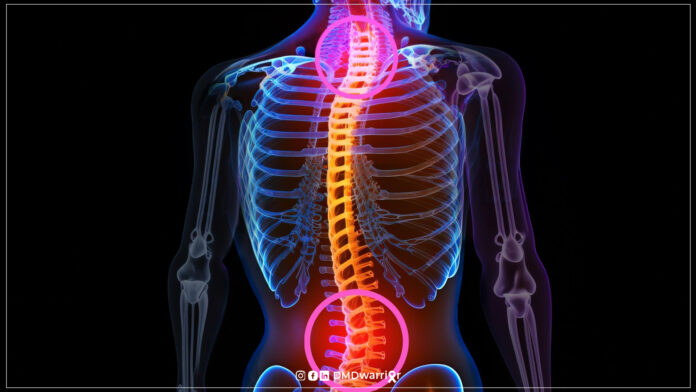
Scoliosis in Duchenne Muscular Dystrophy is one of the most significant orthopedic complications associated with this progressive neuromuscular disorder. Also described as spinal curvature in Duchenne muscular dystrophy, this condition develops as muscle weakness advances, particularly after the loss of ambulation. It has profound consequences on posture, sitting balance, pulmonary function, and overall quality of life. With advances in respiratory and cardiac care extending life expectancy in Duchenne muscular dystrophy (DMD), the clinical importance of managing scoliosis has increased substantially. Today, early detection, preventive strategies, physiotherapy, and timely surgical intervention are central pillars of comprehensive care.
Table of Contents
Understanding Duchenne Muscular Dystrophy and Its Orthopedic Consequences
Duchenne muscular dystrophy is an X-linked recessive disorder caused by mutations in the dystrophin gene. The absence of dystrophin leads to instability in muscle cell membranes, making them susceptible to damage during contraction. Over time, muscle fibers degenerate and are replaced by adipose and fibrotic tissue. Read More: What is Duchenne?
This progressive degeneration affects not only limb muscles but also axial muscles responsible for maintaining posture and spinal alignment. As trunk stability declines, the spine becomes increasingly vulnerable to deformity, culminating in scoliosis.

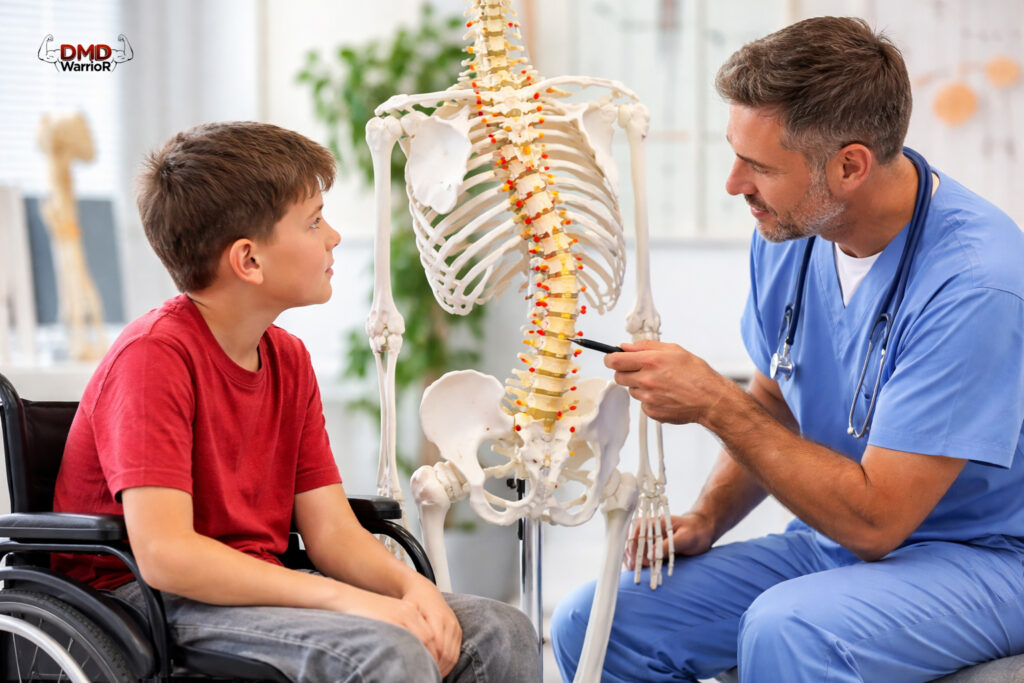
Epidemiology and Natural History of Scoliosis in DMD
Scoliosis is a near-universal complication in untreated or late-stage DMD:
- 70–90% of non-ambulatory patients develop scoliosis
- Incidence approaches 90–95% without corticosteroid therapy
- Onset typically follows loss of ambulation (ages 10–12)
The introduction of long-term corticosteroid therapy has significantly altered disease progression. Studies have demonstrated that steroid-treated patients experience delayed onset and reduced severity of scoliosis.
Bushby et al. (2010, Lancet Neurology) reported that corticosteroids can prolong ambulation and reduce the need for spinal surgery.1
Pathophysiology of Scoliosis in Duchenne Muscular Dystrophy
Neuromuscular Mechanisms
Unlike idiopathic scoliosis, which has multifactorial and often unclear causes, scoliosis in DMD is directly attributable to muscle weakness and imbalance.
Key Mechanisms:
- Progressive weakness of paraspinal muscles
- Reduced abdominal core stability
- Loss of symmetrical trunk control
These factors create asymmetrical forces on the spine, leading to curvature.
Biomechanical Factors
Pelvic Obliquity
Pelvic tilt is a hallmark feature in DMD scoliosis:
- One side of the pelvis drops
- The spine compensates with lateral curvature
Vertebral Rotation
As scoliosis progresses:
- Vertebrae rotate
- Rib cage deformity develops
- Thoracic cavity becomes restricted
Role of Loss of Ambulation
Ambulation provides axial loading and promotes spinal stability. When walking is lost:
- Mechanical support is reduced
- Sitting posture becomes primary
- Spinal deformity accelerates
Clinical Presentation and Progression
Early Signs
- Subtle asymmetry in shoulders
- Mild pelvic tilt
- Difficulty maintaining upright sitting posture
Progressive Symptoms
- Visible spinal curvature
- Increased reliance on upper limbs for balance
- Pain and discomfort (less common but possible)
Advanced Stage
- Severe deformity
- Fixed curvature
- Respiratory compromise
Early Detection of Scoliosis in Duchenne Muscular Dystrophy
Early detection is critical because scoliosis progression in DMD can be rapid and severe. Identifying curvature early allows for better management and improved outcomes.
Screening Recommendations
- Begin monitoring at loss of ambulation
- Clinical assessments every 6 months
- Radiographs annually or as needed
Cobb Angle Assessment
The Cobb angle remains the gold standard for measuring scoliosis severity:
- Mild: 10–20°
- Moderate: 20–40°
- Severe: >40°
Risk Factors for Rapid Progression
- Early loss of ambulation
- Lack of steroid treatment
- Rapid growth during puberty
Choi et al. 2019 (BMC Musculoskeletal Disorders) demonstrated that scoliosis progression is significantly faster in non-ambulatory patients.2
Key Precautions for Managing Scoliosis in DMD
Effective management begins with proactive precautions aimed at slowing progression and minimizing complications.
Postural Management
Maintaining optimal posture is essential:
- Use of customized wheelchair seating systems
- Lateral trunk supports
- Headrests and pelvic stabilizers
Monitoring Growth and Development
Growth spurts accelerate scoliosis progression:
- Frequent assessments during adolescence
- Adjust seating systems accordingly
Respiratory Surveillance
Because scoliosis impacts lung function:
- Regular spirometry is recommended
- Monitor forced vital capacity (FVC)
Key Points to Consider for Scoliosis in DMD
Disease Stage and Timing
- Scoliosis rarely develops before loss of ambulation
- Early adolescence is a critical period
Role of Corticosteroids
Steroids such as prednisone and deflazacort:
- Delay muscle degeneration
- Reduce incidence and severity of scoliosis
Michael D. Sussman et al. confirmed long-term benefits of corticosteroids in delaying orthopedic complications.3
Multidisciplinary Care Model
Optimal management requires coordination among:
- Neurologists
- Orthopedic surgeons
- Pulmonologists
- Physiotherapists
This integrated approach ensures comprehensive care.
Discover More: Multidisciplinary Care in DMD
Benefits of Physical Therapy for Scoliosis in Duchenne
Physical therapy is a cornerstone of supportive management in DMD-related scoliosis.
Goals of Physical Therapy
- Preserve functional mobility
- Maintain spinal alignment
- Prevent contractures
- Improve comfort
Postural Training
Therapists focus on:
- Symmetrical sitting posture
- Core engagement techniques
- Proper wheelchair positioning
Respiratory Benefits
Physical therapy also supports respiratory function through:
- Breathing exercises
- Chest expansion techniques
Effective Exercises for Scoliosis in DMD Patients
Exercise must be carefully tailored to avoid muscle damage while maintaining function.
Passive Range of Motion (PROM)
- Maintains joint flexibility
- Prevents stiffness
Assisted Active Exercises
- Improve trunk control
- Enhance sitting balance
Breathing Exercises
- Strengthen respiratory muscles
- Improve ventilation efficiency
Important Limitations
- Exercises cannot reverse scoliosis
- Overexertion should be avoided
- Programs must be individualized
When Is Surgery Needed for Scoliosis in DMD?
Surgery is often required to manage progressive scoliosis.
Indications for Surgery
- Cobb angle exceeding 30–40°
- Rapid curve progression
- Declining sitting balance
Surgical Procedure: Posterior Spinal Fusion
This involves:
- Placement of rods and screws
- Fusion of vertebrae to stabilize the spine
Outcomes of Surgery
Benefits
- Stabilization of spinal curvature
- Improved sitting posture
- Slower decline in respiratory function
Risks
- Blood loss
- Infection
- Cardiac and respiratory complications
Nikhil R Nayak et al. (2018, Pubmed) reported significant improvements in quality of life post-surgery.4
Timing of Surgery
Optimal timing is crucial:
- Before severe respiratory decline
- Typically between ages 12–16
Preoperative evaluation must include:
- Cardiac assessment
- Pulmonary function testing
Impact of Scoliosis on Respiratory Function
Scoliosis contributes to restrictive lung disease by reducing thoracic volume and impairing ventilation. This leads to decreased vital capacity and increased susceptibility to respiratory infections.
Finder et al. (2004, AJRCCM) emphasized the importance of respiratory monitoring in DMD patients with scoliosis.5
Learn More: Maintaining for Lung Muscles in Duchenne
Role of Corticosteroids in Preventing Scoliosis
Corticosteroids delay scoliosis onset by preserving muscle strength and prolonging ambulation. Their use has significantly reduced the prevalence of severe scoliosis.
Learn More: Pros and Cons of Steroids (Cortisone) for Duchenne
Wheelchair Positioning and Seating Systems
Customized seating systems:
- Improve posture
- Reduce asymmetry
- Enhance comfort
Proper positioning is essential for long-term spinal health.
Learn More: Power Wheelchair in DMD
Prognosis and Long-Term Outcomes
With modern multidisciplinary care:
- Survival has improved into adulthood
- Quality of life is enhanced
- Scoliosis progression can be managed effectively
FAQ: Scoliosis in Duchenne Muscular Dystrophy
When does scoliosis start in Duchenne muscular dystrophy?
Scoliosis in Duchenne muscular dystrophy typically develops after the loss of ambulation, usually between the ages of 10 and 12. As walking ability declines, trunk muscles weaken significantly, leading to reduced spinal support. This creates the conditions for spinal curvature to develop and progress rapidly. Early monitoring during this transition phase is critical for timely intervention and better long-term outcomes.
How fast does scoliosis progress in DMD?
Scoliosis in DMD can progress quickly, especially after a child becomes wheelchair-dependent. Studies show that the curvature may increase by 10–15 degrees per year if left untreated. Growth spurts during adolescence can further accelerate progression. Regular clinical and radiological monitoring is essential to track changes and determine the appropriate timing for interventions.
Can scoliosis be prevented in Duchenne muscular dystrophy?
Scoliosis cannot be completely prevented in DMD, but its onset and progression can be delayed. Long-term corticosteroid therapy has been shown to significantly reduce the incidence and severity of scoliosis. Additionally, proper wheelchair positioning, regular physiotherapy, and close medical follow-up can help manage risk factors and slow progression.
Does scoliosis affect breathing in DMD patients?
Yes, scoliosis has a significant impact on respiratory function in DMD patients. As the spine curves, the thoracic cavity becomes compressed, limiting lung expansion. This leads to reduced lung capacity and increased risk of respiratory infections. Over time, this may necessitate the use of non-invasive ventilation. Early management of scoliosis is crucial to preserving respiratory health.
Is bracing effective for scoliosis in DMD?
Bracing is generally not effective in preventing or stopping scoliosis progression in Duchenne muscular dystrophy. Unlike idiopathic scoliosis, neuromuscular scoliosis is driven by muscle weakness rather than structural misalignment alone. However, braces may still be used to improve sitting balance and comfort in certain cases, especially in early stages.
What are the benefits of physical therapy for scoliosis in DMD?
Physical therapy plays a supportive but important role in managing scoliosis in DMD. It helps maintain joint mobility, improve sitting posture, and reduce discomfort. Respiratory exercises included in therapy programs can also support lung function. While physical therapy does not stop scoliosis progression, it significantly improves quality of life and functional independence.
What exercises are safe for children with DMD and scoliosis?
Safe exercises include passive range of motion (PROM), gentle assisted movements, and breathing exercises. These help maintain flexibility, prevent contractures, and support respiratory function. High-resistance or high-impact exercises should be avoided, as they can accelerate muscle damage. All exercise programs should be individualized and supervised by a physiotherapist experienced in neuromuscular disorders.
When is surgery recommended for scoliosis in DMD?
Surgery is typically recommended when the spinal curvature exceeds 30–40 degrees and shows signs of rapid progression. Other indications include declining sitting balance and impact on respiratory function. Early surgical intervention, before severe lung impairment develops, is associated with better outcomes and improved quality of life. Read More: Surgery Under Anesthesia
Is scoliosis surgery safe for DMD patients?
Scoliosis surgery can be safely performed in specialized centers with experience in neuromuscular conditions. However, it carries higher risks compared to typical scoliosis surgery due to cardiac and respiratory involvement in DMD. Comprehensive preoperative assessment and multidisciplinary care are essential to minimize complications and ensure optimal outcomes.
How does scoliosis surgery improve quality of life?
Scoliosis surgery stabilizes the spine, improves sitting posture, and reduces discomfort. It also helps maintain better respiratory function by preventing severe spinal deformity. Many patients experience improved daily functioning, easier caregiving, and enhanced overall well-being following successful surgery.
Final Thoughts
Scoliosis in Duchenne Muscular Dystrophy requires proactive and multidisciplinary care. Early detection remains essential for better outcomes. Regular monitoring helps guide timely interventions. Physical therapy supports posture and comfort. Proper seating reduces progression risks. Corticosteroids may delay onset. Surgical treatment can stabilize severe curves. Respiratory care is equally critical. Individualized plans improve quality of life. With coordinated care, outcomes continue to improve.
References and Academic Sources
- Diagnosis and management of Duchenne muscular dystrophy, part 1: diagnosis, and pharmacological and psychosocial management ↩︎
- Scoliosis in Duchenne muscular dystrophy children is fully reducible in the initial stage, and becomes structural over time ↩︎
- Efficacy of corticosteroid in decreasing scoliosis and extending time to loss of ambulation in a single clinic: An effectiveness trial ↩︎
- Quality of Life in Patients Undergoing Spine Surgery: Systematic Review and Meta-Analysis ↩︎
- Respiratory care of the patient with Duchenne muscular dystrophy: ATS consensus statement ↩︎