

Mutations amenable to exon 50 skipping are an important topic in Duchenne muscular dystrophy (DMD) research because exon skipping therapies are designed to restore the disrupted reading frame of the DMD gene in patients with specific genetic mutations. Unlike conventional treatments that target all individuals with the same condition, exon skipping is a form of precision medicine that only benefits patients with particular mutation patterns. Understanding mutations amenable to exon 50 skipping helps families better interpret genetic testing results, follow emerging clinical trials, and discuss future treatment options with their neuromuscular specialists.
The DMD gene contains 79 exons and provides the instructions for producing dystrophin, a structural protein that protects muscle fibers from damage. When deletions or other mutations disrupt the reading frame, dystrophin production is severely reduced or absent, leading to progressive muscle weakness. Exon skipping therapies use antisense oligonucleotides (ASOs) to encourage cells to skip selected exons during RNA splicing, potentially restoring production of a shorter but functional dystrophin protein similar to that seen in Becker muscular dystrophy. Learn More: Dystrophin Gene
Table of Contents
Mutations Amenable to Exon 50 Skipping
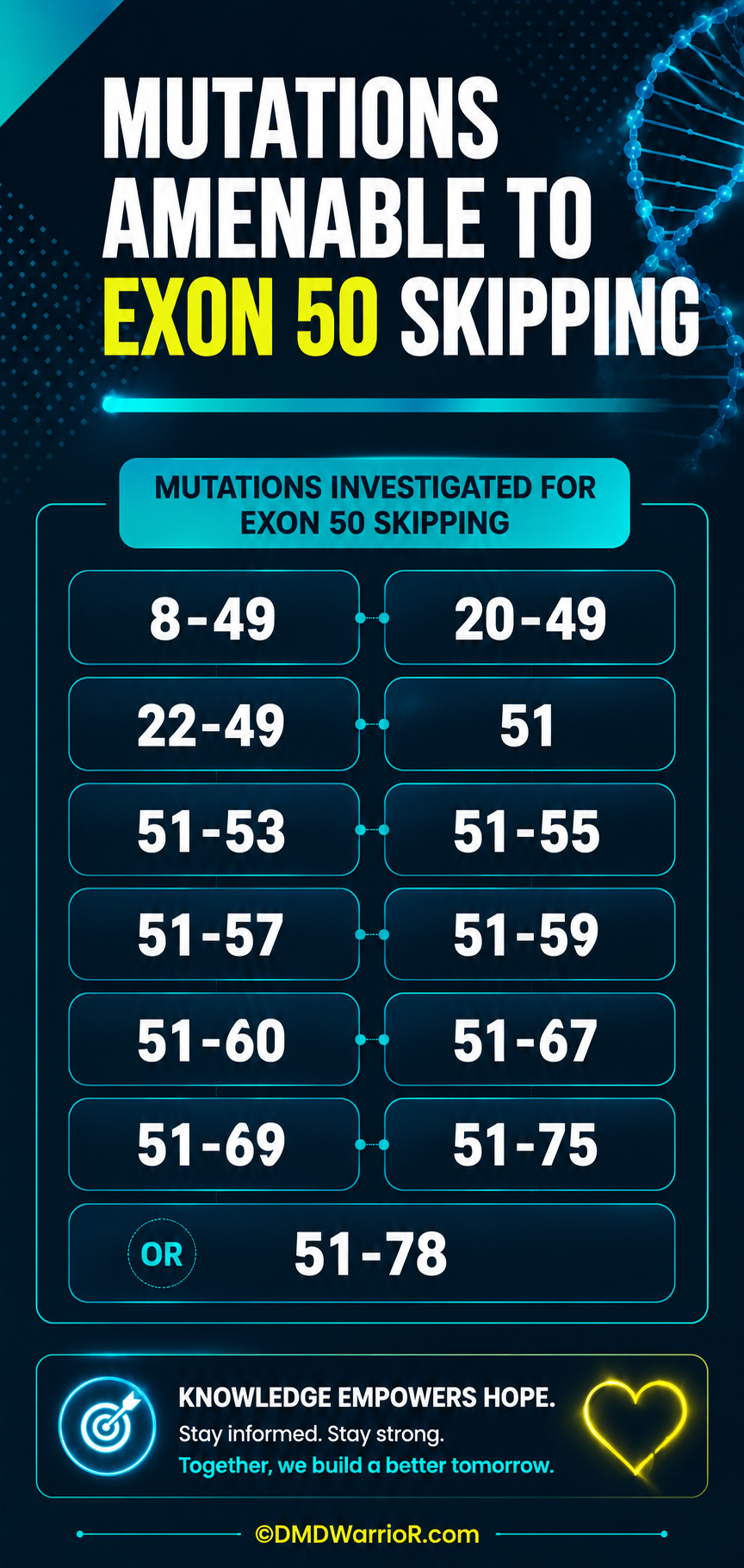
Mutations amenable to exon 50 skipping refer to genetic variants in which skipping exon 50 may restore the disrupted reading frame and enable production of partially functional dystrophin. Based on published mutation applicability analyses, exon 50 skipping has been investigated for specific deletion patterns including 8-49, 20-49, 22-49, 51, 51-53, 51-55, 51-57, 51-59, 51-60, 51-67, 51-69, 51-75, or 51-78. These deletion patterns are examples of mutations for which exon 50 skipping may theoretically restore the reading frame. However, every patient’s eligibility should always be confirmed through comprehensive genetic testing, reading-frame analysis, and consultation with an experienced neuromuscular specialist, since treatment decisions cannot be based solely on exon numbers. Learn More: What is Exon Deletion?
How Does Exon 50 Skipping Work?
Exon skipping therapy targets messenger RNA (mRNA) rather than DNA. After the DMD gene is transcribed into RNA, antisense oligonucleotides bind to specific sequences around exon 50, causing the cellular splicing machinery to exclude that exon during RNA processing.
The therapeutic objective is to:
- Restore the disrupted reading frame
- Produce internally shortened dystrophin protein
- Slow muscle degeneration
- Preserve muscle strength and function
Unlike gene editing technologies such as CRISPR, exon skipping does not permanently modify DNA. Instead, it temporarily changes how RNA is processed, meaning repeated treatment is generally required.
Why Are Only Certain Patients Eligible?
One of the most common questions families ask is:
Who Can Benefit from Exon 50 Skipping?
Only individuals whose mutations are compatible with exon 50 skipping are considered potential candidates. Because each DMD mutation affects the reading frame differently, the same therapy cannot be used for every patient.
Eligibility depends on several factors:
- Exact exon deletion pattern
- Reading-frame disruption
- Molecular diagnostic findings
- Clinical trial inclusion criteria
- Regulatory approval status
A certified genetic laboratory can determine whether a patient’s mutation is theoretically amenable to exon 50 skipping.
Current Research on Exon 50 Skipping Therapy
Although approved exon skipping therapies currently target exons such as 45, 51, and 53 in some regions, researchers continue investigating therapies for additional exons, including exon 50.
Current areas of research include:
Improved Antisense Oligonucleotides
Scientists are developing more stable ASOs with greater muscle penetration.
Enhanced Delivery Systems
Novel peptide-conjugated oligonucleotides aim to improve delivery to skeletal muscle, diaphragm, and cardiac muscle.
Better Dystrophin Expression
Researchers are evaluating whether newer chemistries can increase dystrophin production while maintaining safety.
Combination Therapies
Future treatment strategies may combine exon skipping with gene therapy, gene editing, anti-inflammatory drugs, or muscle-protective therapies.
Frequently Asked Questions
Is Exon 50 Skipping a Cure?
No. Exon skipping is considered a disease-modifying therapy that aims to improve dystrophin production rather than permanently cure Duchenne muscular dystrophy.
Can Every Patient Receive Exon 50 Skipping Therapy?
No. Only patients with mutations amenable to exon 50 skipping may potentially benefit after detailed genetic evaluation. Explore Now: DMDWarrioR Exon Check Tool
How Can Families Learn Whether They Are Eligible?
Eligibility should be determined by reviewing a patient’s complete genetic report with a neuromuscular specialist or genetic counselor.
Are Clinical Trials Available?
Clinical trials continue to investigate new exon skipping therapies. Families should regularly review ClinicalTrials.gov and discuss trial opportunities with their healthcare team. Explore Now: DMDWarrioR Clinical Trials Hub
Future Outlook
The future of precision medicine for Duchenne muscular dystrophy is evolving rapidly. Advances in exon skipping, gene replacement therapy, CRISPR-based gene editing, RNA therapeutics, and novel delivery technologies are expanding the range of mutation-specific treatment strategies. As researchers gain a better understanding of the DMD gene and dystrophin biology, more patients may become eligible for personalized therapies.
For families, staying informed through reputable scientific organizations, peer-reviewed publications, and experienced neuromuscular specialists remains the best way to prepare for future therapeutic opportunities.
Learn More: ClinicalTrials.gov. Ongoing Duchenne muscular dystrophy clinical trials.