Duchenne muscular dystrophy (DMD) is not a newly discovered condition, nor is it an unsolvable one. Scientific progress over the past two decades has produced exon-skipping therapies, corticosteroid optimization protocols, and most notably, gene therapies that are already approved in major regulatory jurisdictions. Yet, across large parts of the world, children with DMD remain untreated—not because treatments do not exist, but because systems designed to deliver them have failed.
At the center of this failure sits an uncomfortable reality: many DMD associations and foundations have not only underperformed but have become structurally ineffective. Worse, in some cases, they have normalized inaction while projecting the illusion of advocacy.
This article critically examines that failure—systematically, unapologetically, and with evidence-based context.
Learn More: FDA-Approved Treatments for DMD
Table of Contents
The Illusion of Advocacy in Duchenne Muscular Dystrophy
Awareness Without Outcomes
DMD associations frequently position themselves as patient advocates. They organize awareness days, publish social media content, and hold meetings with policymakers. However, awareness without measurable outcomes is not advocacy—it is optics.
The fundamental question must be asked:
How many associations can demonstrate that their actions directly resulted in treatment access or reimbursement?
In many countries, the answer is either unclear or nonexistent.
What did you promise, did you achieve your goals, and nevertheless why is your association’s management still made up of the same people?
The Metrics That Matter (But Are Ignored)
Effective advocacy should be measured through:
- Regulatory approvals achieved
- Reimbursement decisions secured
- Number of treated patients
- Time-to-access reduction
- Clinical trial inclusion rates
Instead, associations often highlight:
- Meetings held
- Photos taken
- Statements issued
This disconnect reflects a shift from results-based accountability to performative engagement.
The Global Inequality in DMD Treatment Access
A Two-Tier System of Survival
Patients in countries like the United States or parts of Europe have access to therapies such as:
- Exon skipping drugs
- Stop codon readthrough treatments
- Emerging gene therapies
Meanwhile, in many regions:
- No approved therapies are available
- Importation is restricted
- Reimbursement systems are absent or dysfunctional
This disparity is not merely economic—it is organizational and political failure compounded by weak advocacy.
The Role of Associations in This Inequality
Associations are supposed to bridge gaps. Instead, many have:
- Failed to engage effectively with regulators
- Avoided confrontation with pricing structures
- Neglected global collaboration
This creates a paradox:
Organizations established to fight inequality have, through inaction, reinforced it.
Bureaucracy Over Urgency: The Institutional Paralysis
Meetings That Lead Nowhere
A recurring complaint from patients and families is the lack of transparency and follow-through after meetings with:
- Government officials
- Health ministries
- Pharmaceutical companies
These meetings often result in:
- No public roadmap
- No timelines
- No accountability mechanisms
This raises a critical issue:
Are these engagements strategic efforts—or symbolic gestures?
The Culture of Excuses
Common narratives include:
- “The process takes time”
- “The drugs are too expensive”
- “Regulatory systems are complex”
While partially true, these explanations become problematic when they replace action instead of motivating it.
The Failure to Apply Pressure
Advocacy Without Confrontation Is Ineffective
Effective patient advocacy requires:
- Policy pressure
- Media engagement
- Legal challenges
- International alliances
Yet many associations avoid confrontation, opting instead for:
- Diplomatic silence
- Passive negotiations
- Non-binding discussions
This reluctance undermines their core mission.
The Consequences of Passive Advocacy
The result is predictable:
- Delayed approvals
- No reimbursement frameworks
- Lost patient time
In a progressive disease like DMD, delay is not neutral—it is irreversible harm.
The Role of Physicians Within Associations
The Expertise Paradox
Many associations include pediatric neurologists and geneticists in leadership roles. This should be a strength. Instead, it often becomes a liability.
Why?
Because:
- Clinical expertise is not policy expertise
- Scientific caution is mistaken for strategic paralysis
Criticism Without Contribution
A recurring pattern emerges:
- Doctors criticize existing therapies
- Highlight limitations
- Question long-term efficacy
Yet:
- They do not initiate drug development
- They do not lead access programs
- They defer responsibility to external actors
This creates a damaging dynamic:
Critique replaces contribution.
The Ethical Question
If clinicians:
- Do not research available therapies
- Do not engage with treated patient populations
- Do not advocate for access
Then their role in associations becomes questionable.
Pharmaceutical Companies: Convenient Scapegoat or Real Barrier?
Pricing Is a Problem—But Not the Only One
Pharmaceutical companies undeniably set high prices. However:
- Many countries never receive licensing applications
- Some regulators are never formally engaged
This suggests:
The problem is not only supply—it is also lack of demand pressure.
The Silence Around Pricing
Where are the associations:
- Challenging pricing models?
- Advocating for tiered pricing?
- Collaborating on access programs?
In many cases, they are absent or ineffective.
Political Failure and Performative Support
Symbolism vs Policy
Politicians frequently:
- Meet with families
- Share photos
- Express sympathy
But fail to:
- Allocate funding
- Accelerate approvals
- Reform reimbursement systems
Accountability Gap
Associations rarely:
- Publicly evaluate political commitments
- Track promises vs outcomes
- Apply sustained pressure
This allows political inaction to persist unchecked.
The Myth of “Nothing Can Be Done”
Global Models That Contradict This Narrative
Organizations like World Health Organization and Médecins Sans Frontières have demonstrated that:
- Drug access barriers can be overcome
- Pricing can be negotiated
- Distribution systems can be built
The difference lies in:
- Strategy
- Persistence
- Willingness to challenge systems
What Effective Advocacy Looks Like
Successful models include:
- Coordinated international pressure
- Legal frameworks for access
- Strategic partnerships
Most DMD associations fall short of these standards.
The Structural Weakness of DMD Associations
Lack of Strategic Roadmaps
Few associations publish:
- Clear objectives
- Measurable milestones
- Transparent progress reports
Without these, accountability is impossible.
Fragmentation Instead of Collaboration
Instead of unified global efforts:
- Associations operate in isolation
- Duplicate efforts
- Fail to share data
This fragmentation slows progress significantly.
The Responsibility to Deliver, Not Just Represent
Representation Is Not Enough
Associations often claim to “represent patients.”
But representation without results is insufficient.
Patients need:
- Access
- Treatment
- Survival
The Urgency of DMD
DMD progression is relentless:
- Muscle degeneration
- Loss of ambulation
- Cardiac and respiratory failure
Time lost cannot be recovered.
What Needs to Change Immediately
Radical Transparency
Associations must:
- Publish all negotiations
- Share timelines
- Report failures openly
Aggressive Advocacy
This includes:
- Legal action where necessary
- Public campaigns
- International alliances
Data-Driven Decision Making
Associations must:
- Track treatment outcomes globally
- Use real-world evidence
- Engage directly with treated patients
Holding All Stakeholders Accountable
Including:
- Governments
- Pharmaceutical companies
- Medical professionals
DMD Associations Financial Transparency and Accountability Issues
A major concern surrounding many DMD associations is the lack of transparency regarding their financial activities. In numerous cases, annual income and expenditure reports are either not published at all or presented in a vague and incomplete manner. This absence of clear financial disclosure raises serious questions about how funds are being allocated and whether they are being used effectively to advance patient access to treatments. Without transparent reporting, it becomes impossible for patients, families, and donors to evaluate the true impact of these organizations.
The failure to publish detailed financial statements does more than obscure numbers—it undermines accountability. Associations that operate without financial transparency effectively remove themselves from scrutiny, weakening trust within the very communities they claim to represent. In the context of a life-limiting disease like Duchenne muscular dystrophy, where every resource should be strategically directed toward access and outcomes, this lack of accountability is not a minor oversight—it is a systemic failure.
Misuse of Funds: When Travel Takes Priority Over Patients
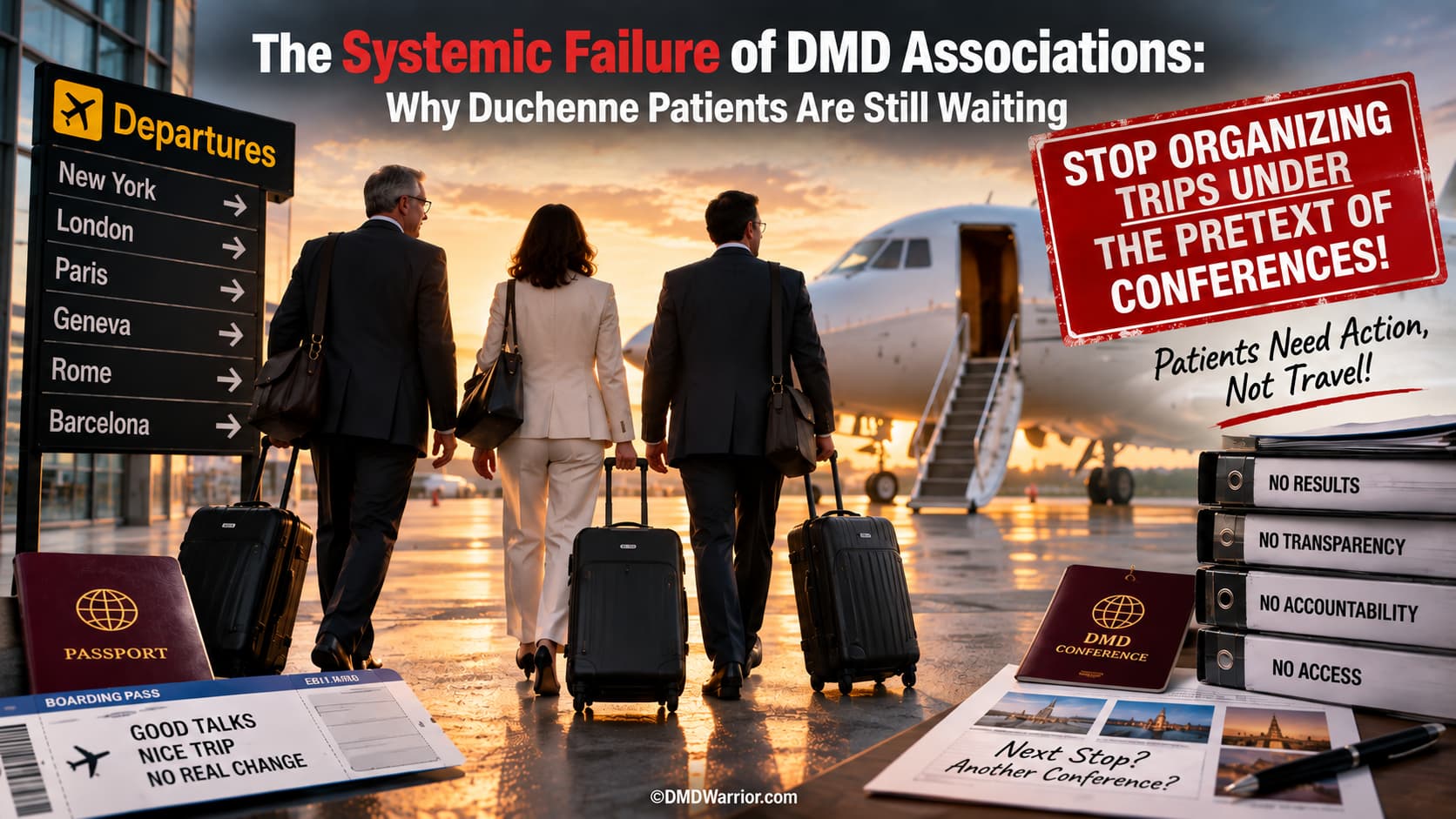
One of the most troubling patterns reported by families is the use of association funds for so-called “trips” that offer little to no measurable benefit to patients. These expenditures are often presented as networking opportunities, conferences, or international visits, yet there is rarely any transparent reporting on outcomes, agreements secured, or tangible progress achieved. When organizations funded by patients and donors prioritize travel over results, it raises a fundamental question: are these activities genuinely advancing access to treatment, or simply sustaining the appearance of activity? In a disease where time is critical, every resource diverted to non-essential spending represents a missed opportunity to push for real solutions.
Even more concerning is the lack of accountability surrounding these expenses. Families are asked to donate, support campaigns, and trust that funds will be used to fight for treatment access—yet they are given little insight into how much is spent on travel, who benefits from it, and what concrete outcomes are delivered in return. This creates a perception that “trips” have become normalized within some associations, not as strategic tools, but as routine privileges. In the context of Duchenne muscular dystrophy, where urgency should define every decision, spending on poorly justified travel is not just questionable—it is ethically indefensible.
FAQ: Questions to Ask DMD Associations in Your Country!
Why are DMD treatments not available in my country?
Access to Duchenne muscular dystrophy treatments depends on several factors, including regulatory approval, pricing negotiations, and national reimbursement policies. In many countries, delays occur because governments have not prioritized rare diseases, pharmaceutical companies have not applied for licensing, or advocacy efforts have not been strong enough to push the process forward. Without coordinated pressure from associations, policymakers, and patient groups, treatments can remain unavailable for years.
Are DMD associations responsible for treatment access?
DMD associations play a critical role in advocating for treatment access, but they are not the sole decision-makers. Their responsibility is to apply pressure on governments, engage with pharmaceutical companies, and represent patient needs effectively. When associations fail to produce results, it often reflects weak advocacy strategies, lack of transparency, or insufficient engagement with key stakeholders.
Why do some DMD associations fail to achieve results?
Failures often stem from a combination of bureaucratic inefficiency, lack of strategic planning, limited expertise in policy and negotiation, and reluctance to challenge authorities or pharmaceutical companies. Some associations focus more on awareness activities than on measurable outcomes such as approvals and reimbursement decisions, which limits their real-world impact.
What can families do if treatments are not accessible?
Families can organize collectively, demand transparency from associations, and engage directly with policymakers and media. Building patient coalitions, raising public awareness, and collaborating with international advocacy groups can increase pressure on decision-makers. In some cases, legal action or participation in clinical trials may also be viable options.
Why are DMD drugs so expensive?
DMD treatments, especially gene therapies, are costly due to complex research, development, and manufacturing processes. Pharmaceutical companies also price drugs based on market dynamics and expected returns. However, high prices are not the only barrier—lack of negotiation, absence of pricing strategies such as tiered pricing, and weak advocacy can further limit access. Read more: Is Geography Destiny?
Do doctors have a role in improving access to DMD treatments?
Yes, doctors play an important role by staying informed about global treatment developments, contributing to research, and advocating for patient access. They can support clinical trials, collect real-world data, and influence policy discussions. When doctors remain passive or overly critical without contributing solutions, progress can be slowed.
Why is financial transparency important for DMD associations?
Financial transparency allows patients, families, and donors to understand how funds are being used and whether they are aligned with the organization’s mission. Without clear reporting of income and expenses, it is impossible to assess effectiveness or hold leadership accountable. Transparency builds trust and ensures that resources are directed toward meaningful outcomes.
What is reimbursement and why does it matter?
Reimbursement refers to whether a healthcare system or insurance provider covers the cost of a treatment. Even if a drug is approved, patients cannot access it without reimbursement in most cases due to high costs. Securing reimbursement is therefore one of the most critical steps in ensuring real access to DMD therapies.
Can international organizations help improve access?
Yes, international collaboration can significantly improve access. Global health organizations, patient networks, and NGOs can help coordinate efforts, share data, and apply pressure across borders. Successful models in other diseases show that unified global strategies can overcome regulatory and pricing barriers.
What should families expect from a DMD association?
Families should expect clear communication, measurable goals, transparent financial reporting, and tangible progress toward treatment access. Associations should not only raise awareness but also actively work to secure approvals, reimbursement, and equitable access to therapies. Most importantly, they should be accountable to the patients they represent.
Conclusion
The current state of DMD treatment access is not an inevitable outcome of complexity—it is the result of systemic underperformance.
Associations that:
- Fail to deliver access
- Avoid accountability
- Rely on symbolic actions
are not merely ineffective—they are part of the problem.
The expectation is not perfection. It is progress.
And where there is no progress, there must be scrutiny. The management team should be renewed.
If a DMD association in your country does not publish its annual income and expense statements, do not donate to it.
Follow This Page >>> All Clinical Trials for Duchenne