









As interest in next-generation CRISPR-based therapies continues to grow, innovative tools such as hfCas12Max and advanced gene-editing strategy platforms are attracting increasing attention within the scientific community. Taiwo Afolabi reached out (via Arda Bora Yigit) to DMDWarrior to introduce CRISPR GuideX, a platform he developed for mapping gene-editing strategies using the hfCas12Max system.
Afolabi, a software engineer and computational biologist currently completing his studies in Microbiology at Obafemi Awolowo University (OAU), focuses on building high-performance bioinformatics tools. He also emphasized that CRISPR GuideX is an independent project and is not affiliated with or funded by the university.
As treatments for Duchenne Muscular Dystrophy continue to advance rapidly, next-generation CRISPR-based technologies such as hfCas12Max tool and CRISPR GuideX, developed by Taiwo Afolabi, are drawing increasing attention for their potential to accelerate the development of more precise and effective genetic therapies. These innovative tools may help researchers design safer gene-editing strategies, improve targeting accuracy, and expand the possibilities for personalized treatment approaches in DMD.

In this article, we will explore how hfCas12Max could benefit the Duchenne community, why researchers are excited about its therapeutic potential, and how the CRISPR GuideX platform may help simplify and accelerate the gene-editing development process.
Table of Contents
What is hfCas12Max in CRISPR-based therapeutics?
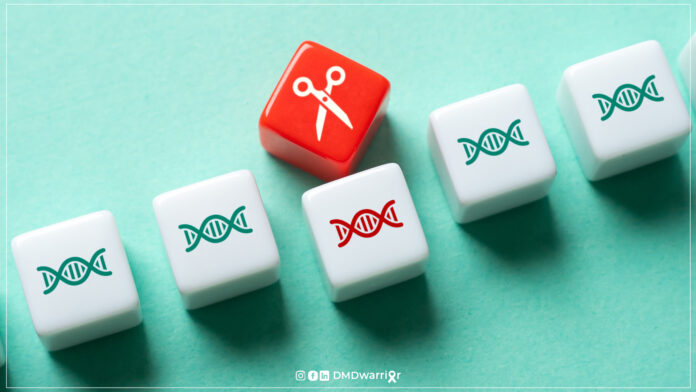
hfCas12Max is a newer and more advanced CRISPR gene-editing tool designed to make genetic treatments safer and more effective. Like other CRISPR systems, it works like “molecular scissors” that can cut DNA at specific locations to repair harmful mutations.
What makes hfCas12Max important is that it was specially engineered for human therapies. It is smaller, more precise, and may cause fewer unwanted DNA changes compared to older CRISPR tools. Because of its compact size, it can fit more easily into delivery systems such as AAV viruses, which are commonly used in gene therapy.
Scientists are studying hfCas12Max for diseases such as Duchenne Muscular Dystrophy and other inherited disorders where long-lasting genetic correction may be possible with a single treatment.
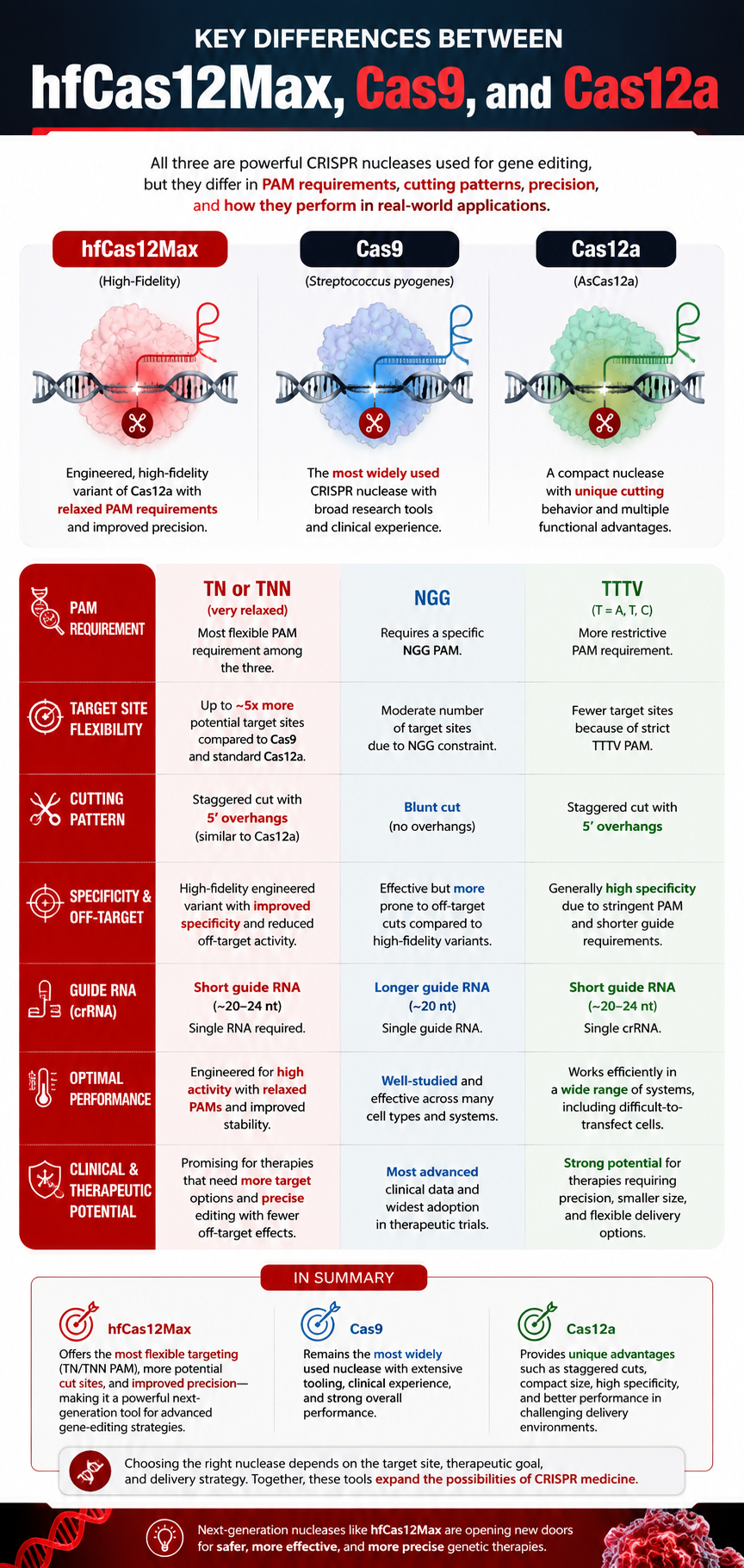
What are the key differences between hfCas12Max, Cas9, and Cas12a?
All three are CRISPR tools used to edit genes, but they have different strengths and weaknesses.
| Feature | Cas9 | Cas12a | hfCas12Max |
|---|---|---|---|
| Size | Larger | Medium | Smaller |
| Precision | Good | Better | Very high |
| Delivery into the body | More difficult | Moderate | Easier |
| DNA targeting flexibility | Limited | Better | Broadest |
| Risk of unwanted edits | Higher | Lower | Lowest |
| Designed specifically for therapies | Partly | Partly | Yes |
In simple terms:
- Cas9 is the most famous and widely used CRISPR tool, but it is larger and can sometimes edit the wrong DNA locations.
- Cas12a improved some of these problems and can target more areas of the genome.
- hfCas12Max is a newer high-fidelity version designed to be smaller, safer, and more flexible for future gene therapies.
Many researchers believe hfCas12Max could become an important next-generation CRISPR system because it combines:
- strong editing power,
- lower off-target risks,
- and easier delivery into human cells.
This is especially important for diseases that require treatment throughout the body, such as muscular disorders.
How important is hfCas12Max in the development of treatments for Duchenne Muscular Dystrophy?
hfCas12Max is a next-generation CRISPR tool designed to improve the safety and precision of gene editing therapies.
Why Does It Matter for DMD?
Duchenne Muscular Dystrophy is caused by mutations in the dystrophin gene. hfCas12Max may help scientists repair these mutations more effectively.
Key Advantages
Compared to older CRISPR systems, hfCas12Max is:
- Smaller and easier to deliver into muscle cells
- More precise with fewer unwanted DNA edits
- More flexible in targeting different mutations
Future Potential
Many researchers believe hfCas12Max could play an important role in future one-time genetic treatments for DMD, although more clinical research is still needed.
Interview: Understanding CRISPR GuideX and hfCas12Max for Duchenne Muscular Dystrophy
As interest in next-generation CRISPR-based therapies continues to grow, innovative tools such as hfCas12Max and CRISPR GuideX are attracting increasing attention within the Duchenne muscular dystrophy community. To help DMDWarrior readers better understand these technologies and their potential role in accelerating genetic therapies, we spoke with Taiwo Afolabi, the developer of CRISPR GuideX.
Who is Taiwo Afolabi?
My name is Taiwo Afolabi. I am a software engineer and computational biologist focused on building high-performance bioinformatics tools. I am currently completing my studies in Microbiology at Obafemi Awolowo University (OAU). While my academic background informs my research, CRISPR GuideX is an independent project and is not affiliated with or funded by the university.
What is CRISPR GuideX?
CRISPR GuideX v3.1 is a fully original and independently developed gene-editing strategy platform. The software architecture, user interface, and source code were designed entirely from the ground up. Although it is currently unpatented, it operates as a proprietary independent platform.
Take a Closer Look at CRISPR GuideX
What inspired you to develop CRISPR GuideX?
I noticed a major gap in the field. Many existing gene-editing tools are slow, overly technical, or rely on outdated interfaces that slow researchers down. My goal was to combine modern web development with advanced genomics to create a fast and visually intuitive platform. I also wanted to address PAM restrictions, which often limit CRISPR-based clinical trial designs.
What is hfCas12Max, and how does it differ from Cas9 or Cas12a?
CRISPR enzymes work like molecular scissors, but they cannot cut DNA randomly. They first need to recognize a specific docking sequence called a PAM.
Standard Cas9 requires an “NGG” PAM sequence, while Cas12a requires a more restrictive “TTTV” sequence. hfCas12Max, however, only needs a much more flexible “TN” or “TNN” PAM sequence.
This flexibility allows hfCas12Max to identify significantly more potential editing sites within the genome. In some cases, if a patient’s mutation disrupts a standard PAM site, hfCas12Max may still identify an alternative nearby target site, potentially preserving the therapeutic strategy.
Can you explain the exon 2 example in DMD?
Certainly. In our simulation, we modeled a multiplex exon deletion strategy, also known as exon dropout. Instead of correcting a small mutation directly within exon 2, the approach uses two guide RNAs to remove exon 2 entirely by targeting the intronic regions surrounding it.
After editing, the body splices exon 1 directly to exon 3. Although this technically creates an out-of-frame transcript, the DMD gene contains a unique biological backup mechanism.
Research has shown that this specific exon 1-to-exon 3 junction activates an Internal Ribosome Entry Site (IRES) located in exon 5. This mechanism allows the ribosome to bypass the disrupted reading frame and restart protein production from exon 6, resulting in a functional shortened dystrophin protein.
GuideX helps researchers identify the safest and most efficient intronic cutting boundaries needed to achieve this process using hfCas12Max.
What about patients with exon 42–43 deletions?
In patients missing exons 42 and 43, the reading frame becomes disrupted. By precisely removing exon 44, the cell can reconnect exon 41 directly to exon 45, restoring the reading frame. This is one of the core concepts behind exon-skipping therapies for DMD.
Do pharmaceutical companies already use mapping systems like CRISPR GuideX?
Absolutely. Companies developing CRISPR therapies already rely heavily on mapping systems. However, many current platforms require large computational infrastructures, advanced coding expertise, and lengthy processing times.
CRISPR GuideX focuses on accessibility and speed. It uses highly optimized algorithms that can perform simulations directly in the browser with extremely low latency. The platform also includes dynamic visual simulations and specialized filters specifically optimized for hfCas12Max. Learn More: CRISPR GuideX v3.1
Have you discussed CRISPR GuideX with pharmaceutical companies?
We are currently in the early stages of outreach. Through my network, we have started conversations with researchers and executives in the gene-editing field to gather feedback about integrating GuideX into real-world clinical workflows.
Will CRISPR GuideX remain free in the future?
At the moment, GuideX is freely accessible for educational purposes and research validation. In the future, I am open to commercialization, enterprise licensing, and partnerships with biotechnology companies
What is the next step?
It is important to remember that this is a computational breakthrough (done on computers), not a medicine ready for the clinic tomorrow. We use advanced software to solve the puzzle virtually so that doctors and scientists don’t waste years doing trial-and-error in the lab.
By proving that hfCas12Max can safely and efficiently target Exon 2 on the computer, we have provided a clean “treasure map” for laboratory scientists. The next step is for wet-labs to take these exact computer-generated guides and test them in human cells in a petri dish.
We are incredibly hopeful about this next-generation technology, and we will keep building the software to help bring these therapies out of the computer and into the real world faster.
How Can Researchers and CRISPR-Based Drug Developers Contact Taiwo Afolabi?
Researchers, biotechnology companies, and CRISPR-based therapeutic developers interested in learning more about CRISPR GuideX, hfCas12Max-based gene-editing strategies, or potential scientific collaborations can contact Taiwo Afolabi directly through the communication channels provided below. Those seeking additional technical information about the platform, pre-clinical strategy mapping, or future development opportunities are encouraged to reach out for further discussion.
Email: [email protected]
LinkedIn: https://www.linkedin.com/in/taiwo-afolabi-b5b827227/
Final Thoughts
hfCas12Max and CRISPR GuideX represent a promising step forward in CRISPR-based therapies for Duchenne Muscular Dystrophy. These technologies may help researchers design safer and more precise gene-editing strategies. Their flexibility could improve dystrophin restoration approaches for different mutations.
CRISPR GuideX also offers faster and more accessible strategy mapping for scientists. Although more clinical research is still needed, early interest in hfCas12Max continues to grow. Many experts believe next-generation CRISPR tools could transform future DMD treatments. Faster development pipelines may also accelerate therapeutic discoveries.
The Duchenne community continues to follow these advances closely. Innovative platforms like CRISPR GuideX may play an important role in future research. The future of precision gene editing for DMD appears increasingly promising.