The pathway to Investigational New Drug (IND) clearance for Duchenne muscular dystrophy is one of the most critical regulatory milestones in modern drug development. IND clearance allows experimental therapies—ranging from gene therapies to exon-skipping drugs—to move from laboratory research into human clinical trials. In the context of Duchenne muscular dystrophy (DMD), where unmet medical need is profound, IND approval pathways, IND submissions, and regulatory clearances are shaping the future of treatment access and innovation.
Duchenne muscular dystrophy is a severe X-linked genetic disorder characterized by progressive muscle degeneration due to the absence of dystrophin. Despite recent approvals such as gene therapies and exon-skipping drugs, there is still no definitive cure. Therefore, Investigational New Drug (IND) clearance for Duchenne muscular dystrophy remains the gateway to next-generation therapies that aim to slow, halt, or potentially reverse disease progression.
Table of Contents
What Is an Investigational New Drug (IND)?
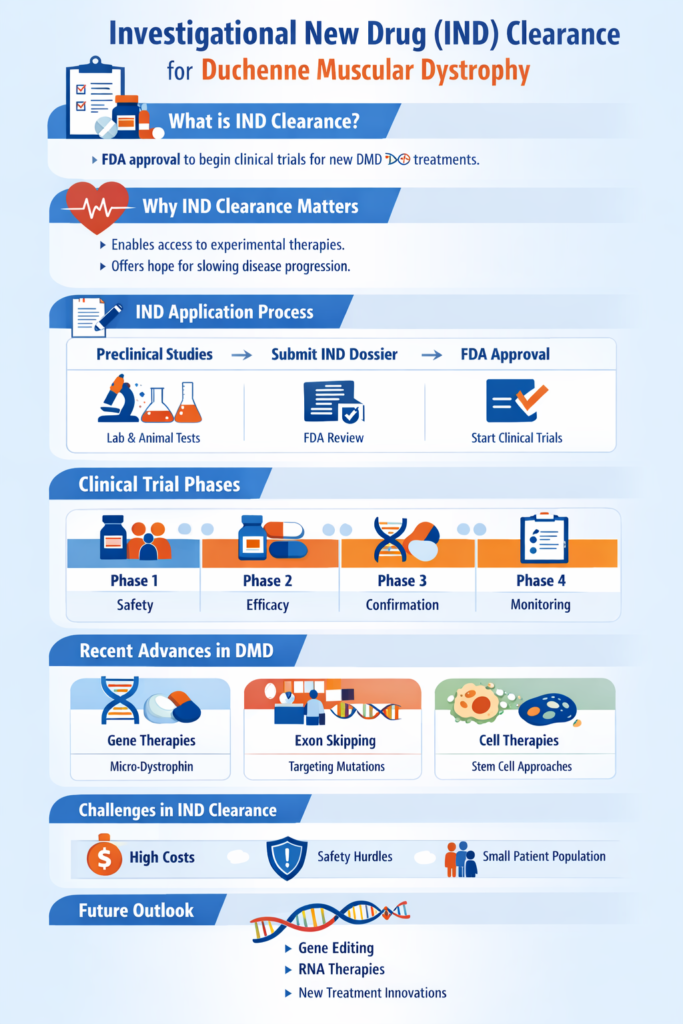
An Investigational New Drug (IND) is a regulatory authorization granted by the U.S. Food and Drug Administration (FDA) that allows a pharmaceutical or biotechnology company to begin testing a new therapy in humans.
Before any clinical trial begins, sponsors must submit an IND application containing:
- Preclinical data (animal safety and pharmacology)
- Manufacturing details
- Clinical trial protocols
- Investigator qualifications
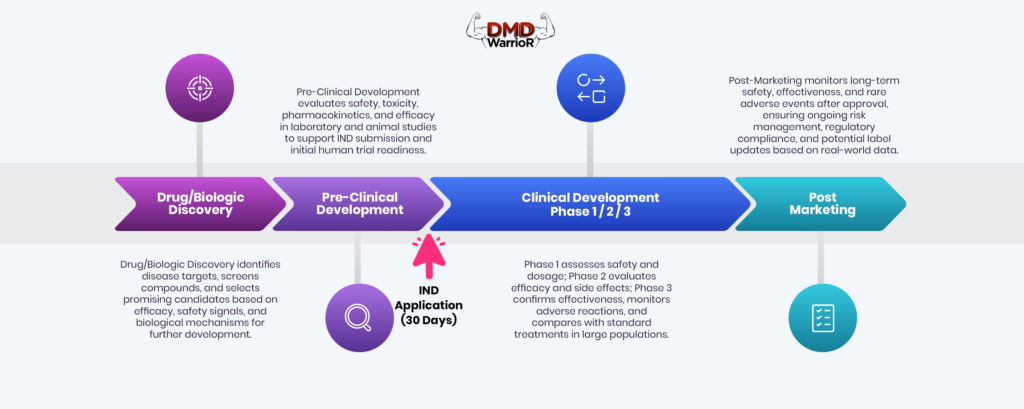
The FDA reviews the IND within 30 days. If no objections are raised, the trial may proceed.
This process is essential for ensuring that experimental treatments for Duchenne muscular dystrophy meet minimum safety standards before being administered to patients.
Why IND Clearance Matters in Duchenne Muscular Dystrophy
The importance of Investigational New Drug (IND) clearance for Duchenne muscular dystrophy cannot be overstated. DMD is a rapidly progressive disease, and early intervention is critical.
Key reasons IND clearance is vital:
- Enables first-in-human trials
- Validates preclinical research
- Accelerates innovation in rare diseases
- Provides early access to potentially life-changing therapies
Recent data suggests that thousands of children globally are affected by DMD, with significant morbidity and mortality by early adulthood.
The IND Application Process for DMD Therapies
Preclinical Phase
Before seeking Investigational New Drug (IND) clearance for Duchenne muscular dystrophy, researchers must complete:
- Toxicology studies
- Pharmacokinetic analysis
- Proof-of-concept efficacy in animal models
IND Submission
The IND dossier includes:
- Chemistry, Manufacturing, and Controls (CMC)
- Clinical protocols (Phase 1 design)
- Investigator brochures
FDA Review
The FDA evaluates:
- Risk vs benefit
- Trial design safety
- Ethical considerations
If approved, the therapy enters clinical trials.
Types of IND Applications Relevant to DMD
Different IND pathways exist depending on clinical context:
- Commercial INDs – For drug development pipelines
- Investigator INDs – Academic-led research
- Expanded Access INDs – Compassionate use for severe cases
- Treatment INDs – Early access before full approval
These pathways are particularly relevant for Duchenne muscular dystrophy due to its life-threatening nature.
Clinical Trial Phases After IND Clearance
Once Investigational New Drug (IND) clearance for Duchenne muscular dystrophy is granted, clinical trials proceed in phases:
Phase 1: Safety
- Small patient groups
- Focus on tolerability
Phase 2: Efficacy and Dosing
- Larger cohorts
- Early signals of effectiveness
Phase 3: Confirmation
- Large-scale trials
- Comparison with standard care
Phase 4: Post-Marketing
- Long-term monitoring
Each phase builds evidence required for full regulatory approval.
Learn More: Explore Of 5 Phases In Drug Development
Recent IND Clearances in Duchenne Muscular Dystrophy
The landscape of Investigational New Drug (IND) clearance for Duchenne muscular dystrophy is evolving rapidly.
Example: Ryoncil (Remestemcel-L)
- IND clearance granted for registrational trial
- Targets inflammation in DMD
- Focus on preserving muscle function
This therapy is based on mesenchymal stromal cells and aims to reduce inflammatory damage in muscle tissue.
Example: PBGENE-DMD Gene Editing Therapy
- Received IND clearance and Fast Track designation
- Uses genome editing to restore dystrophin production
- Targets up to 60% of DMD patients
Ongoing Clinical Trials
Several investigational therapies are progressing under IND clearance:
- ENTR-601-44 (exon skipping)
- INS1201 (novel delivery approaches)
- SGT-003 gene therapy
Types of Therapies Advancing Through IND in DMD
1. Gene Therapy
Gene therapies aim to introduce functional dystrophin genes.
Example: micro-dystrophin therapies already show promise but remain under evaluation.
2. Exon Skipping
Targets specific mutations to restore reading frame.
3. Gene Editing (CRISPR-like)
Permanent correction of genetic defects.
4. Cell Therapy
Uses stem cells to regenerate muscle tissue.
5. Anti-inflammatory Approaches
Addresses secondary disease mechanisms such as inflammation.
Regulatory Designations Supporting IND Programs
To accelerate Investigational New Drug (IND) clearance for Duchenne muscular dystrophy, the FDA offers:
- Fast Track designation
- Orphan Drug designation
- Breakthrough Therapy designation
These programs reduce development timelines and facilitate regulatory interactions.
Challenges in IND Clearance for Duchenne Muscular Dystrophy
Despite progress, several barriers remain:
Scientific Challenges
- Genetic heterogeneity
- Limited animal model predictability
Regulatory Challenges
- High safety standards
- Complex trial endpoints
Economic Challenges
- Extremely high development costs
- Limited patient populations
Even approved therapies often face accessibility and reimbursement challenges.
Ethical Considerations in IND Trials for DMD
Ethics play a central role in Investigational New Drug (IND) clearance for Duchenne muscular dystrophy:
- Pediatric patient involvement
- Informed consent complexities
- Risk-benefit uncertainty
Families often face difficult decisions when enrolling in early-stage trials.
Future Outlook: IND and the Next Generation of DMD Therapies
The future of Investigational New Drug (IND) clearance for Duchenne muscular dystrophy is closely tied to emerging technologies:
- CRISPR-based gene editing
- RNA-based therapeutics
- Combination therapies
As regulatory frameworks evolve, IND approvals may become faster and more adaptive.
Frequently Asked Questions (FAQ)
What is IND clearance for Duchenne muscular dystrophy?
Investigational New Drug (IND) clearance for Duchenne muscular dystrophy is FDA authorization that allows a new experimental therapy to be tested in human clinical trials. It confirms that preclinical data (lab and animal studies) show sufficient safety to begin testing in patients. This step is essential before any new DMD treatment—such as gene therapy or exon skipping—can be evaluated in children.
Why is IND clearance important for DMD patients?
IND clearance is critical because it opens access to new therapies that are not yet approved. For families affected by Duchenne muscular dystrophy, it represents the first real opportunity to benefit from cutting-edge treatments that may slow disease progression or improve muscle function. Without IND approval, clinical trials cannot legally begin.
How long does it take to get IND approval?
The FDA typically reviews an IND application within 30 days. If no safety concerns are identified, the study can proceed. However, the preparation phase—preclinical studies, manufacturing, and documentation—can take several years before submission.
What happens after IND clearance is granted?
After Investigational New Drug (IND) clearance for Duchenne muscular dystrophy, the therapy enters clinical trials. These trials progress through phases:
• Phase 1: Safety
• Phase 2: Effectiveness and dosing
• Phase 3: Large-scale validation
Each phase gathers data required for full regulatory approval.
Can my child access a treatment after IND approval?
Not automatically. IND clearance allows clinical trials to begin, but participation depends on eligibility criteria such as age, mutation type, and disease stage. In some cases, expanded access or compassionate use programs may be available for children who do not qualify for trials.
Are IND-approved treatments safe?
IND clearance means the therapy has passed initial safety checks in preclinical studies, but it does not guarantee full safety or effectiveness. Clinical trials are designed to identify risks and benefits. Families should carefully review trial protocols and consult with specialists before enrolling.
What types of therapies receive IND clearance in DMD?
Therapies that obtain Investigational New Drug (IND) clearance for Duchenne muscular dystrophy include:
• Gene therapies (micro-dystrophin delivery)
• Exon skipping drugs
• Gene editing approaches (CRISPR-based)
• Cell therapies
• Anti-inflammatory treatments
Each targets different aspects of the disease.
How can families find IND clinical trials for DMD?
Families can search for active trials through:
• ClinicalTrials.gov
• Neuromuscular clinics
• Patient advocacy organizations
Using keywords like “Duchenne muscular dystrophy IND trial” can help identify relevant studies and recruitment status.
Does IND clearance mean the treatment will be approved?
No. IND clearance is only the first regulatory step. Many therapies fail during clinical trials due to lack of effectiveness or safety concerns. Only treatments that successfully complete all trial phases can apply for full FDA approval.
What are the risks of joining an IND clinical trial?
Clinical trials involve uncertainties. Potential risks include:
• Unknown side effects
• Limited effectiveness
• Frequent hospital visits and testing
However, trials also offer early access to promising therapies and contribute to advancing research for all DMD patients.
Learn More: FDA IND
Final Thoughts
Investigational New Drug (IND) clearance for Duchenne muscular dystrophy remains a critical gateway to innovation. It determines which therapies advance into human trials and how quickly they reach patients. For families, understanding this process empowers informed decisions. While challenges remain, progress in gene therapy and exon skipping is accelerating. Regulatory pathways are also evolving to support rare diseases. Each IND approval brings new hope to the DMD community. However, access and affordability still require attention. Collaboration between regulators, researchers, and advocates is essential. Staying informed is key to navigating options. The future of DMD treatment depends on continued IND progress.
Learn More: Biologics License Application (BLA): A Complete Guide to the FDA Approval Process