
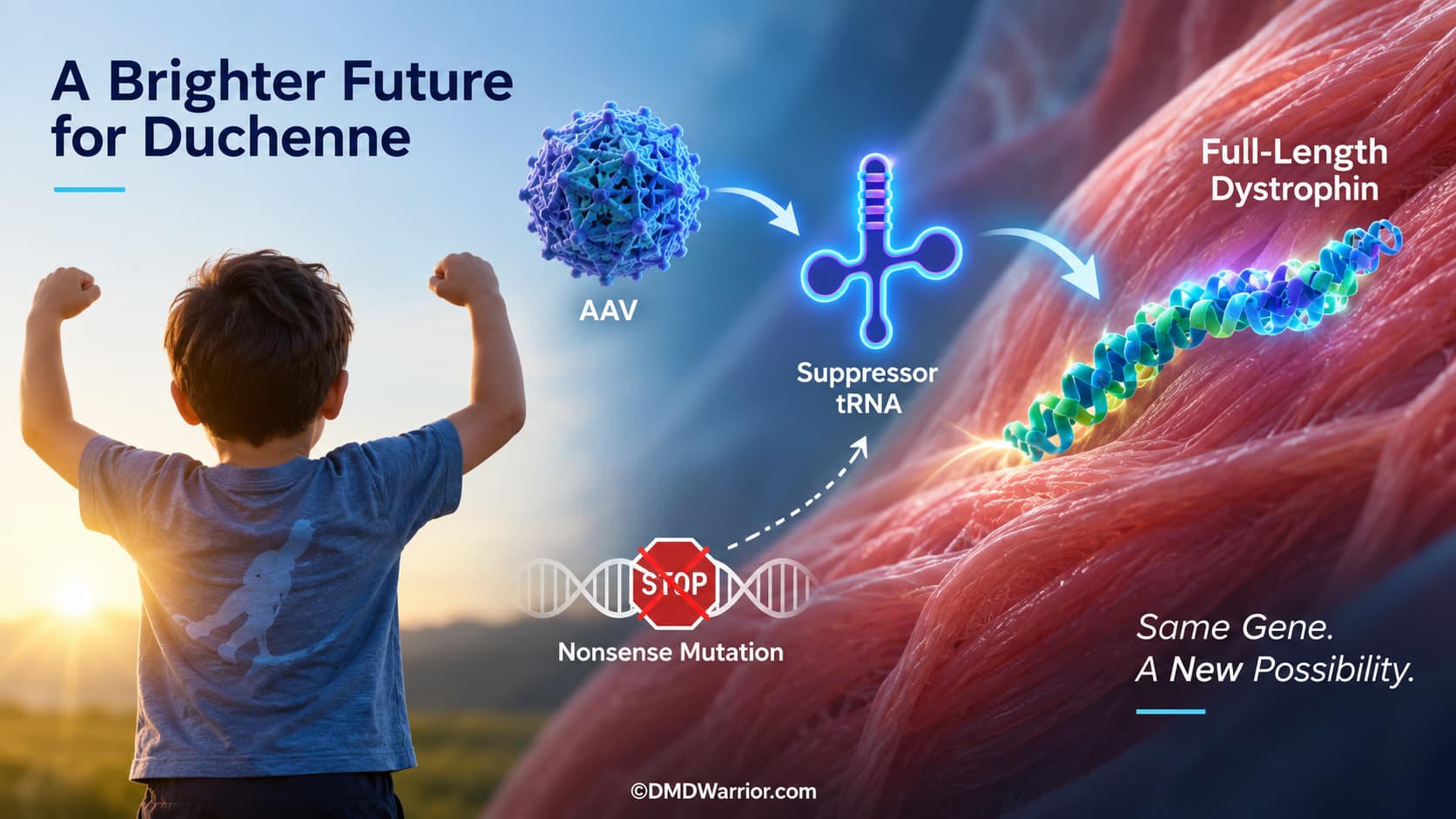
Tevard 的 tRNA 疗法靶向无义突变,以恢复 DMD 中的全长肌营养不良蛋白。

|
|

Tevard’s tRNA therapy is opening a new path for Duchenne muscular dystrophy. By targeting nonsense mutations, this AAV-delivered approach may help restore full-length dystrophin and offer new hope to families waiting for better treatments.

Tevard’s suppressor tRNA therapy could offer a new way to address nonsense mutations in Duchenne muscular dystrophy (DMD), potentially allowing cells to produce full-length dystrophin. Using an AAV-delivered engineered tRNA, researchers aim to bypass premature stop signals in the dystrophin gene rather than replacing the entire gene.

How Do Nonsense Mutations Cause Duchenne Muscular Dystrophy?

DMD occurs when mutations in the DMD gene prevent muscle cells from producing enough functional dystrophin, a protein essential for maintaining muscle fiber stability.

One type of mutation, known as a nonsense mutation, creates a premature stop codon in the genetic message. When the cell’s ribosome reaches this abnormal stop signal, protein production stops too early. As a result, the cell cannot produce normal full-length dystrophin.

This creates a particularly interesting therapeutic target: instead of replacing the enormous dystrophin gene, could researchers simply teach the cell to ignore the premature stop signal?

Tevard Biosciences and academic collaborators are investigating exactly this strategy.

How Does Suppressor tRNA Therapy Work?

Transfer RNA, or tRNA, normally helps cells translate genetic instructions into proteins. Researchers have engineered special tRNAs, called suppressor tRNAs or sup-tRNAs, to recognize specific premature stop codons.

The idea is relatively simple.

When the ribosome encounters a disease-causing premature stop codon, the engineered tRNA can insert an amino acid and allow translation to continue. The ribosome can then complete the genetic message and produce a full-length dystrophin protein.

This is different from approaches that deliver a shortened dystrophin gene. Instead, suppressor tRNA therapy attempts to allow the patient’s own dystrophin gene to produce the complete protein despite the nonsense mutation.

Why Is AAV Delivery Important?

The engineered suppressor tRNA is delivered using an adeno-associated virus (AAV) vector. AAV is being investigated extensively as a delivery vehicle for genetic medicines because it can transport therapeutic genetic instructions into cells.

In Tevard’s preclinical research, researchers developed an optimized AAV expression system designed to deliver the suppressor tRNA to affected tissues.

Importantly, the strategy is intended to distinguish disease-causing premature stop codons from the normal stop codons that cells need to terminate protein production correctly.

That selectivity is one of the most important aspects of the approach.

Preclinical Results Show Full-Length Dystrophin Restoration

The results reported so far are preclinical, but they are significant.

In the D2.mdx mouse model, systemic administration of the engineered suppressor tRNA was reported to restore full-length dystrophin across skeletal muscle, diaphragm, and heart tissue. The study also reported normalization of cardiac muscle fiber size.

The treated animals also showed improvements in muscle strength and motor coordination, measured through grip-strength and rotarod tests.

Proteomic analysis additionally indicated a broad reversal of disease-associated molecular signatures, suggesting effects beyond simply detecting dystrophin protein.

Why Could This Be Important for People With DMD?

Nonsense mutations represent an important subset of DMD mutations. The material from Tevard estimates that they account for approximately 15% of DMD patients.

A therapy that targets nonsense mutations as a mutation class, rather than one specific dystrophin mutation, could therefore potentially serve many patients with different nonsense variants.

Perhaps most importantly, the approach attempts to restore full-length dystrophin from the patient’s existing gene.

That makes suppressor tRNA therapy an intriguing addition to the growing range of genetic strategies being investigated for Duchenne muscular dystrophy.

An Important Step, But Not Yet a Treatment

The findings should be viewed in the context of their current stage of development. The reported evidence comes from preclinical research in animal models, not from an established treatment for people with DMD.

Human clinical trials will be needed to determine whether AAV-delivered suppressor tRNAs can safely and effectively restore dystrophin in patients.

Nevertheless, the concept offers something particularly compelling: rather than replacing the enormous dystrophin gene, AAV-delivered suppressor tRNA therapy attempts to bypass the genetic error and allow the cell to make its own full-length dystrophin.

For families affected by nonsense mutations, that possibility makes this emerging approach one worth watching closely.

The research was published in Science Advances and involved scientists from Tevard Biosciences, Johns Hopkins University, MIT, and the Whitehead Institute for Biomedical Research.

The paper is available: https://doi.org/10.1126/sciadv.aeg3466.

- 跟着我们 -
DMDWarrioR Instagram
将 DMDWarrior 添加为 Google 首选信息源,即可查看更多我们值得信赖的报道。.

免责声明:本文仅供参考,不构成医疗建议。患者及其家属应与医护人员讨论治疗方案和临床试验事宜。.

DMDWarrior 临床试验中心现已推出 10 种语言版本,提供全球范围内的 AI 辅助杜氏肌营养不良症临床试验信息。.

DMDWarrioR 上的热门新闻 - 杜氏新闻

相关文章